
1 General guiding principles
1.1 Substance over form
The ICS balance sheet differs from publicly reported GAAP financial statements, as it reflects a different objective (prudential supervision as opposed to investor information). For example, certain assets in a GAAP balance sheet do not qualify as assets for the ICS.
The economic substance of transactions and events are recorded in the ICS balance sheet rather than just their legal form, in order to present a true and fair view of the risk profile of the entity. This may require the use of judgment when preparing the ICS balance sheet.
The allocation of insurance liabilities to the ICS line of business segments follows the principle of substance over form. This means that insurance liabilities are allocated to the segment that best reflects the nature of the underlying risks rather than the legal form of the contract. The definitions for the insurance line of business segmentation are specified in the Level 2 text.
1.2 Proportionality
Calculations and valuation are subject to the proportionality principle. When the IAIG can demonstrate that taking into account a specific factor/rule in their calculation or valuation would lead to a significant increase in complexity, without material improvement to the quality of the figure produced or to the assessment of risk linked to this figure, then this factor or rule can be ignored or simplified.
The materiality of the impact of using a simplification is assessed with regard to:
- The volume of the item valued;
- The overall volume of the group’s business and capital resources; and
- The assessment of risk.
Examples
Consider a portfolio of inflation indexed annuities. In theory, a full stochastic modelling of future inflation may be needed. However, considering:
- The complexity of such a modelling (and justification of the associated parameters); and
- That inflation and mortality are assumed to not be correlated
IAIGs may use a flat future level of inflation for deriving future annuity payments in the calculation of insurance liabilities.
Consider an IAIG with capital resources of 10 and insurance liabilities (savings contracts) of 100. The calculation of those insurance liabilities can be achieved either on a policy by policy basis, or by grouping all policies and using an average actuarial age and average lapse rates. The latter leads to a difference of 1% in the amount of insurance liabilities. Although such a difference can be considered as non-material with regard to the insurance liabilities, the relative impact on the capital resources is 10% (assuming the asset side is unchanged). This should be considered a material difference, and the simplification should be rejected.
Please note this example is in no way intended to mean that the materiality threshold is 10% of capital resources.
1.3 Look-through
In order to assess properly the risk inherent in collective investment funds and other indirect exposures, their economic substance needs to be taken into account. This is achieved, to the extent possible, by applying a look-through approach. Additional requirements on the use of look-through are provided in the Level 2 text.
The look-through approach applies to insurance arrangements and indirect investments (including unleveraged mutual funds, other collective investment vehicles, etc.) in order to identify all underlying exposures embedded in such arrangements and investments, including all indirect holdings that may artificially inflate the qualifying capital resources of an Internationally Active Insurance Group (IAIG).
When a full look-through is not possible, a partial look-through may be applied, along the lines provided by the Basel III framework1.
When no look-through is possible, the full investment is considered as unlisted equity for the purpose of calculating the insurance capital standard (ICS) risk charges.
Explanatory Texts
1. In the context of Market risks, look-through is applied, for instance, to collective investment funds, hedge funds, mandatory convertible bonds, etc. in order to identify all of the indirect exposures embedded in such instruments. A look-through approach is applied to the extent possible, in order to identify which assets are sensitive to the stress-based approaches to measuring risks. A similar approach can be applicable in the context of capital resources, in order to identify any relevant adjustments to ICS capital resources in respect of indirect holdings or reciprocal cross holdings.
2. In the context of Insurance risks, the look-through approach is applied to the underlying risk of investments such as single tranche mortality bonds, catastrophe bonds, etc. in order to appropriately capture the effect on such instruments of the stress scenarios designed for mortality, longevity, catastrophe events and any other relevant scenario.
1.4 ICS Rating Categories
The IAIS has developed a mapping between ICS Rating Categories (ICS RC) and credit rating agency ratings. ICS Rating Categories range from 1 to 7. Additional specifications on ICS Rating Categories, including the mapping to agency ratings, are included in the Level 2 text.
Whenever the use of an ICS Rating Category (ICS RC) is needed, the IAIG uses the agency ratings listed in the table below. Modifiers such as + or – do not affect the ICS RC. Where two ratings are listed in a cell, the first rating represents a long-term rating, and the second rating represents the short-term rating mapped to the same ICS RC. The short-term rating is used only for instruments with a remaining maturity of one year or less. For purposes of calculating the risk charge on reinsurance exposures, the financial strength rating is used if it exists. Where such a financial strength rating does not exist, the long-term issuer credit rating is used. Financial strength ratings are used only for purposes of calculating the risk charge on reinsurance exposures.
| ICS RC | S&P | Moody’s | Fitch | JCR | R&I | DBRS | AM Best |
| 1 | AAA | Aaa | AAA | AAA | AAA | AAA | aaa |
| 2 | AA / A-1 | Aa / P-1 | AA / F1 | AA / J-1 | AA / a-1 | AA / R-1 | aa/AMB-1+ |
| 3 | A / A-2 | A / P-2 | A / F2 | A / J-2 | A / a-2 | A / R-2 | a/AMB-1- |
| 4 | BBB / A-3 | Baa / P-3 | BBB / F3 | BBB / J-3 | BBB / a-3 | BBB / R-3 | bbb /AMB-2 to AMB-3 |
| 5 | BB | Ba | BB | BB | BB | BB | bb/AMB-4 |
| 6 | B / B | B / NP | B / B | B / NJ | B / b | B / R-4 | b |
| 7 | CCC / C and lower | Caa and lower | CCC / C and lower | CCC and lower | CCC / c and lower | CCC / R-5 and lower | ccc and lower |
| ICS RC | S&P | Moody’s | Fitch | DBRS | AM Best |
| 1 | AAA | Aaa | AAA | AAA | |
| 2 | AA | Aa | AA | AA | A+ |
| 3 | A | A | A | A | A |
| 4 | BBB | Baa | BBB | BBB | B+ |
| 5 | BB | Ba | BB | BB | B |
| 6 | B | B | B | B | C+ |
| 7 | CCC and lower | Caa and lower | CCC and lower | CCC and lower | C and lower |
Additionally, the IAIG may use ratings issued by a rating agency that the banking regulator in its jurisdiction (or for a subsidiary, in the subsidiary’s jurisdiction) has recognised as an External Credit Assessment Institution (ECAI) under the Basel II framework. The ICS RC corresponding to a rating produced by such an agency is the Basel II rating category to which the supervisor has mapped the rating (the combined rating class AAA/AA corresponds to ICS RC 2).
ICS RCs 1 to 4 in the table above are considered investment grade.
The use of ICS RCs is further developed in section 5.4.3.
2 Perimeter of the ICS calculation
2.1 Scope for starting ICS balance sheet
The starting point of the ICS is the audited consolidated GAAP balance sheet of the insurance holding company of an insurance group or financial holding company of a financial conglomerate.
Where an IAIG does not prepare audited consolidated GAAP financials, statutory financial statements are aggregated to reflect the group level starting balance sheet.
The audited GAAP balance sheet is split into two components: (1) entities that are insurers, and entities whose purpose is insurance related; and (2) non-insurance entities. The Level 2 text provides further description of which entities are considered insurance related and non-insurance.
The non-insurance entities are reported separately from insurance entities, on a GAAP basis, with the exceptions described in the Level 2 text.
The perimeter of the ICS calculation is defined as including all consolidated legal entities within the IAIG.
The starting point to derive the balance sheet of the insurance group, prior to application of any Market-Adjusted Valuation (MAV) adjustments, is the consolidated Generally Accepted Accounting Principles (GAAP) balance sheet of the Head of the IAIG, as defined in the Common Framework for the Supervision of IAIGs (ComFrame). For entities that do not have consolidated GAAP financials, see paragraph L2-15.
For purposes of the ICS calculation, balance sheets are segregated into insurance related and non-insurance components. The insurance portion of the balance sheet is comprised of entities that meet the following definitions:
- Insurer: Insurance legal entity or insurance group.
- Insurance legal entity: A legal entity, including its branches, that is licensed to conduct insurance, regulated and subject to supervision.
- Insurance related entities: Legal entities that mainly exist to support the operations of the insurer.
Legal entities that comprise the consolidated GAAP balance sheet are further categorised according to the following definitions in order to apply certain accounting treatments that differ from GAAP as well as to derive a capital requirement for non-insurance components:
- Insurer and Insurance related entities;
- Regulated non-insurance financial entity;
- Non-regulated non-insurance financial entity; and
- Non-financial entity.
The ICS follows GAAP accounting rules for consolidation accounting treatment except for the following:
- For insurer and insurance related entities that are determined under GAAP to be controlled as joint ventures2, a proportional consolidation method is used unless it is determined through consultation with the group-wide supervisor (GWS) that such treatment is not considered feasible; in which case the entity remains unadjusted and reported as per GAAP as an equity method investment.
- For insurer and insurance related entities that are determined under GAAP to be controlled as joint operations3 and reported by recognising its own assets, liabilities and transactions, including its share of those incurred jointly, the entity may remain unadjusted (ie proportional consolidation on shared assets).
- For non-insurance financial and non-financial entities that are determined under GAAP to be joint operations and reported by recognising its own assets, liabilities and transactions, including its share of those incurred jointly, the entity is reported as an equity method investment.
- For non-insurance financial and non-financial entities that are determined under GAAP to be joint ventures, the entity is reported as an equity method investment.
2 A joint venture is a joint arrangement whereby the parties that have joint control of the arrangement have rights to the net assets of the arrangement.
3 A joint operation is a joint arrangement whereby the parties that have joint control of the arrangement have rights to the assets, and obligations for the liabilities, relating to the arrangement.
Adjustments related to non-voting interest entities4:
- A non-voting interest entity that has been determined under GAAP to be unconsolidated is consolidated if either the IAIG or its GWS assesses that it poses a material risk5 to the group, either individually or in the aggregate.
- A securitisation originated within the group may not be consolidated provided that it meets all of the conditions outlined in Annex 1.
- Notwithstanding the materiality assessment or application of additional criteria, a non-voting interest entity is consolidated when the GWS determines that the nature, scale and complexity of the risks cannot be considered insignificant.
4 A non-voting interest entity is an entity where voting or similar rights are not the dominant factor in assessing control. Entities are often thinly capitalised or contain no capital and are designed for a specific purpose (eg, special purpose entities, structured entities, GP/LP structures, trusts and investment partnerships).
5 Material risk in this case relates to the risks posed to the group. In considering what might significantly contribute to group risks, a firm may assess whether the related entity’s gross assets or gross revenue are more than 1% of the group’s gross assets or revenue. In addition, an assessment of all immaterial entities exceeding 5% of the group’s assets or revenue, in the aggregate, may indicate that other entities should be consolidated in order to avoid missing material risks.
Other non-GAAP adjustments: Structured settlement agreements with third parties are recorded on a net basis (ie removed from reserves and reinsurance recoverables) when the underlying claim is settled and the risk to the non-life company is contingent upon the life insurer (and the guarantee fund, if applicable) having the ability to pay.
Aggregated group balance sheet: an IAIG that does not prepare consolidated or group level financial statements generates a balance sheet on an aggregated basis to reflect group level starting balances.
Non-insurance entities (financial and non-financial) are incorporated into the ICS, based on the entity type and whether or not the entity is subject to a sectoral capital requirement. The capital requirement for financial non-insurance entities is based on the entity’s sectoral capital rules, when available. For financial non-insurance entities without sectoral capital rules and for non-financial entities, the capital requirement included in the ICS is described in the Level 2 text. For all non-insurance entities, capital resources follow the capital resources framework set out for the ICS.
2.2 Development of starting MAV balance sheet
The starting MAV balance sheet is comprised of the insurance and insurance-related entities.
The starting MAV balance sheet is subject to adjustments as described in the Level 2 text and section 3.
3 Market-Adjusted Valuation
3.1 Valuation principles
The MAV approach is based on the amounts as reported on audited, consolidated, general-purpose GAAP or Statutory Accounting Principles (SAP) accounts, and includes adjustments to the following items:
- Insurance liabilities and reinsurance balances;
- Financial investments (assets) and instruments (liabilities); and
- Deferred taxes.
Unless they are replicable by a portfolio of assets (cf section 3.4), MAV insurance liabilities are the sum of a current estimate and a margin over current estimate (MOCE). The details underpinning the calculation of the current estimate and the MOCE are developed in the following sub-sections as well as in the Level 2 text.
The adjustments to items b) and c) are described in the Level 2 text.
When deriving the adjustments to be made to insurance liabilities, reinsurance balances, financial investments and instruments, and tax, the IAIG applies the following principles:
- Property for own use is adjusted to fair value using the fair value guidance under the IAIG’s GAAP or when the IAIG does not produce a GAAP consolidated balance sheet, the GAAP fair value principles in the IAIG’s jurisdiction.
- Mortgages and loans are adjusted to fair value using the fair value guidance under the IAIG’s GAAP or when the IAIG does not produce a GAAP consolidated balance sheet, the GAAP fair value principles in the IAIG’s jurisdiction.
- Reinsurance recoverables are restated on a basis consistent with the determination of insurance liabilities. Recoverables on paid and unpaid balances are reported net of allowances for estimated uncollectable amounts.
- Deferred tax assets (DTA) and liabilities (DTL) are treated according to section 0.
- Deferred acquisition costs and other deferred expenses that are on the balance sheet at the reporting date are adjusted to zero. Future acquisition costs related to future premiums (within contract boundaries – see section 3.2.2) are reflected in the value of insurance liabilities.
- Premium receivables falling due after the reporting date and related to contracts that are included in the current estimate calculation are reflected in the valuation of insurance liabilities as negative cash flows. Premium receivables for which the due date is prior to the reporting date are not part of the current estimate calculation and remain as assets on the balance sheet.
- Loans to policyholders are reported separately and are not netted against insurance liabilities.
- Other financial assets that are reported on the GAAP balance sheet at amortised cost (eg Hold-To-Maturity investments) are restated to a fair value.
- Financial liabilities: upon initial recognition, the valuation of these items is based on the IAIG’s reported GAAP, and there is no subsequent adjustment to take account of changes to the IAIG’s own credit standing.
Example
Subordinated debt issued by the IAIG should not be revalued to market prices. However, the present value of the liability should be updated to reflect changes in the time value of money (update of yield curves).
Explanatory Text
3. The following balance sheet items’ valuation should be based on the IAIG’s reported International Financial Reporting Standards (IFRS) or GAAP valuations, as applicable for consolidated audited general-purpose financial statements in each IAIG’s respective home jurisdiction:
- a. Goodwill and other intangibles;
- b. Pension assets/liabilities;
- c. Other assets (including other reinsurance and other insurance-related assets);
- d. Provisions other than insurance liabilities;
- e. Contingent liabilities: add contingent liabilities that are reported in the notes to financial statements in the balance sheet; and
- f. Other non-financial liabilities.
3.2 Current Estimate
3.2.1 Basis for calculation
The current estimate corresponds to the probability-weighted average of the present values of the future cash flows associated with insurance liabilities, discounted using the yield curve relevant for the currency and bucket of each liability. The three buckets to which liabilities can be allocated are described in section 3.2.5.3.
The current estimate does not include any implicit or explicit margins.
Reinsurance recoverables are included in a way that is consistent with the current estimates of insurance liabilities, based on the same assumptions and inputs.
When valuing insurance liabilities, no adjustment is made to take into account the IAIG’s own credit standing.
More details on how to project cash flows for the current estimate calculation are provided in the Level 2 text.
3.2.1.1 General considerations
The current estimate calculation is based on the probability weighted average of the future cash flows, taking into account the uncertainty relating to:
- The timing, frequency and severity of claim events;
- Claim amounts and claim inflation, including where relevant any uncertainty on the value of indices used to determine claim amounts;
- The time needed to settle claims;
- The amount of expenses; and
- Policyholder behaviour.
Cash flow projections reflect expected future demographic, legal, medical, technological, social or economic developments, and are based on appropriate inflation assumptions, recognising the different types of inflation to which the entity can be based. Premium adjustment clauses are also considered, where relevant.
The current estimate is calculated gross of reinsurance and special purpose vehicles (SPV). Recoverables from reinsurance or SPVs are calculated separately and recognised as an asset.
The projected cash flows include at a minimum the following items within the contract boundaries:
- Benefit and claim payments;
- Direct and indirect expenses incurred;
- Premiums received;
- Subrogation payments and recoveries other than from reinsurance and special purpose vehicles; and
- Other payments made in order to settle the claims.
All expenses related to existing contracts and contracts that are recognised at the reporting date, but not yet in force, are included in the current estimate calculation. The expenses estimation assumes that the IAIG will write business in the future. Future expenses relating exclusively to future business are not considered for the current estimate calculation.
Where a yield curve is needed as input to assess future returns on assets, the IAIG makes use of the relevant IAIS yield curves with specified adjustments.
Examples
Future expenses of the IAIG should be allocated to all contracts within the contract boundaries. The current estimate should not include the premium, expenses and claims for contracts out of the contract boundaries. The expense assumptions should be on a going concern basis and, ceteris paribus, consistent with the prior years.
Therefore if a contract is underwritten on 31.12.N, the current estimate should not reflect the paid expenses to settle the policy (eg costs associated with pricing the product and selling the product etc.), but should reflect future related expenses (eg overhead, claims management expenses etc.).
Calculation example (Non-life)
Allocate the overhead expenses to premiums/claims by determining a per policy/claim expense on a going concern basis and multiply by the policies/claims. The result is that overhead expenses are recognised consistently with premiums/claims.
Explanatory Texts
4. The current estimate of non-life premium liabilities (PL) should include, but is not limited to the following cash flows:
- Cash flows from future premiums falling within the contract boundary.
- Cash flows resulting from future claim events (including the potential for claims that have high severity, low probability of occurrence).
- Cash flows arising from all expenses stemming from premiums and on-going administration of existing and future business falling within the contract boundary (a non-exhaustive list of examples includes: administrative expenses, investment management expenses, claim management expenses, acquisition expenses, overhead expenses, commission payments, premium collection costs and investment-related expenses). Acquisition costs should be included in the premium liabilities valuation and not reflected as an asset on the balance sheet.
5. Two proxies can be considered for the purpose of calculating non-life premium liabilities.
- a. The first proxy attempts to approximate the concept of a current estimate, through the application of a formula composed of several elements:
PL = (CR – AER) × UPR + (CR – 1) × PVFP
Where:
PL = Premium liability
CR = Combined ratio (including all expenses)
AER = Acquisition expense ratio
UPR = Unearned premium reserves (difference between written premiums for all contracts on the balance sheet at the valuation date and earned premiums)
PVFP = Present value of future premiums (within contract boundaries) - b. A second proxy may be used if, for materiality or other reasons, the IAIG needs to further simplify the calculation, in the case where the combined ratio is smaller than 1:
PL = UPR = Premiums Written – Premiums Earned
6. The current estimate for claim liabilities should reflect all cash flows arising from claims that happened before the valuation date, including incurred but not reported (IBNR) claims.
3.2.1.2 Options and guarantees
The expected cash flows relating to options and guarantees embedded in the insurance contract are taken into account for the calculation of the current estimate. All payments connected to the risks insured, and profit participation payments in particular, are taken into consideration for the calculation of the value of options and guarantees.
All options and guarantees are valued using arbitrage-free techniques6 based on the adjusted yield curve as a proxy for the risk-free curve.
6 This implies in particular that where relevant, path dependency is taken into account in the valuation of options and guarantees.
Example
Variable annuities may contain guaranteed living benefits (eg minimum maturity or withdrawal benefits) tied to the performance of specific assets, which may cause a path dependency of the liability cash flow.
3.2.1.3 Policyholder behaviour
Where relevant, expected cash flows reflect the contractual right of policyholders to change the amount, timing or nature of their benefits.
The likelihood that policyholders will exercise contractual options, including lapses and surrenders, is taken into account with a prospective view, considering in particular:
- Past and expected behaviour of policyholders, considering also their reaction to management actions;
- How beneficial the exercise of options would be to policyholders under specific circumstances; and
- Economic conditions.
To the extent that it is deemed representative of future expected behaviour, assumptions on policyholder behaviour are based on appropriate statistical and empirical evidence.
The assumptions concerning policyholder behaviour are consistent with the assumed investment returns and the yield curves used for discounting insurance liabilities.
3.2.1.4 Future discretionary benefits (FDB)
Future discretionary benefits (FDB) are comprised of all non-guaranteed amounts, including those bonuses linked to a legal or contractual obligation to distribute a portion of the IAIG’s financial/underwriting profits to policyholders.
The current estimate recognises FDB expected to be paid consistently with expected future developments, the economic scenarios on which the liability valuation is based and policyholders’ reasonable expectations.
The projection of FDB is also consistent with the yield curve applicable to the contract, as well as with the modelling of policyholder behaviour as described in section 3.2.1.3.
Example
For participating products that have benefits paid linked to the investment returns of the IAIG’s asset portfolio, currently held assets should be reflected in the projection of participating cash flows. As new investments occur in the projection, these new investments should be assumed to earn a yield consistent with the prescribed discount curve. As a result, the asset portfolio rate will begin at the IAIG’s current assumed book portfolio rate used in the calculation of participating cash flows and converge with the prescribed yield curve as inforce assets mature and new investments are made.
Similarly, where stresses require valuations assuming a different yield curve, liability cash flows should be re-projected to reflect convergence of the returns of the asset portfolio to the prescribed stressed yield curve and participating cash flows should reflect the expected amount of pass through that would occur under the stress given the resulting portfolio investment returns.
Consider a simplified example: assume a participating product passes through an IAIG’s investment experience without a spread or guaranteed minimum crediting rate. Assume the portfolio yield on a book basis of assets held at the valuation date is 5% and the prescribed yield curve is consistent with a flat 2% for all years. 20% of the initial assets mature each year until all starting assets have matured by the end of year 5. Application may look as follows:
| Year | 1 | 2 | 3 | 4 | 5 | 6 | 7 | 8 |
|---|---|---|---|---|---|---|---|---|
| Asset Book Portfolio Rate | 5.0% | 4.4% | 3.9% | 3.4% | 2.9% | 2.0% | 2.0% | 2.0% |
| Projected Liability Crediting Rate | 5.0% | 4.4% | 3.9% | 3.4% | 2.9% | 2.0% | 2.0% | 2.0% |
| Prescribed Market Rate/Discount Rate | 2.0% | 2.0% | 2.0% | 2.0% | 2.0% | 2.0% | 2.0% | 2.0% |
*Note that based upon the rate of asset turn-over, the degree of cash flow matching and the type of assets held, the pattern may evolve differently.
3.2.2 Contract recognition, contract boundaries and time horizon
A contract is recognised when the IAIG becomes a party to that contact, until all obligations related to that contract are extinguished. All contracts that are recognised at the valuation date, and only those, are taken into account for the current estimate calculation.
The future premiums and associated claims and expenses linked to those recognised contracts are taken into account up to each contract boundary.
The projection horizon used in the calculation of the current estimate covers the full lifetime of all the cash in- and out-flows required to settle the obligations (within contract boundaries) related to recognised insurance and reinsurance contracts at the valuation date.
The details for contract recognition and contract boundaries are specified in the Level 2 text.
A contract is recognised and valued as soon as the IAIG becomes party to that contract, without any possibility to amend or cancel it, even when the insurance coverage has not yet started.
A contract is derecognised when all possible claims linked to this contract have been completely settled, and all future cash flows are nil.
Only those contracts recognised at the reporting date are taken into account in the current estimate calculation; in particular, no future business is included in the calculation.
All obligations, including future premiums, relating to a recognised contract are taken into account in the current estimate cash flow projection. However, future premiums (and associated claims and expenses) beyond either of the following dates are not considered, unless the IAIG can demonstrate that it is able to and willing to compel the policyholder to pay the premiums:
- The future date where the IAIG has a unilateral right to terminate the contract or reject the premiums payable under the contract; or
- The future date where the IAIG has a unilateral right to amend the premiums or the benefits payable under the contract in such a way that the premiums fully reflect the risks.
For group policies, similar rules apply. If premiums can be amended unilaterally for the entire portfolio in a way that fully reflects the risks of the portfolio, the second condition above is considered to be met.
Examples
Consider a contract providing health coverage starting on 1 March N+1. The contract has been underwritten on 20 December N, with no possibility to change the terms of the contracts before the coverage starts. On 31 December N, this contract should be recognised in the balance sheet.
Consider an annually renewable life protection policy sold on a group basis. The IAIG does not manage this portfolio on a contract-by-contract basis, but can freely adjust the premiums for the entire portfolio at the policy anniversary date, to fully reflect the risks stemming from that portfolio. In this case, the conditions defined in paragraph 91 are deemed to have been met. The calculation of current estimates should not include any premiums beyond the next future anniversary date where such adjustment is possible, along with the related claims and expenses.
Consider a whole life policy, with a level premium. According to the terms of the insurance contract, the IAIG cannot reject any premium, and the premium is constant throughout the life of the contract. Therefore, all (probability-weighted) future premiums of this contract should be taken into account in the insurance liabilities, along with the related claims and expenses.
Consider a health policy (medical expenses), starting on 1 July N, with a premium paid monthly. Premium indexation is possible at each anniversary date, and the IAIG has no right to cancel the policy during the first 12 months. On 31 December N, insurance liabilities should include 6 months of future premiums (January – June N+1), along with the related claims and expenses.
3.2.3 Data quality and setting of assumptions
The calculation of the current estimate is based on up-to-date and credible information and realistic assumptions. The determination of the current estimate is objective, comprehensive, and uses observable input data.
The requirements relating to data quality and modelling assumptions are specified in the Level 2 text.
When selecting data for the calculation of the current estimate, the IAIG considers:
- The quality of data based on the criteria of accuracy, completeness and appropriateness;
- The use and setting of assumptions made in the collection and processing of data; and
- The frequency of regular updates and the circumstances that trigger additional updates.
When only limited or unreliable data are available from the IAIG’s own experience, the IAIG supplements its own data with data from other sources. When the characteristics of the portfolio differ from those of the population represented in the external data used, the external data are adjusted in order to ensure consistency with the risk characteristics of the IAIG’s portfolio.
The assumptions used to calculate the current estimate reflect current expectations based on all information available. This requires an assessment of expected future conditions, in particular as soon as:
- There is evidence that historical trends will not continue, that new trends will emerge or that economic, demographic and other changes may affect the cash flows that arise from the existing insurance contracts.
- There have been changes in underwriting procedures and claims management procedures that may affect the relevance of historical data to the portfolio of insurance contracts.
- Historical data do not capture types of events that may have an impact on the current estimate.
3.2.4 Management actions
The current estimate calculation may recognise management actions when such actions are objective, realistic and verifiable. Management actions recognised in the calculation are not contrary to contract boundaries, to the IAIG’s obligations to policyholders or to legal provisions applicable to the IAIG.
Further details regarding the recognition of management actions in the current estimate calculation are provided in the Level 2 text.
Assumed future management actions are consistent with the IAIG’s current business practice and business strategy unless the GWS is satisfied that there is sufficient evidence that the IAIG will change its practices or strategy.
When calculating the current estimate, future management actions are taken into account only if they can reasonably be expected to be carried out under the specific circumstances to which they apply.
The assumptions about future management actions take into account the time needed to implement them, as well as any resulting incremental expenses and changes in policyholder behaviour.
3.2.5 Discounting
3.2.5.1 Determination of yield curves for current estimate discounting
In order to calculate a current estimate, insurance liabilities are discounted using an adjusted yield curve. The adjusted yield curve is based on:
- Risk adjusted liquid interest rate swaps or government bonds (risk-free yield curve); and
- An adjustment.
The adjusted yield curve is determined based on the methodology specified in the Level 2 text (sections 3.2.5.2 and 3.2.5.3).
3.2.5.2 Determination of the risk-free yield curve
The risk-free yield curve is determined based on a three-segment approach:
- Segment 1: based on market information from government bonds or swaps, including a credit risk correction, where necessary;
- Segment 2: extrapolation between the first and third segments; and
- Segment 3: based on a stable currency specific long-term forward rate (LTFR), to which a spread is added in order to represent the expected spread that may be earned from reinvestments in the long-term.
For each currency, the transition from the first to the second segment occurs at the last maturity for which market information can be observed in deep, liquid and transparent financial markets (the last observed term or LOT).
For each currency, the LTFR is the sum of an expected real interest rate and an inflation target.
For the purpose of determining the expected real interest rate, jurisdictions are allocated according to areas that share common macroeconomic characteristics. The same expected real interest rate is used for all currencies within a given area. For each area, the expected real interest rate is based on a simple average of observed real interest rates over a certain period of time.
The two components of the LTFR are reviewed annually, in order to reflect potential changes in macroeconomic expectations. However, the magnitude of annual changes to the LTFR is capped in order to mitigate its potential volatility.
Further specifications on the methodology to determine the risk-free interest rate are provided in the Level 2 text.
3.2.5.2.1 Choice of instrument for and length of Segment 1
The base yield curves are derived from financial instruments that are traded in deep, liquid and transparent (DLT) financial markets. A DLT assessment is carried out at regular intervals in order to identify the financial instruments and maturities for which a DLT market exists.
The DLT assessment determines, in particular, whether swaps or government bonds are the relevant financial instruments for the risk-free interest rates and what the LOT is. The DLT assessment is performed for each currency.
3.2.5.2.1.1 DLT assessment of the swap market
The assessment of depth and liquidity of the swap market is carried out on the basis of swap trade data, in particular the number and notional amount of trades and is made separately for each currency and maturity. Only single-currency fixed-to-floating swaps are considered. Thresholds may need to be adapted in light of the specific circumstances of individual markets (eg less liquid currencies).
3.2.5.2.1.2 DLT assessment of the government bond market
Given the specificity of government bond markets, a different approach to swap markets may be followed to assess the DLT nature of government bond rates.
The assessment starts from the analysis of trade volume and trade frequency of government bonds, for all currencies.
Where trade volume and frequency data are not available or their analysis is not conclusive, other criteria are assessed, including where possible, bid-ask spreads, the rate volatility, zero-trading days, the number of pricing sources and the number of quotes.
3.2.5.2.1.3 Conclusions from the assessment
The DLT assessment of the relevant instruments informs the choice of the instrument on which the base yield curve is built upon, as well as the DLT maturities that are used in the derivation of the base yield curve.
To maximise the use of market information, the instrument with the longer DLT segment or the instrument with a higher overall degree of liquidity should be chosen.
Given the specificities of the financial markets of each currency, the group wide supervisor should seek advice from the relevant jurisdiction which instrument to take as a basis, with due consideration of the key objectives of the MAV approach. An appropriate justification for this choice is presented, covering also the outcome of the DLT analysis.
3.2.5.2.1.4 Last Observed Term (Length of Segment 1)
Following the DLT assessment and the choice of the instrument underlying segment one of the yield curve, the LOT is set taking into consideration:
- the longest maturity, which is deemed to fulfil the DLT criteria, for the chosen instrument; and
- the specificities of the financial market.
3.2.5.2.2 Credit Risk Adjustment
Inputs from chosen instruments are subject to the Credit Risk Adjustment (CRA).
The CRA is 0 basis points when instruments for Segment 1 are considered risk free. The CRA is 10 basis points otherwise.
3.2.5.2.3 Length of Segment 2
For all currencies, the start of the third segment as referred to in paragraph L1-33 is the later of the following:
- 30 years after the LOT; and
- 60 years.
3.2.5.2.4 Extrapolation, interpolation and convergence tolerance
Both the interpolation between Segment 1 maturities and the extrapolation beyond the LOT are based on the Smith-Wilson methodology.
The control input parameters for the interpolation and extrapolation are the LOT, the LTFR, the convergence point and the convergence tolerance.
If the reference instruments are swap rates, the market interest rates to be used as inputs are the swap par rates after deduction of the credit risk adjustments. If the reference instruments are zero coupon government bonds, the market interest rates to be used as inputs are the zero-coupon rates.
The parameter alpha that controls the convergence speed is set at the lowest value that produces a yield curve reaching the convergence tolerance of the LTFR by the convergence point. A lower bound for alpha is set at 0.05.
The convergence tolerance is 0.1 basis point, and is achieved at the tenor which marks the end of Segment 2.
3.2.5.2.5 LTFR Components
The LTFR is the sum of the following two components:
- The expected real interest rate, computed as the simple arithmetic mean of annual real interest rates. Annual real rates r are calculated as:

The expected real interest rate is rounded to the nearest five basis points.
- The expected inflation target, computed as follows:
- For currencies for which the central bank has announced an inflation target, the expected inflation target is based on that inflation target. In this case the expected inflation rate is:
- 1%, where the inflation target is lower than or equal to 1%;
- 2%, where the inflation target is higher than 1% and lower than 3%;
- 3%, where the inflation target is higher or equal to 3% and lower than 4%; and
- 4%, otherwise.
- For currencies for which the central bank has not announced an inflation target, the expected inflation rate is set to 2%. However, where past inflation experience and projection of inflation both clearly indicate that the inflation in a currency area is materially higher or lower than 2%, the expected inflation rate is chosen in accordance with those indicators.
- For currencies for which the central bank has announced an inflation target, the expected inflation target is based on that inflation target. In this case the expected inflation rate is:
In order to determine the expected real interest rate, countries are grouped in the following three geographical areas:
- Geographical area 1, comprised of the following currency areas: AUD, CAD, CHF, CZK, DKK, EUR, GBP, JPY, NOK, NZD, SEK, SGD, USD;
- Geographical area 2, comprised of the following currency areas: HKD, ILS, KRW, TWD;
- Geographical area 3, comprised of all other currency areas.
The initial values of the expected real interest rate component are:
- 1.8% for geographical area 1;
- 2.4% for geographical area 2; and
- 3.0% for geographical area 3.
The values will be regularly reviewed.
The maximum annual change to the LTFR is limited to 15 bps. The LTFR is changed according to the following formula:
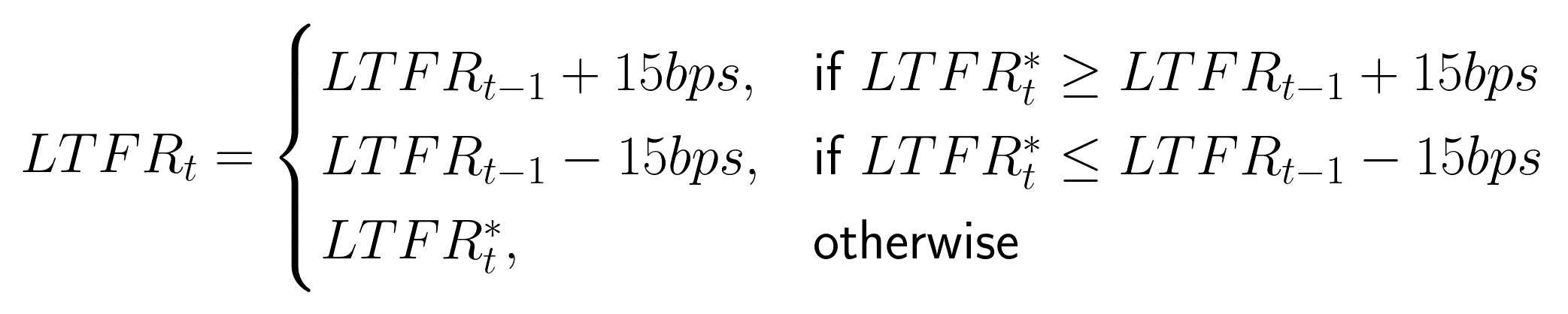
where:
- LTFRt denotes the LTFR of year t, after limitation of the annual change;
- LTFRt–1 denotes the LTFR of year t – 1, after limitation of the annual change; and
- LTFR*t denotes the LTFR of year t, before limitation of the annual change.
3.2.5.3 Determination of the adjustment to the risk-free yield curve
The ICS yield curves include an adjustment to the risk-free curves. This adjustment is determined using the Three-Bucket Approach.
The Three-Bucket Approach classifies liabilities into General Bucket, Middle Bucket and Top Bucket, depending on the nature of the liabilities and the assets backing these liabilities. A different yield curve adjustment is determined for each bucket.
The criteria used for the classification of liabilities and the adjustment relevant for each bucket are specified in the Level 2 text.
The following spread over the LTFR is added to all LTFR calculated according to paragraphs L2-61 to L2-64 above:
- 20 basis points for geographical area 1;
- 25 basis points for geographical area 2; and
- 35 basis points for geographical area 3.
using the geographical areas laid down in L2-62.
3.2.5.3.1 Classification criteria
Insurance liabilities are eligible for the Top Bucket if they meet all of the following criteria:
- They belong to the category of life insurance and disability annuities in payment with no cash benefits on withdrawal, taking into account e) below.
- The portfolio of assets to cover the insurance liabilities is identified and, together with the corresponding liabilities, it is managed separately, without being used to make payments relating to other business of the IAIG.7
- The expected cash flows of the identified portfolio of assets replicate the expected cash flows of the portfolio of insurance liabilities in the same currency, up to the LOT of the risk-free yield curve for the relevant currency. Any mismatch, addressed through the carry forward of cash generated from excess of asset cash flows at previous maturities, does not give rise to material risks. Carry forward of cash is limited to 10% of the total undiscounted liability cash flows up to the LOT. Where insurance liabilities are backed with assets denominated in a different currency, the same currency requirement is taken into account in the cash flow testing, provided that the currency mismatch is fully hedged and the cost of hedging is deducted from the asset cash flows.
- The contracts underlying the insurance liabilities do not include future premiums.
- The portfolio of insurance liabilities includes either no surrender option for the policyholder or only a surrender option where the surrender value does not exceed the value of the assets identified for this portfolio at the reporting date and at all future points in time.
7 For both the Top and Middle Buckets, the separate management of assets does not refer to a legal ring fencing but to a portfolio
segmentation of clearly identified assets that would support an identified group of insurance liabilities over their lifetime. Should a portfolio be restructured within the entity, this being exceptional, the assets contained therein can only be transferred to another portfolio when done in conjunction with their corresponding liabilities. This does not preclude changes in investments within a portfolio in the normal course of business.
No unbundling is allowed when assessing eligibility for the Top Bucket.
Insurance liabilities are eligible for the Middle Bucket if they meet all the following criteria:
- The portfolio of assets to cover the insurance liabilities is identified and, together with the corresponding liabilities, is managed separately, without being used to cover losses arising from other business of the IAIG.7
- The portfolio of insurance liabilities includes either no surrender option for the policyholder or only a surrender option where the surrender value does not exceed the value of the assets identified for this portfolio at the reporting date.
- The ICS Lapse risk charge does not represent more than 5% of the current estimate of the liabilities discounted using the risk-free yield curve.
- The total market value of assets identified for this portfolio is, at the reporting date, greater than the current estimate of the liabilities calculated using the General Bucket yield curve. For the calculation of the total market value of assets, all assets identified for this portfolio are taken into account, irrespective of their classification in Table 2.
- The contracts underlying the liabilities do not include future premiums or include only future premiums that are contractually fixed or are at the discretion of the IAIG. Policyholder options to pay additional future premiums do not disqualify these liabilities from the Middle Bucket, but all corresponding cash flows that are not at the discretion of the IAIG are unbundled and are subject to the General Bucket. The additional premiums outside the contract boundaries and the use of discretionary benefits to purchase additional insurance are not considered future premiums.
7 For both the Top and Middle Buckets, the separate management of assets does not refer to a legal ring fencing but to a portfolio segmentation of clearly identified assets that would support an identified group of insurance liabilities over their lifetime. Should a portfolio be restructured within the entity, this being exceptional, the assets contained therein can only be transferred to another portfolio when done in conjunction with their corresponding liabilities. This does not preclude changes in investments within a portfolio in the normal course of business.
No unbundling is allowed when assessing eligibility for the Middle Bucket with the exception in the context of L2-68e.
An insurance portfolio which has met the criteria in L2-68 for the prior three years and where there has not been any substantial change in the portfolio, will not be disqualified from the Middle Bucket if any criteria are breached in the current year.
Unless they are replicable by a portfolio of assets (as specified in section 3.4), liabilities that are not in the Top or Middle Bucket belong to the General Bucket.
3.2.5.3.2 Adjustments to the yield curve
3.2.5.3.2.1 Eligible investments
For the purpose of calculating the Top Bucket and Middle Bucket adjustments, the eligibility of types of investments is specified in the following table:
| Type of investment | Eligible |
| Cash and other liquid assets not for investment purposes | (Excluded from portfolio) |
| Investment income receivable/accrued | N |
| Fixed Interest Government Bonds | Y |
| Fixed interest Corporate Bonds | Y |
| Fixed Interest Municipal Bonds | Y |
| Variable Interest Government Bonds | Y |
| Variable interest Corporate Bonds | Y |
| Variable Interest Municipal Bonds | Y |
| Convertible notes | N |
| Residential Mortgage Loans | Y |
| Non-residential Mortgage Loans | Y |
| Other (non-mortgage) Loans | Y |
| Loans to policyholders | Y |
| Residential Mortgage Backed Securities | Y |
| Commercial Mortgage Backed Securities | Y |
| Other structured securities | Y |
| Insurance Linked Securities | N |
| Equities | N |
| Hedge Funds | N |
| Private equity | N |
| Real estate (for investment purposes) | N |
| Infrastructure debt | Y |
| Infrastructure equity | N |
| Other investment assets | N |
Assets backing unit-linked or separate account insurance liabilities are not taken into account when those insurance liabilities are valued using the asset replication approach presented in section 3.4.
Government bonds include only debt instruments issued or guaranteed by central governments (excluding exposures to municipal and other public sector entities).
Assets featuring call options (used at the discretion of the issuer) are ineligible to back liabilities, unless it can be demonstrated that the exercise of the option does not imply a loss to the IAIG and that the matching of the liability cash flows can be maintained.
3.2.5.3.2.2 Top Bucket
The adjustment for the Top Bucket is based on the average spread above the risk-free yield curve of the eligible assets, as listed in Table 2, identified by the IAIG to back the portfolio of liabilities meeting the Top Bucket criteria.
The IAIG may identify different portfolios, which will lead to the calculation of portfolio-specific adjustments.
A cap at the level of the ICS RC 4 spread applies for assets with a lower credit quality. The ICS RC 4 cap is based on the spreads earned by the IAIG for ICS RC 4 rated assets denominated in the same currency. Where no such assets exist, the spread used for the Middle Bucket adjustment calculation is used.
The spread is adjusted for credit risk and any other risk, using the same risk correction parameters as specified in paragraph L2-85.
For the Top Bucket, 100% of the spread adjustment is added to the risk-free rate to discount insurance liabilities.
The IAIG uses the relevant adjusted yield curves according to the currency of the insurance liability cash outflows.
Where insurance liabilities are backed with assets denominated in a different currency, the spread adjustment for the currency of the liability includes spreads which may be earned by the IAIG in those assets, provided that the currency mismatch is hedged. The cost of hedging is deducted from the Top Bucket adjustment.
The spread adjustment determined according to this methodology is applied as a parallel shift up to the run-off of the liabilities, which may be beyond the relevant LOT.
3.2.5.3.2.3 Middle Bucket
The Middle Bucket spread adjustment is a group-wide adjustment based on the eligible assets backing the Middle Bucket liabilities. The Middle Bucket spread adjustment can be portfolio specific within a single currency.
The term structures of spreads by credit quality and currency serve as a basis for the calculation of the Middle Bucket adjustment.
Parametric spread term structures are determined by credit quality and currency. They are obtained using the Nelson-Siegel approach on observed market spreads up to the LOT. Credit spreads are segmented by credit quality and duration buckets and sourced from recognised market data providers or if needed, derived from supervisory data.
These corporate spreads are supplemented with a contribution from sovereign holdings when the risk-free rate for the currency is determined from observing swap market instrument. A proportional risk correction factor is applied on these spread components. The risk correction on government bonds is defined as 30% of the difference between the government bonds indices at the reporting date and their average over the last 10 years.
For corporate bonds, the risk correction factor captures the expected loss and the credit risk premium. The expected loss is determined assuming an annualised probability of default for a theoretical 10-year bond and a loss given default of 70%. Credit risk premium is based on one standard deviation of the loss distribution.
Where insurance liabilities are backed with assets denominated in a different currency, the weighted average calculation of the spread adjustment for the currency includes spreads earned by the IAIG in those assets, subject to paragraph L2-95.
The spread adjustment is calculated according to the Weighted Average of Multiple Portfolios (WAMP) methodology, as specified in the following paragraphs.
The Wampspread(t) at maturity t for a given portfolio is calculated as follows:

where:
- wgov is the weight of government bonds;
- wICS RCi is the weight of debt instruments belonging to ICS rating category i;
- spreadgov after RC(t) is the spread after risk correction corresponding to government bonds. When a government bond rate is used for the risk-free yield curve, the applied spread is nil; and
- spreadICS RCi after RC(t) is the spread after risk correction corresponding to debt instruments that belong to ICS rating category i.
wgov and wICS RCi are determined only considering eligible assets according to Table 2.
Debt instruments in ICS RC 4 and lower, as well as unrated debt instruments, are allocated to the ICS RC 4.
In the case of currency unions, the sovereign exposure (and the corresponding weight in the WAMP calculation) is split by jurisdiction within the currency union.
The Total Observed Matching (TOM) ratio is computed as follows:

where:
- lifetime of liability is the maturity after which the insurance liabilities are not expected to generate any cash flow, and M is the last maturity for which, under the cash flow test described in paragraph L2-66.c, neither the cash carry forward limit of 10% is breached nor the remaining cash becomes negative. When the remaining cash becomes negative on the first year of projection, M is taken equal to 0. When the cash carry forward limit of 10% is not breached at any point in time, and the remaining cash remains non-negative over the lifetime of liability, M is taken equal to lifetime of liability. For the purpose of determining M, asset cash flows in a different currency than liability cash flows can be taken into consideration provided that either:
- a. the asset cash flows are fully hedged;
- b. a rolling hedge is in place and the replacement frequency of the hedge is not less than one month. In this case, a haircut equal to the minimum of (50% of the currency risk stress factor according to section 5.3.6, 20%) is applied on the asset cash flows; or
- c. the IAIG can demonstrate to the GWS that no rolling hedging with replacement frequency not lower than a month or other hedging that is practical/cost-effective is available. In this case, when this approach is allowed by the GWS, a haircut according to the currency risk stress factor is applied to the asset cashflows.
In cases a. and b. above, the cost of hedging is deducted from the expected cash flows. Only cash flows from eligible assets (Table 2), cash and callable bonds up to the first call date can be used for the cash flow test.
The final spread adjustment for the Middle Bucket (Spread AdjMB(t)) applied to the yield curve is computed such that it is greater than or equal to the spread adjustment for the General Bucket (Spread AdjGB(t)) at each maturity t.


The spread adjustment Spread AdjMB(t) determined according to this methodology is applied additively to the risk-free rate at each maturity t up to year M. After that maturity, the spread adjustment is phased out in such a way that the resulting spot curve remains above the spot curve for the corresponding General Bucket.
Examples
The following assets back liabilities that are eligible for the Middle Bucket.
- Government bonds:100
- Corporate bonds ICS RC1:50
- Corporate bonds ICS RC2:30
- Equity:70
- Cash: 10
wgov = 100 / (100 + 50 + 30) = 5/9
wICS RC1 = 50 / (100 + 50 + 30) = 5/18
wICS RC2 = 30 / (100 + 50 + 30) = 1/6
Equity is not eligible according to paragraph L2-72 and therefore not considered for the calculation of the weights. Cash is excluded according to Table 3 and therefore not considered for the calculation of the weights.
The test in Figure 3 is failed in year 15 (M = 14). According to the assumption the LOT is 20 years and the lifetime of the liabilities 16 years.
TOM = min(14/min(20,16), 100%) = 87,5%
3.2.5.3.2.4 General Bucket
The gross spread adjustment for the General Bucket (Spread AdjGross–GB(t)) is based on a representative portfolio that reflects the assets typically held by IAIGs in a particular currency and assumes that Spread AdjGross–GB(0) = 0.
The gross spread adjustment Spread AdjGross–GB(t) includes a correction for credit risk and any other risk.
For corporate bonds, the aforementioned correction is derived from the annualised cumulative default experience for a hypothetical 10-year bond, computed on the basis of transition matrices.
For government bonds, the risk correction is determined depending on the data underpinning the risk-free rate. Where risk-free rates are determined based on swap rates, risks other than liquidity risk are assumed to represent 30% of the 10-year average spread. For currencies where risk-free rates are based on government bond rates, no risk correction is applied.
The spot rate for the General Bucket yield curve is computed as follows:

up to the LOT, where rfr(t) is the risk-free spot rate at maturity τ and ω the IAIG specific modulation factor. For Segments 2 and 3 of the adjusted yield curve, the same extrapolation methodology is used as for determining the risk-free yield curve is applied to the adjusted yield curve.
The IAIG uses the relevant adjusted yield curves according to the currency of the insurance liability cash outflows.
3.2.5.3.2.5 Modulation Factor ωi
The modulation factor ωi is computed on a portfolio basis. It is computed using all assets, which are sensitive to changes in credit spreads8, in the same currency spread bucket as the main currency of the liabilities.
8 This includes government bonds when the respective yield curve is based on swaps.
The currency spread buckets are based on the spread mappings which are used for determining the credit spreads for those currencies.
The modulation factor ωi is computed using the following formula:

and

where:
- ωGB is the modulation factor to be applied for General Bucket portfolios;
- ωMB is the modulation factor to be applied for Middle Bucket portfolios;
- PVBPU stands for the price value of a basis point up, and is calculated in the following way

where PV(X) is the current price and PVup(assets) the price obtained by applying a parallel shift of one basis point upwards to the relevant yield curve, while PVup(liabilities) is the price obtained by applying a parallel shift up to the LOT of one basis point upwards to the relevant yield curve, after the LOT extrapolation according to section 3.2.5.2 is used. Changes in cash flows due to the parallel shift of one basis point are considered when they are expected to have a non-negligible impact on the ICS coverage ratio. The spot rates of the relevant yield curve rrelevant(t) for liabilities are obtained as follows:

up to the LOT and using the same extrapolation methodology for Segments 2 and 3 as used for determining the risk-free yield curve. Re-calculations are performed taking into consideration potential changes in cash flows when interest rates change. The relevant yield curve for assets is the yield curve used to determine the current balance sheet value.
- weightspread is the weight of spread contributing assets. weightspread,MB is the weight of the spread contributing assets for the Middle Bucket. These are computed using the parameters as for paragraph L2-91.
Examples
USD credit spreads are used to proxy spreads for AUD, CAD, HKD, ILS, INR, KRW, MXN, MYR, PEN, PHP, SAR, SGC, THB and TWD. These currencies form one currency spread bucket. If the main currency of liabilities is eg HKD then all assets backing these liabilities denominated in one of the currencies in this bucket can be used for the calculation of the modulation factor.
The relevant yield curve for an asset will be typically of the form:
spot rate(t) = risk free spot rate(t) + spread
where spread is chosen such that the discounted cash flows using spot rate(t) yield the market value of the asset.
3.3 Margin over Current Estimate (MOCE)
3.3.1 Definition and underlying principles
The MOCE is a margin added to the current estimate of insurance obligations in order to achieve a market adjusted value of insurance liabilities. As such, MOCE covers the inherent uncertainty in the cash flows related to insurance obligations. As such, MOCE considers all uncertainties attached to these obligations.
3.3.2 Calculation of the MOCE
The MOCE is calculated as a given percentile of the normal distribution characterised by:
- A mean equal to the current estimate of life (and non-life) obligations; and
- A 99.5% percentile equal to the life (and non-life) risk charge.
The percentiles for life and non-life insurance normal distributions are specified in the Level 2 text.
The 85th percentile is used to compute the life component of the MOCE and the 65th percentile is used for the non-life component.
3.3.3 Interaction of MOCE with other components
All stress-based calculations include only current estimates for determining the pre- and post-stress Net Asset Value (NAV), ie the MOCE remains constant during the stress. Factors applied to insurance liabilities are only applied to current estimates. MOCE is neither deducted from the ICS capital requirement, nor added to qualifying capital resources.
3.4 Obligations replicable by a portfolio of assets
Where future cash flows associated with insurance obligations can be replicated reliably, using financial instruments for which a market value is observable, the value of insurance liabilities associated with those future cash flows is determined on the basis of the market value of those financial instruments.
Additional conditions under which such an approach is applicable are specified in the Level 2 text.
Insurance liabilities are considered to be replicated reliably when their cash flows are in every circumstance precisely matched by cash flows of corresponding assets.
The cash flows associated with insurance liabilities are not considered to be reliably replicated when:
- Policyholders can exercise contractual options, including lapses and surrenders.
- Obligations depend on mortality, disability, sickness and morbidity rates.
- Expenses associated with insurance obligations cannot be reliably replicated.
Financial instruments used to replicate insurance liabilities must be traded in deep, liquid and transparent markets.
4 Capital resources
4.1 General considerations
Qualifying capital resources are determined on a consolidated basis for all financial activities and comprise qualifying financial instruments and capital elements other than financial instruments.
Qualifying capital resources are subject to adjustments, exclusions and deductions, as defined in section 4.4. Any item deducted from capital resources is excluded from the calculation of the ICS capital requirement.
The ICS identifies two tiers of capital:
- Tier 1 capital resources comprise financial instruments and capital elements, other than financial instruments, that absorb losses on a going-concern basis and in winding-up; and
- Tier 2 capital resources comprise financial instruments and capital elements, other than financial instruments, that absorb losses only in winding-up.
In determining qualifying capital resources, the ICS differentiates between mutual and non-mutual IAIGs.
4.2 Classification of financial instruments
Financial instruments are classified into those two tiers based on consideration of a number of criteria, focused on five key principles:
- loss absorbing capacity (on a going-concern basis and/or in winding-up);
- subordination;
- availability to absorb losses;
- permanence; and
- absence of both encumbrances and mandatory servicing costs.
Within each tier, financial instruments are allocated into two categories with differing qualifying criteria:
- Tier 1:
- Tier 1 financial instruments for which there is no limit (Tier 1 Unlimited); and
- Tier 1 financial instruments for which there is a limit (Tier 1 Limited).
- Tier 2:
- Tier 2 Paid-Up financial instruments (Tier 2 Paid-Up); and
- Tier 2 Non-Paid-Up financial instruments (Tier 2 Non-Paid-Up).
Table 3 presents the features of Tier 1 Unlimited, Tier 1 Limited and Tier 2 Paid-Up capital with respect to the classification of financial instruments against the five key principles:
| Key Principles | Tier 1 Unlimited | Tier 1 Limited | Tier 2 Paid-Up |
| Loss absorbing capacity | Absorbs losses on both a going-concern basis and in winding-up. | Absorbs losses on both a going-concern basis and in winding-up. | Absorbs losses in winding-up. |
| Level of subordination | Most subordinated (ie is the first to absorb losses); subordinated to policyholders, other non-subordinated creditors, holders of Tier 2 capital instruments, and holders of Tier 1 Limited capital instruments. | Subordinated to policyholders, other non-subordinated creditors and holders of Tier 2 capital instruments. | Subordinated to policyholders and other non-subordinated creditors. |
| Availability to absorb losses | Fully paid-up | Fully paid-up | Fully paid-up |
| Permanence | Perpetual | Perpetual For mutuals, this requirement is considered to be met if redemption at maturity (for a dated instrument) can be deferred, subject to supervisory approval or a lock-in feature, subject to a sufficiently long initial maturity. No incentives to redeem permitted. Issuer may redeem after a minimum specified period after issuance or repurchase at any time, subject to prior supervisory approval. |
Sufficiently long initial maturity– may have incentives to redeem but first occurrence deemed to be “effective maturity date”. |
| Absence of both encumbrances and mandatory servicing costs | IAIG has full discretion to cancel distributions (ie distributions are non-cumulative); the instrument is neither undermined nor rendered ineffective by encumbrances. |
IAIG has full discretion to cancel distributions (ie distributions are non-cumulative); the instrument is neither undermined nor rendered ineffective by encumbrances. |
The instrument is neither undermined nor rendered ineffective by encumbrances. |
With regard to Tier 2 Paid-Up capital, the form of subordination can be either contractual or structural. Structurally subordinated instruments are subject to certain conditions that capture the specificities of structural subordination.
The recognition of Tier 2 Non-Paid-Up capital is restricted to mutual IAIGs. It is also required that once these items become paid-up, the resulting capital element will possess the features required of Tier 1 or Tier 2 Paid-Up capital resources.
The list of criteria and conditions associated with each tier of capital is specified in the Level 2 text.
4.2.1 Tier 1 Unlimited financial instruments
Financial instruments that meet all of the following criteria qualify as Tier 1 Unlimited capital resources:
- The instrument is fully paid-up.
- The instrument is in the form of issued capital such that it is the first instrument to absorb losses as they occur.
- The instrument represents the most subordinated claim in a winding-up of the IAIG where the holder has a claim on the residual assets proportional to its share of the issued share capital after all other claims have been repaid, and which is not subject to a fixed or capped amount.
- The instrument is perpetual (ie it does not have a maturity date).
- The principal amount of the instrument is not repaid outside winding-up, other than by means of discretionary repurchase permitted under national law.
- There is not an expectation created by the IAIG at issuance, through the terms of the instrument or otherwise, that the IAIG will repurchase or cancel the instrument.
- There are no circumstances under which a distribution is obligatory (non-payment of a distribution is, therefore, not an event of default).
- Distributions are paid out of distributable items, including retained earnings.
- The instrument is neither undermined nor rendered ineffective by encumbrances. In particular, the priority of claims is not compromised by guarantees or security arrangements given by either the IAIG or a related entity over which the IAIG exercises control or significant influence, for the benefit of investors.
- Neither the IAIG nor a related entity over which the IAIG exercises control or significant influence has purchased the instrument, nor has the IAIG directly or indirectly funded the purchase of the instrument.
- The paid-in amount is recognised as equity capital (ie is not recognised as a liability) where a determination that liabilities exceed assets constitutes a test of insolvency.
4.2.2 Tier 1 Limited financial instruments
Financial instruments that do not qualify as Tier 1 Unlimited capital resources, but meet all of the following criteria, qualify as Tier 1 Limited capital resources:
- a. The instrument is fully paid-up.
- b. The instrument is subordinated to policyholders and other non-subordinated creditors and holders of Tier 2 financial instruments but may rank senior to holders of Tier 1 unlimited financial instruments.
- c. The instrument is perpetual (ie it does not have a maturity date). For mutual IAIGs9, the requirement for an instrument to be perpetual is considered to be met if redemption at maturity (for a dated instrument) can be deferred subject to supervisory approval or a lock-in10 feature, and where an instrument has an initial maturity of at least ten years.
- d. The instrument does not contain any incentive to redeem, such as a step-up.
- e. The instrument is only callable at the option of the issuer after a minimum of five years from the date of issue and prior supervisory approval is required for any redemption. By way of derogation, call options, the exercise of which may take place in the first five years, may be permitted only in the following two situations:
- Tax and regulatory event call options, the exercise of which is subject to prior supervisory approval, and provided the IAIG was not in a position to anticipate such exercise at the time of issuance. Before granting approval, the supervisor ensures that after redemption of the instrument, the IAIG will cover its ICS capital requirement with a margin sufficient to ensure that the ICS will not be breached over the foreseeable future, taking into account any relevant trend and specificities of the IAIG.
- Other call options, provided that their exercise complies with all of the following:
- Prior to or concurrent with the exercise of the call, the IAIG replaces the called instrument with capital of the same or better quality, and the replacement of the called instrument is made on terms that are sustainable for the income capacity of the IAIG;
- The IAIG demonstrates to the satisfaction of the supervisor that the call is economic; and
- The call is approved by the supervisor.
When assessing whether the call is economic, the supervisor ensures that the cost of issuing the replacement instrument is lower than the cost of keeping the existing instrument outstanding. This analysis may consider various scenarios including, but not necessarily limited to, comparative spread levels and issuance volume.
- f. The instrument may be repurchased by the issuer at any time with prior supervisory approval.
- g. There is not an expectation created by the IAIG, through the terms of the instrument or otherwise, that the IAIG will repurchase the instrument or exercise any right to call the instrument, or that the repurchase or redemption will receive supervisory approval.
- h. The IAIG has full discretion at all times to forego or cancel distributions (ie dividends and coupon payments are non-cumulative). The IAIG’s obligation to pay missed distributions is forever extinguished and non-payment is not an event of default.
- i. Distributions are paid out of distributable items, including retained earnings.
- j. The instrument does not have distributions that are linked to the credit standing or financial condition of the IAIG or a related entity, such that those distributions may accelerate winding-up.
- k. The instrument is neither undermined nor rendered ineffective by encumbrances. In particular, the priority of claims is not compromised by guarantees or security arrangements given by either the IAIG or a related entity over which the IAIG exercises control or significant influence, for the benefit of investors.
- l. Neither the IAIG nor a related entity over which the IAIG exercises control or significant influence has purchased the instrument, nor has the IAIG directly or indirectly funded the purchase of the instrument.
- m. The paid-in amount is recognised as equity capital (ie is not recognised as a liability) where a determination that liabilities exceed assets constitutes a test of insolvency.
- n. The instrument does not possess features that hinder recapitalisation, such as provisions that require the issuer to compensate investors if a new instrument is issued at a lower price during a specified time frame.
- o. If the instrument is not issued out of an operating entity or the holding company of the IAIG (eg it is issued out of an SPV), proceeds are made immediately available, without limitation, to an operating entity or the holding company of the IAIG, through the issuance of an instrument that meets or exceeds all of the other criteria for inclusion in Tier 1 limited capital resources (ie the SPV may only hold assets that are intercompany instruments issued by the IAIG or a related entity with terms and conditions that meet or exceed the criteria for Tier 1 limited capital resources).
9 Characteristics of a mutual group typically include the inability to issue substantial amounts of common equity and an ultimate parent within the group that cannot issue common equity.
10 A lock-in feature is a requirement for the IAIG to suspend repayment or redemption if it is in breach of its applicable regulatory capital requirement or would breach it if the instrument is repaid or redeemed.
Instruments issued before the date of adoption of the ICS may be considered compliant with T1 Limited criterion e., even when the relevant supervisor has not committed to check the economic nature of a call before granting approval of that call within the first 5 years. This legacy exemption is applicable until the instrument is redeemed.
Explanatory Text
7. For the purpose of assessing compliance of an instrument with criterion e., the conditions for supervisory approval (assessment of post-redemption solvency, assessment of the economic character of the call) should be specified upon issuance of the instrument. This can be included for instance in the terms and conditions of the instrument, in a public document specifying the applicable supervisory practice with that respect, in a letter from the supervisor to the IAIG, etc.
4.2.3 Tier 2 financial instruments (other than structurally subordinated)
Financial instruments that do not qualify as Tier 1 (Unlimited or Limited) capital resources, but meet all of the following criteria qualify as Tier 2 capital resources:
- a. The instrument is fully paid-up.
- b. The instrument is subordinated to policyholders and other non-subordinated creditors of the IAIG.
- c. The instrument has an initial maturity of at least five years with its effective maturity date defined to be the earlier of:
- i. The first call date, together with a step-up or other incentive to redeem the instrument; and
- ii. The contractual maturity date fixed in the instrument’s terms and conditions.
- d. The instrument’s availability to absorb losses as it nears its effective maturity is captured by either:
- i. Decreasing the qualifying amount of the instrument from 100% to 0% on a straight-line basis in the final five years prior to maturity; or
- ii. The existence of a lock-in clause.
- e. If the instrument is callable within the first five years from the date of issue:
- Any such call is at the option of the issuer only;
- Any such call is subject to supervisory approval; and
- The called instrument must be replaced in full before or at redemption by a new issuance of the same or higher quality instrument.
The obligation of replacement mentioned in the third bullet point above may be waived when the call is tied to a materially adverse tax or regulatory event that could not reasonably be anticipated at the time of issuance; or
Before granting approval, the supervisor ensures that after redemption of the instrument, the IAIG will cover its ICS capital requirement with a margin sufficient to ensure that the ICS will not be breached over the foreseeable future, taking into account any relevant trend and specificities of the IAIG.
Other than in cases of replacement outlined above, the instrument is only callable at the option of the issuer after a minimum of five years from the date of issue and prior supervisory approval is required for any redemption prior to contractual maturity.11 - f. The instrument may be repurchased by the issuer at any time with prior supervisory approval.
- g. There is not an expectation created by the IAIG, through the terms of the instrument or otherwise, that the IAIG will repurchase the instrument or exercise its right to call the instrument, or that the repurchase or redemption will receive supervisory approval.
- h. The instrument does not have distributions that are linked to the credit standing or financial condition of the IAIG or a related entity, such that those distributions may accelerate winding-up.
- i. The instrument does not give holders rights to accelerate the repayment of scheduled principal or coupon payments, except in winding-up.
- j. The instrument is neither undermined nor rendered ineffective by encumbrances. In particular, the priority of claims is not compromised by guarantees or security arrangements given by either the IAIG or a related entity over which the IAIG exercises control or significant influence, for the benefit of investors.
- k. Neither the IAIG nor a related entity over which the IAIG exercises control or significant influence has purchased the instrument, nor has the IAIG directly or indirectly funded the purchase of the instrument.
- l. If the instrument is not issued out of an operating entity or the holding company of the IAIG (eg it is issued out of an SPV), proceeds are made immediately available, without limitation, to an operating entity or the holding company of the IAIG, through the issuance of an instrument that meets or exceeds all of the other criteria for inclusion in paid-up Tier 2 capital resources (ie the SPV may only hold assets that are intercompany instruments issued by the IAIG or a related entity with terms and conditions that meet or exceed the criteria for Tier 2 Paid-Up capital resources).
11 In the absence of a requirement for prior supervisory approval, this criterion is considered to be met if the following conditions are met:
- The terms of the financial instrument include a lock-in feature that prevents redemption when a firm does not comply with its regulatory capital requirement (or where redemption would lead to non-compliance);
- Either:
- the supervisor receives prior notification upon redemption, or
- call dates are fixed and known and the supervisor monitors potential redemption; and
- The supervisor has the power to prevent redemption of the instrument.
Explanatory Text
8. For the purpose of assessing compliance of an instrument with criterion e., the conditions for supervisory approval should be specified upon issuance of the instrument. This can be included for instance in the terms and conditions of the instrument, in a public document specifying the applicable supervisory practice with that respect, in a letter from the supervisor to the IAIG, etc.
4.2.4 Structurally subordinated Tier 2 financial instruments
Instruments issued before the date of adoption of the ICS, which can be called only at a make-whole price, may be considered compliant with Tier 2 Paid-Up criterion e., even in the absence of a commitment or requirement to replace the instrument before or concurrent to a call within the first five years of issuance. This legacy exemption is applicable until the instrument is redeemed.
Structural subordination of debt refers to a situation where a holding company issues a financial instrument directly to third party investors and then down-streams the proceeds into insurance subsidiaries.
Structurally subordinated financial instruments that meet the criteria for Tier 2 financial instruments, subject to the clarifications of criteria b), e), and f), and new criteria n), o), and p) below, qualify as Tier 2 capital resources:
- b. Subordination to other non-subordinated creditors of the IAIG is not relevant to structurally subordinated instruments that are issued by an IAIG’s holding company to senior creditors.
- e. The requirement for supervisory approval of such a call within the first five years from the date of issue can be fulfilled through the exercise of supervisory controls and supervisory review, including the ability (direct/indirect) for supervisors to limit, defer and/or disallow the issuance or redemption of financial instruments.
- f. The requirement for supervisory approval of repurchases can be fulfilled through supervisory approval12 of dividends prior to their payment from an insurance subsidiary to the holding company.
- n. The debt instrument has been issued by a clean holding company, which is defined as a holding company that does not have policyholder liabilities on its stand-alone balance sheet.
- o. The IAIG and its GWS have determined that the proceeds of the instruments, which have been down-streamed into insurance subsidiaries, are being tracked and reported appropriately.
- p. Amounts from the instrument issuance have been down-streamed into an insurance subsidiary of the holding company and the insurance subsidiary is located in a jurisdiction whose regulatory regime proactively enforces structural subordination through appropriate regulatory/supervisory controls over distributions from insurance subsidiaries13.
12 For structurally subordinated financial instruments, supervisory approval of ordinary dividends can be met if the supervisor has in place supervisory controls over distributions, including the ability for the supervisor to limit, defer and/or disallow the payment of any distributions should it find that the insurer is presently, or may potentially become, financially distressed.
13 Supervisory controls over distributions from insurance subsidiaries refer to the supervisory review and/or prior supervisory approval of all distributions, including the ability for the supervisor to limit, defer and/or disallow the payment of any distributions should it find that the insurer is presently, or may potentially become, financially distressed. As part of its review and/or prior approval of distributions, the relevant supervisor considers surplus adequacy, financial flexibility, the quality of earnings, and other factors deemed to be pertinent as they relate to the financial strength of the insurer and policyholder protection.
4.2.4.1 National discretion on acceleration clauses
Criterion i. in paragraph L2-114 is subject to a national discretion. When a GWS elects to apply that national discretion, criterion i. is waived for all IAIGs headquartered in the jurisdiction of that GWS.
IAIGs to which the national discretion applies provide a reconciliation of the impact between the ICS with and without applying the national discretion.
4.2.5 Tier 2 Non-paid-up capital
Non-paid-up capital consists of commitments, received by entities of the IAIG from third parties non-related to the IAIG, to provide capital upon request.
Financial items, contracts and arrangements established by mutual IAIGs qualify as Tier 2 Non-paid-up capital resources when they meet all of the following criteria:
- The item has been approved by the supervisor as satisfying criteria b) to g) below as to its characteristics and amount.
- The item can be called up on demand by the mutual IAIG and is not subject to any contingencies or conditions that prevent or act as a disincentive to the call being made or satisfied.
- When called up, the item becomes either a financial instrument that meets in full the criteria for inclusion in Tier 1 or Tier 2 paid-up capital resources or a capital element listed in section 4.3.
- The item is legally enforceable in each relevant jurisdiction.
- The counterparty to the contract to provide capital is able and willing to pay the agreed amounts when called upon by the mutual IAIG.
- The item is neither undermined nor rendered ineffective by encumbrances.
- The mutual IAIG is required to notify the supervisor of any changes of fact or circumstance that could affect the supervisor’s approval of the item.
Explanatory Text
9. Non-paid-up capital items may take a number of different forms, including unpaid preference shares, unpaid subordinated debt, letters of credit, guarantees and mutual member calls.
4.3 Capital elements other than financial instruments
4.3.1 Tier 1 capital elements
Subject to any exclusion, adjustment or deduction as specified in section 4.4.1, Tier 1 capital elements, other than financial instruments, include the following items:
- Retained earnings;
- Share premium, resulting from the issuance of instruments included in Tier 1, and other forms of contributed surplus earned from sources other than profits;
- Accumulated Other Comprehensive Income (AOCI);
- The fair market value of equity-settled employee stock options, provided that a corresponding expense is recorded in the profit and loss account of the IAIG, under applicable accounting standards; and
- Other allocated to equity, which includes:
- i. Minority/Non-controlling interests (NCI); and
- ii. Adjustments applied to the IAIG’s consolidated balance sheet (as per audited financial statements) to produce the ICS balance sheet.
Explanatory Texts
10. Retained earnings are defined as the accumulated balance of income less losses resulting from operations, including earnings retained as surplus held in the participating policyholders’ equity account for joint stock companies, and in the non-participating account for mutual companies.
11. Share premium include for example members’ contributions and initial funds for mutual companies and other contributions by shareholders in excess of amounts allocated to share capital for joint stock companies.
12. Minority/Non-controlling interests (NCI) represent third party equity interest in consolidated subsidiaries. This includes any interest generated by share issuance and subsequent changes in reserves of issuing entities.
4.3.2 Tier 2 capital elements
Subject to any exclusion, adjustment or deduction as specified in section 4.4.2, Tier 2 capital elements, other than financial instruments, include the following:
- Share premium resulting from the issuance of instruments included in Tier 2 Paid-Up capital resources;
- The value of encumbered assets in excess of the on-balance sheet liabilities secured by the encumbered assets and incremental ICS capital requirement, in respect of those assets and liabilities excluded from Tier 1 (see section 4.4.3 for details on the treatment of encumbered assets); and
- The Tier 2 basket, comprised of proportions of the following three items which relate to deductions from Tier 1 (see section 4.4.1):
- i. the value of each net defined benefit pension fund that is an asset on the IAIG’s balance sheet, net of any eligible Deferred Tax Liability (DTL);
- ii. Deferred Tax Asset (DTA) deducted from Tier 1 capital resources; and
- iii. the value of computer software intangibles (net of amortisation) deducted from Tier 1 capital resources, net of any eligible DTL.
The Tier 2 basket is subject to a limit, expressed as a percentage of the ICS capital requirement.
The proportions of the three items included in the Tier 2 basket, as well as the overall limit applicable to the basket, are specified in the Level 2 text.
The Tier 2 basket comprises the following three items, subject to a limit of 15% of the ICS capital requirement:
- 50% of the value of each net defined benefit pension fund that is an asset on the IAIG’s balance sheet, net of any eligible DTL;
- 100% of the DTA deducted from Tier 1 capital resources; and
- 10% of the value of computer software intangibles (net of amortisation) deducted from Tier 1 capital resources, net of any eligible DTL.
4.4 Capital adjustments and deductions
4.4.1 Deductions from Tier 1 capital resources
To the extent that they have not already been excluded through valuation in the ICS balance sheet, the following items are deducted from Tier 1 capital resources:
- Goodwill;
- Intangible assets, including computer software intangibles;
- Each asset recognised on the IAIG’s balance sheet that relates to a defined benefit pension fund;
- DTAs on the ICS balance sheet;
- Reciprocal cross holdings, arranged either directly or indirectly between financial institutions and that artificially inflate the Tier 1 capital position of the IAIG;
- Direct and indirect investments in own Tier 1 capital instruments, not otherwise eliminated;
- Reinsurance assets arising from arrangements deemed to constitute non-qualifying reinsurance; and
- Encumbered assets in excess of the on-balance sheet liabilities secured by the encumbered assets and incremental ICS capital requirement in respect of those assets and liabilities (see section 4.4.3 for details on the treatment of encumbered assets).
Items a) to c) are net of any associated DTL that would be extinguished if the item becomes impaired or derecognised under the valuation approach.
Explanatory Texts
13. In determining reciprocal cross holdings between financial institutions that artificially inflate the Tier 1 capital position of the IAIG, as well as direct and indirect investments in own Tier 1 instruments not otherwise eliminated, the IAIG should apply a look-through approach (as described in Section 1.3).
14. Non-qualifying reinsurance refers to agreements:
- a. With entities providing reinsurance that are neither regulated nor subject to risk-based solvency supervision, including appropriate capital requirements; or
- b. That do not provide a sufficient transfer of risk.
4.4.2 Deductions from Tier 2 capital resources
To the extent that they have not already been excluded through valuation in the ICS balance sheet, the following items are deducted from Tier 2 capital resources:
- Reciprocal cross holdings, arranged either directly or indirectly between financial institutions and that artificially inflate the Tier 2 capital position of the IAIG; and
- Direct and indirect investments in own Tier 2 capital instruments, not otherwise eliminated.
4.4.3 Treatment of encumbered assets
When an IAIG holds encumbered assets in excess of the liabilities and associated risks for which those assets have been encumbered, an adjustment to Tier 1 capital resources is made.
The details of this adjustment are specified in the Level 2 text.
The deduction from Tier 1 capital resources is calculated as the total value of encumbered assets in excess of the sum of the value of the IAIG’s on-balance sheet liabilities secured by the encumbered assets, plus the value of the IAIG’s incremental ICS capital requirement for encumbered assets and secured liabilities.
No Tier 1 deduction is required for encumbered assets relating to off-balance sheet securities financing transactions (ie securities lending and borrowing, repos and reverse repos) that do not result in a liability on the balance sheet.
The amount of encumbered assets deducted from Tier 1 capital resources is included in Tier 2 capital resources, subject to the limits applicable to Tier 2 (see section 4.5 on capital composition limits).
Explanatory Text
15. An encumbered asset is an asset that the IAIG has pledged as collateral to a counterparty to either meet regulatory requirements or in order to participate in certain activities involving for instance: centrally cleared derivatives, over-the-counter (OTC) derivatives, mortgage borrowing, on-balance sheet repurchase agreements/securities lending and reverse repurchase agreements/securities lending, letters of credit/guarantees, collateral for reinsurance, assets held in trust, etc.
4.4.4 Limit on non-controlling interests
Non-controlling interests (NCI) are subject to a limit calculated at a legal entity level.
The calculation of the NCI limit is specified in the Level 2 text.
For each legal entity generating NCI at group level, a NCI limit is calculated as: Limit = NCI proportion x estimated contribution to group ICS
where:
– NCI proportion = Equity elements issued to 3rd parties / Total equity
– Estimated contribution to group ICS = α. liabilities
– α = Group ICS capital requirement / Group GAAP liabilities
The amount of NCI generated by that entity and exceeding the limit calculated above is deducted from the amount of Tier 1 capital resources.
4.5 Capital composition limits
The Tier 1 Limited and Tier 2 capital resources after adjustments, exclusions and deductions are subject to limits expressed as a percentage of the ICS capital requirement. Those limits, which may differ depending on the IAIG being mutual or non-mutual, are specified in the Level 2 text.
For a non-mutual IAIG, the following limits are applicable:
- Tier 1 Limited capital resources are limited to 10% of the ICS capital requirement; this limit is increased to 15%, provided that the instruments in excess of the 10% limit possess a Principle Loss Absorbency Mechanism (PLAM);
- Tier 2 capital resources are limited to 50% of the ICS capital requirement; and
- There is no allowance for Tier 2 Non-Paid Up capital.
For the purpose of paragraph L2-127, a PLAM is defined as a mechanism providing for either a write-down of the liability (principal and dividend/coupon) or a conversion of the instrument (into a Tier 1 unlimited financial instrument as defined in section 4.2.1) in contractually predefined going-concern conditions.
For a mutual IAIG, the following limits are applicable:
- Tier 1 Limited capital resources are limited to 30% of the ICS capital requirement;
- Tier 1 Limited + Tier 2 capital resources are limited to 60% of the ICS capital requirement; and
- Tier 2 Non-Paid Up capital are limited to 10% of the ICS capital requirement.
The GWS, in consultation with the supervisory college, may apply temporary supervisory forbearance on the limit on Tier 1 Limited capital resources for mutual IAIGs, provided that the IAIG submits a plan to restore its capital position.
Tier 1 Limited capital resources that are in excess of the associated limit are eligible for inclusion within Tier 2 capital resources, and become subject to the limit applicable to Tier 2 capital resources.
5 Capital requirement – the standard method
5.1 ICS risks and calculation methods
The categories of risk included in the standard method are: Insurance risk, Market risk, Credit risk and Operational risk. Table 4 lists the risk categories, along with the individual risks in each risk category.
The ICS capital requirement is based on the potential adverse changes in qualifying capital resources resulting from unexpected changes, events or other manifestations of the specified risks.
Risks are measured using either a stress approach or a factor-based approach. For natural catastrophe risk, a vendor or proprietary model may be used.
The stress approach uses the IAIG’s current balance sheet pre-stress and the IAIG’s balance sheet post-stress, assuming the stress happens instantaneously. The risk charge for each individual risk is determined as the decrease between the amount of capital resources on the pre-stress balance sheet and the amount of capital resources on the post-stress balance sheet. Stresses are applied individually with individual stressed balance sheets being calculated to determine the risk charge with respect to each individual stress. As a simplification, the change in net asset value is used as a proxy for the changes in qualifying capital resources.
The factor-based approach is determined by applying factors to specific exposure measures.
The scope of the risks covered by the ICS capital requirement, as well as the applicable measurement method, are outlined in Table 4.
| Categories of risk | Risk | Scope/definition: Risk of adverse change in the value of capital resources due to | Measurement Method |
| Insurance risk | Mortality risk (life) | Unexpected changes in the level, trend or volatility of mortality rates. | Stress |
| Insurance risk | Longevity risk (life) | Unexpected changes14 in the level, trend or volatility of mortality rates. | Stress |
| Insurance risk | Morbidity/Disability risk (life) | Unexpected changes14 in the level, trend or volatility of disability, sickness and morbidity rates. | Stress |
| Insurance risk | Lapse risk (life) | Unexpected changes14 in the level or volatility of rates of policy lapses, terminations, renewals and surrenders. | Stress |
| Insurance risk | Expense risk (life) | Unexpected changes14 in liability cash flows due to the incidence of expenses incurred. | Stress |
| Insurance risk | Premium risk (non-life) | Unexpected changes14 in the timing, frequency and severity of future insured events (to the extent not already captured in Morbidity/Disability risk). | Factor |
| Insurance risk | Claims reserve risk (non-life) | Unexpected changes14 in the expected future payments for claims or events that have already occurred (whether reported to the IAIG or not) and not yet fully settled (to the extent not already captured in Morbidity/Disability risk). | Factor |
| Insurance risk | Catastrophe risk | Unexpected changes14 in the occurrence of low frequency and high severity events. | Stress, except for natural catastrophe, which may use a model. |
| Market risk | Interest Rate risk | Unexpected changes14 in the level or volatility of interest rates. | Stress |
| Market risk | Non-default spread risk | Unexpected changes14 in the level or volatility of spreads over the risk-free interest rate term structure, excluding the default component. | Stress |
| Market risk | Equity risk | Unexpected changes14 in the level or volatility of market prices of equities. | Stress |
| Market risk | Real Estate risk | Unexpected changes14 in the level or volatility of market prices of real estate or from the amount and timing of cash flows from investments in real estate. | Stress |
| Market risk | Currency risk | Unexpected changes14 in the level or volatility of currency exchange rates. | Stress |
| Market risk | Asset Concentration risk | The lack of diversification in the asset portfolio. | Factor |
| Credit risk | Credit risk | Unexpected changes14 in actual defaults, as well as in the deterioration of an obligor’s creditworthiness short of default, including migration risk and spread risk due to defaults. | Factor |
| Operational risk | Operational risk | Operational events including inadequate or failed internal processes, people and systems, or from external events. Operational risk includes legal risk, but excludes strategic and reputational risk. | Factor |
14 Expected impacts are assumed to be incorporated in valuation methodologies
The individual risk charges are combined in a way that recognises risk diversification, using correlation matrices.
The ICS target criteria is a 99.5% Value at Risk (VaR), over a one-year time horizon, of adverse changes in the IAIG’s qualifying capital resources.
5.1.1 Risk mitigation techniques
In order to promote good risk management and achieve an appropriate level of risk sensitivity, the ICS recognises the effect of risk mitigation techniques, provided certain criteria are met. These criteria are set out in the Level 2 text and are designed to ensure that the risk mitigation techniques are accurately and appropriately reflected within the risk charges.
In addition, certain conditions are set regarding the renewal of risk mitigation arrangements. The conditions vary depending on whether the risk mitigation arrangement applies to a Market risk exposure or non-life Premium risk. These conditions are specified in the Level 2 text.
Risk mitigation techniques may be recognised in the ICS risk charges provided they meet all of the following requirements:
- The risk mitigation technique is effective and legally enforceable in all relevant jurisdictions and results in an effective transfer of risk to a third party.
- The contractual arrangement ensures that the risk transfer is clearly defined.
- The calculation of the ICS risk charges allows for the effects of risk mitigation techniques through a reduction of the risk charge commensurate with the extent of risk mitigation. That reduction makes reasonable allowance for any basis risk effects due to changes in risk mitigation assumptions and relationships during a stress scenario and there is appropriate treatment for any corresponding risk embedded in the use of risk mitigation techniques (eg Credit risk). These two effects are treated separately.
- The calculation is made on the basis of assets and liabilities existing at the reporting date of the ICS calculation.
- There is no double counting of mitigation effects.
- The documentation for the arrangement sets out a direct claim on the IAIG’s counterparty in the event of its default, insolvency, bankruptcy or other credit event.
- Providers of risk mitigation are of an adequate credit quality (demonstrable through either adequate rating, capitalisation or collateralisation levels) to ensure with appropriate certainty that the IAIG will receive the protection in the cases specified by the contracting parties. Credit quality is assessed consistently with the definition of credit categories provided in section 5.4.
In addition to these requirements, market risk mitigation techniques are based on an explicit reference to specific exposures or a pool of exposures.
Where risk mitigation techniques are in force for a period shorter than 12 months and meet the qualitative criteria above, a proportional factor is applied to the risk mitigation effect taken into account in the ICS risk charges. That factor is defined as either:
- The proportion of the full term of the risk exposure covered by the risk mitigation technique up to a maximum of 100%, where the risk exposure’s term is less than 12 months; or
- The proportion of 12 months covered by the risk mitigation technique up to a maximum of 100%, where the risk exposure term is 12 months or more.
However, where the IAIG plans to replace a risk mitigation arrangement relating to a Market risk exposure at the time of its expiry with a similar arrangement, this renewal may be taken into account if the IAIG expects to renew and all of the foreseeable costs of renewal within the time horizon are taken into account. The requirement of an expectation to renew is considered to be met if all of the following conditions are met:
- The renewal is consistent with previous business practice and documented strategy.
- The replacement of the risk mitigation instrument does not take place more often than every three months, except for Currency risk or Equity risk where the replacement of the risk mitigation instrument does not take place more often than every month.
- The risk that the risk mitigation arrangement cannot be replaced due to an absence of liquidity in the market is not material under different market conditions and there is no material basis or operational risks compared to the risk mitigation effect. If the instruments mitigating Currency or Equity risk are replaced more frequently than every three months, then the IAIG justifies to its group wide supervisor that:
- the market for these instruments is sufficiently liquid at the relevant tenor; and
- these instruments do not pose a materially greater risk than those replaced less frequently than every three months.
- The replacement of the risk mitigation arrangement is not conditional on any future event that is outside of the control of the IAIG. Where the replacement of the risk mitigation arrangement is conditional on any future event that is within the control of the IAIG, then the conditions are clearly set out in the documented strategy referred to in point a).
- The renewal is realistic regarding the availability of the arrangement and its cost is deducted from the value attributed to the instrument. This deduction takes into account the risk that the cost may increase during the following 12 months.
- Any additional risk stemming from the risk mitigation arrangement (eg Credit risk) is taken into account in the ICS risk charges.
- The IAIG is able to demonstrate to its GWS that the required instruments will be available for renewal from a deep and liquid market under all reasonably foreseeable eventualities over the following 12 months. Where this is not the case, the benefit recognised for the renewal of the risk mitigation arrangement is limited to 80% of the full risk mitigating value of the arrangement at the reporting date.
The renewal of risk mitigation arrangements with respect to Non-Life Premium risk may be taken into account if the IAIG expects to renew and the costs of renewal within the time horizon are taken into account. The requirement of an expectation to renew is considered to be met if all of the following conditions are met:
- The renewal is consistent with previous business practice and documented strategy;
- The renewal is realistic with regards to availability of the arrangement and its cost15; and
- Any additional risk stemming from the risk mitigation arrangement (eg Credit risk) is taken into account in the relevant risk charges.
15 Costs may include, but are not limited to, ceded premiums to the reinsurer and commissions.
When modelling natural catastrophe risk, the renewal of the arrangements may be taken into account if all of the following conditions are met:
- The renewal is consistent with previous business practice and documented strategy;
- The renewal is realistic regarding the availability of the arrangement and its cost; and
- Any additional risk stemming from the risk mitigation arrangement (eg Credit risk) is also taken into account in the natural catastrophe risk modelling.
Risk mitigation arrangements are not recognised in the calculation of the Operational risk charge.
5.1.2 Geographical segmentation
For some of the risks, a geographical segmentation is used to calculate the risk charge. The geographical segmentation is set out in the Level 2 text.
For those risk charges calculated using a geographical segmentation, the following regions are used:
- European Economic Area (EEA) and Switzerland;
- US and Canada;
- China;
- Japan;
- Other developed markets; and
- Other emerging markets.
The jurisdictions included in each region are listed in Table 5.
| Region | Jurisdictions included |
| EEA and Switzerland | Austria, Belgium, Bulgaria, Croatia, Republic of Cyprus, Czech Republic, Denmark, Estonia, Finland, France, Germany, Greece, Hungary, Ireland, Italy, Latvia, Lithuania, Luxembourg, Malta, Netherlands, Poland, Portugal, Romania, Slovakia, Slovenia, Spain, Sweden, United Kingdom, Iceland, Liechtenstein, Norway and Switzerland |
| US16 and Canada | US and Canada |
| China | Mainland China and Macao SAR |
| Japan | Japan |
| Other developed markets17 | Australia, New Zealand, Israel, San Marino, Korea, Singapore, Chinese Taipei and Hong Kong SAR |
| Other emerging markets | A list of emerging markets is provided in Table E of the Statistical Appendix of the IMF World Economic Outlook April 201618. For completeness, if a country is not listed in the regions above, it is classified as “Other emerging markets”. |
16 Including American Samoa, Guam, Northern Mariana Island, Puerto Rico and US Virgin Islands.
17 ‘Other developed’ taken from IMF list of advanced economies minus countries mentioned in other regions as of April 2016.
18 See http://www.imf.org/external/pubs/ft/weo/2016/01/pdf/text.pdf (accessed on 12 May 2016).
5.1.3 Management actions
A credit for exercising management actions is taken into account at the level of each risk in the capital requirement, subject to a cap, as described in the Level 2 text.
The impact of management actions for each individual risk is calculated consistently with the provisions set out in section 3.2.4. The impact of management actions is based on realistic assumptions and reflects the IAIG’s obligations to policyholders as well as legal provisions applicable to the IAIG and contract boundaries. The impact of management actions takes into account only the effects of future actions that are contractually enforceable by the IAIG and that are assumed to be enacted after the stress event. This excludes for example dynamic hedging and similar rebalancing strategies that are assumed to be enacted during the stress. For example, the equity stress is assumed to happen instantaneously, therefore a rebalancing during the decline of equity prices of x% is not allowed.
The impact of management actions related to FDB on the pre-tax aggregated ICS risk charges (as specified in section 5.6) is limited to the total initial amount of insurance liabilities related to FDB.
Example
Management actions considered after an equity stress
Consider an IAIG with a portfolio of savings contracts. Those savings contracts do not include any legally enforceable profit participation, however the IAIG has an internal policy aimed at redistributing approximately 80% of each year’s financial profits (when positive) to policyholders. Such a policy leads to an amount of 80 of discretionary benefits in the current estimate figure, corresponding to the maximum loss absorbency that the IAIG would be able to pass through to policyholders in case of adverse financial scenarios.
However, for reasons of competitiveness and avoiding mass lapses, the IAIG is, in practice, not likely to pass through the maximum possible amount of loss to policyholders. For instance, while a drop of 40% in the value of its equity investments would have a negative impact of 100 on the value of assets, and normally result in an amount of discretionary benefits reduced to 0 by applying the distribution policy unchanged, the IAIG could assume that it would decide to distribute future discretionary benefits for an amount of 30. Therefore, the impact of the shock after management actions would be 100 – (80 – 30) = 50.
This example can be summarised as follows:
Balance sheet before shock:
| Assets | 1000 | Capital resources | 150 |
| of which equity | 250 | MOCE | 50 |
| of which other | 750 | Current estimate | 800 |
| of which discretionary | 80 |
Balance sheet after shock, before management actions:
| Assets | 900 | Capital resources | 50 |
| of which equity | 150 | MOCE | 50 |
| of which other | 750 | Current estimate | 800 |
| of which discretionary | 80 |
Balance sheet after shock, after management actions:
| Assets | 900 | Capital resources | 100 |
| of which equity | 150 | MOCE | 50 |
| of which other | 750 | Current estimate | 750 |
| of which discretionary | 30 |
5.2 Insurance risks
5.2.1 Grouping of policies for life insurance risks
For life risks, stress scenarios are applied at the level of homogeneous risk groups, as detailed in the Level 2 text.
The projections of the stressed cash flows are conducted at the same level of granularity as the pre-stress cash flows. Where the pre-stress cash flows have been projected by applying some grouping of policies, the same grouping of policies is applied to the stressed cash flows.
From a practicality standpoint, grouping by portfolios of products (or policies) exposed to homogeneous insurance risks within the class may be applied. For this purpose, a homogeneous risk group encompasses a collection of policies with similar risk characteristics.
Homogeneous risk groups are reasonably stable over time. Where necessary, for the determination of homogeneous risk groups, the IAIG takes into account items such as:
- Underwriting policy;
- Claims settlement pattern;
- Risk profile of policyholders;
- Product features, in particular guarantees; and
- Future management actions.
Explanatory Text
16. For some policies, an upward stress may produce an increase in the risk charge, while for others a downward stress may result in an increase in the risk charge. Even if cash flow projections are mostly performed at a policy level, to determine whether to apply an upward or a downward stress, it is necessary to decide on the appropriate grouping of policies.
5.2.2 Calculation of Life risk charges
Life risk charges are applicable to life business and similar to life health business (refer to paragraph L1-95).
The life risk charge is calculated by aggregating, using the life risks correlation matrix specified in the Level 2 text, the following five sub-risk charges.
- Mortality risk;
- Longevity risk;
- Morbidity/Disability risk;
- Lapse risk; and
- Expense risk.
Life risk charges are calculated based on the geographical segmentation specified in the Level 2 text.
For each of the five sub-risks, the risk charge is calculated both with and without the impact of management actions.
The correlation matrix used for aggregating the life risk charges is the following:
| Mortality | Longevity | Morbidity/ Disability |
Lapse | Expense | |
| Mortality | 100% | -25% | 25% | 0% | 25% |
| Longevity | -25% | 100% | 0% | 25% | 25% |
| Morbidity/ Disability |
25% | 0% | 100% | 0% | 50% |
| Lapse | 0% | 25% | 0% | 100% | 50% |
| Expense | 25% | 25% | 50% | 50% | 100% |
5.2.2.1 Mortality risk
The Mortality risk charge is calculated as the change in net asset value after applying the prescribed stress to the level of mortality rates. The prescribed stresses, based on the geographical segmentation, are specified in the Level 2 text.
The Mortality risk charge only applies to those policies that are negatively affected by an increase in mortality rates.
The prescribed stress for the calculation of the Mortality risk charge consists of an increase of x% in mortality rates at all ages for all policies where an increase in mortality rates leads to a decrease in the NAV.
The stress factors for Mortality risk are given in Table 7:
| Region | x% |
| EEA and Switzerland | 12.5 % |
| US and Canada | 12.5 % |
| China | 15.0 % |
| Japan | 10.0 % |
| Other developed markets | 12.5 % |
| Other emerging markets | 12.5 % |
Explanatory Texts
17. No geographical diversification is assumed when calculating the Mortality risk charge.
18. Even though the stresses are applied to different geographical regions, double counting of the risk mitigating impact of reinsurance arrangements covering more than one geographical area should be avoided.
5.2.2.2 Longevity risk
The Longevity risk charge is calculated as the change in net asset value after applying the prescribed stress to the level of mortality rates. The prescribed stresses, based on the geographical segmentation, are specified in the Level 2 text.
The Longevity risk charge only applies to those policies that are negatively affected by a decrease in mortality rates.
The prescribed stress for the calculation of the longevity risk charge consists of a decrease of x% in mortality rates at all ages for all policies where a decrease in mortality rates leads to a decrease in the NAV.
The stress factors for Longevity risk are given in Table 8:
| Region | x% |
| EEA and Switzerland | 17.5 % |
| US and Canada | 17.5 % |
| China | 17.5 % |
| Japan | 17.5 % |
| Other developed markets | 17.5 % |
| Other emerging markets | 17.5 % |
Explanatory Text
19. Even though the stresses are applied to different geographical regions, double counting of the risk mitigating impact of reinsurance arrangements covering more than one geographical area should be avoided.
5.2.2.3 Morbidity and Disability risk
The Morbidity/Disability risk charge is calculated as the change in net asset value after applying the prescribed stresses to the four specified mutually exclusive benefit segments. The prescribed stresses, based on the geographical segmentation, benefit segments and contract length, are specified in the Level 2 text.
Similar Morbidity/Disability benefits may be classified as life or non-life; however, the Morbidity/Disability risk charge only applies to those policies with benefits classified as similar to life. Examples of policies with benefits similar to life are provided in the Level 2 text. For those classified as similar to non-life, the non-life risk charges (Premium and Claims Reserve risk) apply.
5.2.2.3.1 Segmentation
The Morbidity and disability risk is applied to benefits evaluated on a similar to life technical basis. Irrespective of the legal or contractual classification of insurance obligations, the assignment to life or non-life activities is based on the type of techniques used to calculate insurance obligations19
19 A technical basis is considered similar to life when it involves the explicit use of biometric variables such as mortality, morbidity and recovery rates by age..
Examples
Segmentation of a classic health insurance product (no levelling of premiums) with a morbidity benefit
- If the health insurance liabilities are calculated on the basis of claims triangles or unearned premiums, this liability should be classified into a non-life segment. If the morbidity liability calculations are based on a morbidity/disability table, then this liability should be classified into a life segment.
- If the insurance liability calculation methodology changes after the occurrence of an event in order to reflect the evolution of the underlying risk, the segmentation should reflect this evolution.
Segmentation of a disability product:
- The disability liability should be classified into a non-life segment during the period in which the policyholder does not have a declared disability, if the insurance liability calculation methodology is based on claims triangles or unearned premiums.
- If the insurance liability calculation methodology changes when a policyholder declares a disability and takes into account biometric variables from that moment, this disability liability should be classified into a life segment after the occurrence of the claim.
Segmentation of morbidity and disability products where the insurance liability calculation is based on loss ratios:
- The morbidity or disability liability should be classified into a non-life segment if the determination of the loss ratio was based on non-life techniques such as claims triangles.
- The morbidity or disability liability should be classified into a life segment if the determination of the loss ratio was based on life techniques such as morbidity/disability tables.
Explanatory Text
20. The following is a (non-exhaustive) list of major types of Morbidity/Disability risks that can be pursued on similar to life technical bases:
- a. Sickness;
- b. Accident at work/occupational disease while employed and post-employment (particularly with respect to occupational disease);
- c. Critical illness, specifically tied to benefit availability dependent on surviving a specified period of time following confirmation of diagnosis;
- d. Disability, including temporary and permanent, temporary and full, physical and non-physical (mental);
- e. Loss of income, including past and future income and includes (but not limited to) salary replacement;
- f. Long-term care – all forms of insurance that address full or partial loss of ability to perform all defined and established functions of daily living;
- g. Health insurance – medical and directly related expenses; and
- h. Health insurance – other than medical and directly related expenses such as preventative health and wellness benefits.
5.2.2.3.2 Sub-risks to be covered
For the purpose of the calculation of the Morbidity and disability risk charge, similar to life insurance obligations are split in the following four mutually exclusive benefit segments:
- Category 1: Medical expenses
- Products providing any kind of compensation (either fixed or based on real costs) for medical expenses, in-patient or not. The compensation depends directly on the treatment or expenses incurred by the policyholder, and is not directly dependent on the time spent in a given health status.
- Category 2: Lump sum in case of a health event
- Products providing a single payment at the occurrence of a specified health event or the occurrence of an accident resulting in a certain level of disability.
- Category 3: Short-term recurring payments
- Products providing a recurring amount of compensation for a period depending on the time spent in a given temporary health status, such as inability to work or hospitalisation.
- Category 4: Long-term recurring payments
- Products providing a fixed annuity in case of long-term/permanently deteriorated health status.
The distinction between Category 3 and Category 4 is made according to the temporary versus permanent characteristics of the recurring benefit. A benefit that is contractually limited to a given period, common to all policyholders, is classified as short-term recurring. A benefit that is to be paid life-long, or for a period depending on individual policyholder circumstances, without any upfront short-term limitations, is considered as long-term recurring.
Each benefit category is divided into two segments by original contract term:
- Short-term: Includes contracts with an original term of up to five years.
- Long-term: Includes contracts with an original term longer than five years.
When a policy includes coverage belonging to several of the above benefit categories, each of the different components of such a policy is subject to the relevant stress. When a policy provides a combination of benefits between medical expenses and short-term recurring payments (Categories 1 and 3), it may either be split into both categories, or considered under Category 3 altogether.
Example
- Short-term recurring payments with long contract term (Category 3):
Medical benefit products with a 10-year renewal or whole life term that provide hospitalisation benefits are typically categorised as short-term recurring payments with long contract term. - Long-term recurring payments with short contract term (Category 4):
Group disability contracts that are typically one year in duration but for which the associated benefits could continue to be paid to individuals until age 65 or 70.
Explanatory Texts
a. Category 1: Medical expenses
- Typical examples are medical expense / supplemental medical contracts that provide benefits for practitioner fees, medication fees, vision and dental expenses, etc.
b. Category 2: Lump sum in case of a health event
- Typical examples are accident, critical illness, and permanent disability policies that provide a lump sum payment on occurrence of a claim. This category also generally includes accidental death and dismemberment policies.
c. Category 3: Short-term recurring payments
- Typical examples are hospital indemnity, personal accident / loss of income policy, short-term disability income protection (generally in the context of group insurance).
d. Category 4: Long-term recurring payments
- Typical examples are personal or group policies for permanent disability and long-term care.
21. The typical examples provided above are indicative and are not meant to be exhaustive. The terminology may also vary across jurisdictions.
5.2.2.3.3 Calculation
The prescribed stresses for the calculation of the Morbidity/Disability risk charge depend on the benefit category:
- For benefit categories i = 1, 2 and 3, the stress is defined as a relative increase in inception rates, as specified in Table 9 and Table 10. The inception rate stress is applied differently depending on the underlying type of benefits:
- For benefits where claim costs are explicitly modelled using inception rates and/or recovery rates, the stress is only applied to inception rates. If only recovery rates are modelled, the stress is applied as a decrease in recovery rates.
- For other benefits in categories 1-3, with no explicit inception rates and/or recovery rates, the stress factors are directly applied to medical claim payment amounts.
- For the benefit category 4, the risk charge is calculated for both contract term segments as the maximum of the Inception Rate risk charge and the Recovery Rate risk charge, where:
- The Inception Rate risk charge is calculated as the change in NAV following the increase in inception rates as specified in Table 9 and Table 10; and
- The Recovery Rate risk charge is calculated as the change in NAV following the decrease in recovery rates of 20% (same stress for both short-term and long-term contracts).
| Category (i) | Short-term | Long-term |
| 1 | 20% | 8% |
| 2 | 25% | 15% |
| 3 | 20% | 10% |
| 4 | inception rate stress = 25%, recovery rate stress=20% | inception rate stress = 20%, recovery rate stress = 20% |
| Category (i) | Short-term | Long-term |
| 1 | 20% | 8% |
| 2 | 25% | 20% |
| 3 | 20% | 12% |
| 4 | inception rate stress = 25%, recovery rate stress=20% | inception rate stress = 20%, recovery rate stress = 20% |
5.2.2.4 Lapse risk
The Lapse risk charge is calculated as the maximum of the Lapse risk charge for the level and trend component and the Lapse risk charge for the mass lapse component.
The Lapse risk charges for the level and trend component and the mass lapse component are calculated as the change in net asset value after applying the prescribed stresses to the two components. The prescribed stresses, based on the geographical segmentation, are specified in the Level 2 text.
The Lapse risk charge takes into account all legal or contractual options that can change the value of future cash flows.
The calculation of the maximum of the level and trend component and mass lapse component is performed at the level of each region listed in section 5.1.2.
The Lapse risk charge for the IAIG is then obtained as the sum of Lapse risk charges over all regions.
5.2.2.4.1 Level and Trend component
For each region listed in section 5.1.2, the prescribed stress for the calculation of the Level and Trend component is the most adverse of an upward stress and a downward stress.
The upward stress consists of an increase of x% in the assumed option take-up rates, subject to a maximum of 100%, in all future years for all homogeneous risk groups adversely affected by such risk.
The downward stress consists of a decrease of x% in the assumed option take-up rates in all future years for all homogeneous risk groups adversely affected by such risk.
The stress factors are specified in Table 11:
| Region | x% |
| EEA and Switzerland | 40% |
| US and Canada | 40% |
| China | 40% |
| Japan | 20% |
| Other developed markets | 40% |
| Other emerging markets | 40% |
All options that can affect the amount of insurance coverage, including options that allow for partial or full termination, or increase in the insurance cover, are affected by the lapse stress factors.
For each region listed in section 5.1.2, the Level and Trend component is first determined for each homogeneous risk group before aggregating across all homogeneous risk groups.
When the calculation of the current estimate involves the use of a dynamic lapse function20, the Level and Trend component stress is applied to the base rate of the dynamic lapse function.
20 A dynamic lapse function varies the lapse rate used in the calculation of insurance liabilities depending on the difference between the return the insurer is providing on its policies and the returns provided by competitors.
Example
The following example illustrates how results should be aggregated in a given Region A, assuming that there are only two homogeneous risk groups for Region A
Pre-stress NAV
| Assets (a) | PV Benefits (b) | PV Expenses (c) | PV Premiums (d) | Current Estimate (e)=(b)+(c)-(d) | ||
|---|---|---|---|---|---|---|
| Homogenous Risk Group 1 | Base | 100 | 200 | 20 | 150 | 70 |
| Homogenous Risk Group 2 | Base | 80 | 100 | 10 | 50 | 60 |
| Total | 180 | 300 | 30 | 200 | 130 |
Base NAV for Region A=(100-70)+(80-60)=50
Post stress NAV (net of reinsurance and without the impact of management actions)
| Assets (a) | PV Benefits (b) | PV Expenses (c) | PV Premiums (d) | Current Estimate (e)=(b)+(c)-(d) | ||
|---|---|---|---|---|---|---|
| Homogenous Risk Group 1 | Upward stress | 100 | 150 | 10 | 100 | 60 |
| Downward stress | 100 | 220 | 30 | 160 | 90 | |
| Homogenous Risk Group 2 | Upward stress | 60 | 80 | 10 | 40 | 50 |
| Downward stress | 80 | 110 | 20 | 70 | 60 |
Assuming no impact of management actions
Post stress NAV (net of reinsurance and with the impact of management actions)
| Assets | PV Benefits | PV Expenses | PV Premiums | Current Estimate | ||
|---|---|---|---|---|---|---|
| Homogenous Risk Group 1 | Upward stress | 100 | 150 | 10 | 100 | 60 |
| Downward stress | 100 | 220 | 30 | 160 | 90 | |
| Homogenous Risk Group 2 | Upward stress | 60 | 80 | 10 | 40 | 50 |
| Downward stress | 80 | 110 | 20 | 70 | 60 |
Post stress NAV for Group 1 = Min(100-60,100-90)=10 (downward stress resulted in larger drop in NAV)
Post stress NAV for Group 2 = Min(60-50, 80-60)=10 (upward stress resulted in a larger drop in NAV)
Lapse risk (Level and Trend component) to be reported for Region A
| Pre-stress NAV | Post stress NAV without the impact of management actions | Risk charge without the impact of management actions | Credit for exercising management actions | Risk charge with the impact of management actions | |
|---|---|---|---|---|---|
| Region | 50 | 20 | 30 | 0 | 30 |
Explanatory Text
23. Options that allow for a reduction in insurance coverage (eg options to partially or fully terminate cover) will be affected by the increase (decrease) in take-up rates. Where an option allows for an increase (decrease) in insurance cover (eg extension of cover), the X% increase (decrease) should be applied to the rate that would apply if the option is not taken up (ie not exercised). In the case of an increase, the resulting shocked lapse rate should not exceed 100%, ie min [100%, (1 + X%) × base option takeup rate assumptions]. In the case of a decrease, the resulting shocked lapse rate should be floored at 0%, ie max [0%, (1 – X%) × base option takeup rate assumptions].
5.2.2.4.2 Mass Lapse component
For each region listed in section 5.1.2, the prescribed stress for the calculation of the Mass Lapse component consists of:
- an immediate surrender of 30% of retail policies; and
- an immediate surrender of 50% of non-retail policies.
The Mass Lapse component for each homogeneous risk group is subject to a floor of zero.
For each region listed in section 5.1.2, the Mass Lapse component is first determined for each homogeneous risk group before aggregating across all homogeneous risk groups.
Explanatory Text
22. Legal or contractual options to take into account in the calculation of the Lapse risk charge include options to partially or fully terminate, surrender, renew, extend, reduce or increase insurance coverage as well as the reduction or suspension of premium payments and changes in take up rates of options such as annuitisation options.
5.2.2.5 Expense risk
The Expense risk charge is calculated as the change in net asset value after simultaneously applying the prescribed stresses to the unit expense and expense inflation assumptions. The prescribed stresses, based on the geographical segmentation, are specified in the Level 2 text.
The prescribed stresses for the calculation of the expense risk charge consist of a relative increase of x% in unit expense assumptions and an absolute increase of y% per annum in expense inflation, with x and y specified in Table 12.
| Region | x% (unit expense) |
y% (expense inflation) |
| EEA and Switzerland | 6% | 1% |
| US and Canada | 6% | 1% |
| China | 8% | Year 1 – 10: 3%; Year 11 – 20: 2%; Year 21 onwards: 1% |
| Japan | 6% | 1% |
| Other developed markets | 8% | Year 1 – 10: 2%; Year 11 onwards: 1% |
| Other emerging markets | 8% | Year 1 – 10: 3%; Year 11 – 20: 2%; Year 21 onwards: 1% |
The stresses to the unit expense and expense inflation assumptions are applied simultaneously.
Example
For calculating the current estimate of liabilities, a global expected amount of expenses et is projected for each future year t. This amount is split between an inflation-sensitive amount ∏ts=1(1 + is) . eist (where is is the expected future inflation for year s), an amount enst that is not sensitive to inflation and an amount edt that is deterministic (for instance, edt may include commissions based on a contractually determined percentage of future fixed premiums).
After stress, the amount of expenses for year t should be calculated as:
ẽt = edt + (1 + x) [ ∏ts=1(1 + is + ys) . eist + enst ]
where x and ys are the risk factors specified in paragraph L2-166.
Explanatory Texts
24. The Expense risk charge covers both unit expense risk and expense inflation risk.
25. Unit expense risk is the risk of adverse change in the value of qualifying capital resources due to unexpected changes in the level of expenses incorporated within the insurance liabilities. Such expenses would include administrative and overhead expenses, management expenses and acquisition expenses excluding commissions expected to be incurred in future.
26. Expense inflation risk is the risk of expenses increasing at a higher rate than the inflation rate assumed in the calculation of insurance liabilities due to adverse changes in factors relating specifically to the insurance sector. This risk is applicable only to life business and similar to life health business.
27. Expenses that are not subject to any estimation uncertainty are excluded from both the unit and inflation stresses. The expense inflation stress is applied only to expenses that are sensitive to inflation.
5.2.3 Calculation of Non-life risk charges
Non-life risk charges are applicable to non-life business and similar to non-life health business.
The non-life risk charge comprises both Premium risk and Claims Reserve risk, which are captured by a factor-based approach with factors applied to ICS segments within defined regions, as specified in the Level 2 text. The Claims Reserve risk factors include the effects of Latent Liability risk.
The non-life insurance risk charge is calculated using an aggregation approach that recognises diversification across lines of business and regions. The correlation factors are specified in the Level 2 text. The aggregation approach recognises the following sources of diversification:
- Between Premium risk and Claims Reserve risk;
- Within ICS categories, which is a high-level grouping of the type of business;
- Within a region; and
- Across regions.
Premium and Claims Reserve risk charges are calculated based on the geographical segmentation specified in the Level 2 text. The geographical segmentation is further segmented into lines of business based on statutory reporting in certain regions.
5.2.3.1 Segments / Lines of business
Each exposure for Premium risk and Claims Reserve risk is mapped to a line of business based on the location of risk. Each line of business has a corresponding ICS segment, as specified in Table 14. Any jurisdiction not explicitly listed in Table 14 is allocated to either Other developed markets or Other emerging markets according to Table 5.
5.2.3.2 Definition of ICS segments and risk charges
Each ICS segment is assigned:
- An ICS category: a high level grouping of the type of business (property-like, liability-like, motor-like, other, mortgage and credit); and
- A risk factor for the purpose of calculating the risk charge.
Premium risk factors do not include the impact of catastrophe events since catastrophe risk is a separate risk within the ICS.
Some of the Claims Reserve risk factors take into account latent liability risk. The purpose of the latent liability risk charge is to capture risk from liability exposures that is not adequately captured by historical claims experience.
Table 14 provides the list of ICS segments, the associated ICS category, as well as the risk charges for Premium and Claims Reserve risks. The definitions of ICS segments are provided in 0.
5.2.3.3 Aggregation
The calculation of non-life risk charges for each ICS segment takes into account diversification effects.
The first step of aggregation combines each ICS segment’s Premium risk and Claims Reserve risk charges, applying a 25% correlation factor between the Premium and Claims Reserve risk charges for all segments (with the exception of mortgage and credit as outlined below).
Mortgage business and credit business are added across all regions and then aggregated with Real Estate risk and Credit risk, respectively.
The second step of aggregation is within ICS categories, where a correlation matrix is applied across segments of a given category. The correlation factors are specified in Table 13 below:
| ICS Categories | Correlation factor between segments within the category |
| Liability-like | 50% |
| Motor-like | 75% |
| Property-like | 50% |
| Other | 25% |
The third step of aggregation is within each region listed in section 5.1.2, using a 50% correlation factor between each of the four ICS categories.
The fourth step of aggregation is across regions, using a 25% correlation factor between each region’s total risk charge.
5.2.3.4 Input data required
The Premium risk charge for each ICS segment is calculated as the relevant risk factor multiplied by the greater of the net premium earned and net premium to be earned.
The Claims Reserve risk charge for each ICS segment is calculated as the relevant risk factor multiplied by the net current estimate.
| ICS Segment | ICS Segment | ICS Category | Premium risk factor | Claims Reserve risk factor |
| EEA and Switzerland | Medical expense insurance | Other | 15% | 10% |
| EEA and Switzerland | Income protection | Other | 25% | 35% |
| EEA and Switzerland | Workers’ Compensation | Liability-like | 25% | 27% |
| EEA and Switzerland | Motor vehicle liability – Motor third party liability | Motor-like | 20% | 15% |
| EEA and Switzerland | Motor, other classes | Motor-like | 20% | 15% |
| EEA and Switzerland | Marine, aviation and transport | Property-like | 35% | 25% |
| EEA and Switzerland | Fire and other damage | Property-like | 17.5% | 17.5% |
| EEA and Switzerland | General liability – third party liability | Liability-like | 35% | 27% |
| EEA and Switzerland | Credit and suretyship | Credit | 35% | 50% |
| EEA and Switzerland | Legal expenses | Other | 15% | 40% |
| EEA and Switzerland | Assistance | Other | 15% | 50% |
| EEA and Switzerland | Miscellaneous financial loss | Other | 30% | 35% |
| EEA and Switzerland | Non-proportional health reinsurance | Other | 50% | 45% |
| EEA and Switzerland | Non-proportional Casualty reinsurance | Liability-like | 55% | 45% |
| EEA and Switzerland | Non-proportional marine, aviation and transport reinsurance | Property-like | 55% | 40% |
| EEA and Switzerland | Non-Proportional property reinsurance | Property-like | 45% | 40% |
| Canada | Property – personal | Property-like | 35% | 25% |
| Canada | Home Warranty | Property-like | 30% | 25% |
| Canada | Product Warranty | Property-like | 30% | 25% |
| Canada | Property – commercial | Property-like | 30% | 30% |
| Canada | Aircraft | Property-like | 45% | 35% |
| Canada | Automobile – liability/personal accident | Motor-like | 35% | 20% |
| Canada | Automobile – other | Motor-like | 35% | 20% |
| Canada | Boiler and Machinery | Property-like | 30% | 25% |
| Canada | Equipment Warranty | Property-like | 30% | 25% |
| Canada | Credit Insurance | Credit | 45% | 30% |
| Canada | Credit Protection | Credit | 45% | 30% |
| Canada | Fidelity | Other | 45% | 30% |
| Canada | Hail | Property-like | 35% | 30% |
| Canada | Legal Expenses | Other | 45% | 40% |
| Canada | Liability | Liability-like | 50% | 38% |
| Canada | Mortgage | Mortgage | 45% | 30% |
| Canada | Surety | Credit | 45% | 30% |
| Canada | Title | Liability-like | 35% | 30% |
| Canada | Marine | Property-like | 45% | 35% |
| Canada | Accident and Sickness | Other | 45% | 30% |
| Canada | Other Approved Products | Other | 45% | 35% |
| US | Auto physical damage | Motor-like | 12.5% | 10% |
| US | Homeowners/ Farm owners | Property-like | 30% | 15% |
| US | Special property | Property-like | 25% | 17.5% |
| US | Private passenger auto liability/ medical | Motor-like | 15% | 15% |
| US | Commercial auto/ truck liability/ medical | Motor-like | 15% | 15% |
| US | Workers’ compensation | Liability-like | 15% | 16% |
| US | Commercial multi-peril | Liability-like | 30% | 26% |
| US | Medical professional liability — Occurrence | Liability-like | 40% | 45% |
| US | Medical professional liability – Claims-Made | Liability-like | 30% | 35% |
| US | Other Liability – Occurrence | Liability-like | 17.5% | 28% |
| US | Other Liability – Claims-Made | Liability-like | 15% | 20% |
| US | Products liability | Liability-like | 45% | 47% |
| US | Reinsurance – non-proportional assumed property | Property-like | 35% | 25% |
| US | Reinsurance – non-proportional assumed liability | Liability-like | 45% | 39% |
| US | Special liability | Liability-like | 30% | 25% |
| US | Mortgage insurance | Mortgage | 45% | 30% |
| US | Fidelity/surety | Credit | 35% | 40% |
| US | Financial Guaranty | Credit | 45% | 25% |
| US | Other | Other | 25% | 35% |
| US | Reinsurance – non-proportional assumed financial lines | Other | 45% | 20% |
| China | Motor | Motor-like | 10% | 20% |
| China | Property, including commercial, personal and engineering | Property-like | 30% | 45% |
| China | Marine and Special | Property-like | 25% | 45% |
| China | Liability | Liability-like | 10% | 36% |
| China | Agriculture | Property-like | 25% | 35% |
| China | Credit | Credit | 45% | 35% |
| China | Short-term Accident | Other | 10% | 10% |
| China | Short-term Health | Other | 10% | 10% |
| China | Short-term Life | Other | 10% | 20% |
| China | Others | Other | 35% | 20% |
| Japan | Fire | Property-like | 20% | 35% |
| Japan | Hull | Property-like | 40% | 35% |
| Japan | Cargo | Property-like | 35% | 40% |
| Japan | Transit | Property-like | 40% | 35% |
| Japan | Personal Accident | Other | 10% | 15% |
| Japan | Automobile | Motor-like | 7.5% | 10% |
| Japan | Aviation | Property-like | 50% | 45% |
| Japan | Guarantee Ins. | Credit | 35% | 40% |
| Japan | Machinery | Property-like | 35% | 40% |
| Japan | General Liability | Liability-like | 17.5% | 27% |
| Japan | Contractor’s All Risks | Property-like | 35% | 40% |
| Japan | Movables All Risks | Property-like | 17.5% | 25% |
| Japan | Workers’ Compensation | Liability-like | 35% | 22% |
| Japan | Misc. Pecuniary Loss | Other | 35% | 45% |
| Japan | Nursing Care Ins. | Other | 35% | 45% |
| Japan | Others | Other | 35% | 40% |
| Australia and New Zealand | Householders | Property-like | 30% | 20% |
| Australia and New Zealand | Commercial Motor | Motor-like | 25% | 20% |
| Australia and New Zealand | Domestic Motor | Motor-like | 25% | 20% |
| Australia and New Zealand | Other type A | Other | 25% | 20% |
| Australia and New Zealand | Travel | Other | 35% | 25% |
| Australia and New Zealand | Fire and ISR | Property-like | 30% | 25% |
| Australia and New Zealand | Marine and Aviation | Property-like | 35% | 25% |
| Australia and New Zealand | Consumer Credit | Credit | 35% | 15% |
| Australia and New Zealand | Other Accident | Other | 35% | 25% |
| Australia and New Zealand | Other type B | Other | 35% | 35% |
| Australia and New Zealand | Mortgage | Mortgage | 45% | 30% |
| Australia and New Zealand | CTP | Motor-like | 45% | 35% |
| Australia and New Zealand | Public and Product Liability | Liability-like | 45% | 31% |
| Australia and New Zealand | Professional Indemnity | Liability-like | 45% | 35% |
| Australia and New Zealand | Employers’ Liability | Liability-like | 45% | 36% |
| Australia and New Zealand | Short tail medical expenses | Other | 15% | 25% |
| Australia and New Zealand | Other type C | Other | 45% | 35% |
| Australia and New Zealand | Householders – non-prop reins | Property-like | 45% | 30% |
| Australia and New Zealand | Commercial Motor – non-prop reins | Motor-like | 45% | 30% |
| Australia and New Zealand | Domestic Motor – non-prop reins | Motor-like | 45% | 30% |
| Australia and New Zealand | Other non-prop reins type A | Other | 45% | 30% |
| Australia and New Zealand | Travel – non-prop reins | Other | 45% | 35% |
| Australia and New Zealand | Fire and ISR – non-prop reins | Property-like | 55% | 40% |
| Australia and New Zealand | Marine and Aviation – non-prop reins | Property-like | 55% | 40% |
| Australia and New Zealand | Consumer Credit – non-prop reins | Credit | 55% | 40% |
| Australia and New Zealand | Other Accident – non-prop reins | Other | 55% | 40% |
| Australia and New Zealand | Other non-prop reins type B | Other | 55% | 35% |
| Australia and New Zealand | Mortgage – non-prop reins | Mortgage | 50% | 35% |
| Australia and New Zealand | CTP – non-prop reins | Motor-like | 55% | 40% |
| Australia and New Zealand | Public and Product Liability – non-prop reins | Liability-like | 55% | 43% |
| Australia and New Zealand | Professional Indemnity – non-prop reins | Liability-like | 55% | 40% |
| Australia and New Zealand | Employer’s Liability – non-prop reins | Liability-like | 55% | 43% |
| Australia and New Zealand | Other non-prop reins type C | Other | 55% | 40% |
| Hong Kong SAR | Accident and health | Other | 10% | 25% |
| Hong Kong SAR | Motor vehicle, damage and liability | Motor-like | 25% | 15% |
| Hong Kong SAR | Aircraft, damage and liability | Property-like | 45% | 40% |
| Hong Kong SAR | Ships, damage and liability | Property-like | 45% | 40% |
| Hong Kong SAR | Goods in transit | Property-like | 45% | 50% |
| Hong Kong SAR | Fire and Property damage | Property-like | 35% | 20% |
| Hong Kong SAR | General liability | Liability-like | 45% | 26% |
| Hong Kong SAR | Pecuniary loss | Other | 45% | 35% |
| Hong Kong SAR | Non-proportional treaty reinsurance | Property-like | 45% | 25% |
| Hong Kong SAR | Proportional treaty reinsurance | Property-like | 35% | 35% |
| Korea | Fire, technology, overseas | Property-like | 25% | 30% |
| Korea | Package | Property-like | 35% | 50% |
| Korea | Maritime | Property-like | 45% | 45% |
| Korea | Personal injury | Other | 35% | 50% |
| Korea | Workers accident, liability | Liability-like | 12.5% | 31% |
| Korea | Foreigners | Other | 15% | 10% |
| Korea | Advance payment refund guarantee | Credit | 50% | 50% |
| Korea | Other Non-life | Other | 45% | 50% |
| Korea | Private vehicle (personal injury) | Motor-like | 15% | 30% |
| Korea | Private vehicle (property, vehicles damage) | Motor-like | 25% | 35% |
| Korea | Vehicle for commercial or business purpose(personal injury) | Motor-like | 25% | 20% |
| Korea | Vehicle for commercial or business purpose(property, vehicles) | Motor-like | 25% | 20% |
| Korea | Other motor | Motor-like | 15% | 20% |
| Singapore | Personal Accident | Other | 30% | 25% |
| Singapore | Singapore/Health | Other | 25% | 20% |
| Singapore | Singapore/Fire | Property-like | 30% | 25% |
| Singapore | Marine and Aviation – Cargo | Property-like | 35% | 30% |
| Singapore | Motor | Motor-like | 30% | 25% |
| Singapore | Work Injury Compensation | Liability-like | 35% | 31% |
| Singapore | Bonds | Credit | 35% | 30% |
| Singapore | Engineering Construction | Property-like | 35% | 30% |
| Singapore | Credit | Credit | 35% | 30% |
| Singapore | Mortgage | Mortgage | 35% | 30% |
| Singapore | Others- non liability class | Other | 35% | 30% |
| Singapore | Marine and Aviation – Hull | Property-like | 45% | 35% |
| Singapore | Professional indemnity | Liability-like | 35% | 35% |
| Singapore | Public liability | Liability-like | 35% | 31% |
| Singapore | Others – liability class | Liability-like | 35% | 31% |
| Chinese Taipei | Fire – residence | Property-like | 25% | 40% |
| Chinese Taipei | Fire – commercial | Property-like | 55% | 45% |
| Chinese Taipei | Marine – inland cargo | Property-like | 30% | 25% |
| Chinese Taipei | Marine – overseas cargo | Property-like | 30% | 25% |
| Chinese Taipei | Marine – hull | Property-like | 55% | 45% |
| Chinese Taipei | Marine – fish boat | Property-like | 45% | 45% |
| Chinese Taipei | Marine – aircraft | Property-like | 55% | 45% |
| Chinese Taipei | Motor – personal vehicle | Motor-like | 25% | 25% |
| Chinese Taipei | Motor – commercial vehicle | Motor-like | 25% | 25% |
| Chinese Taipei | Motor – personal liability | Motor-like | 25% | 25% |
| Chinese Taipei | Motor – commercial liability | Motor-like | 25% | 25% |
| Chinese Taipei | Liability – public, employer, product, etc. | Liability-like | 35% | 36% |
| Chinese Taipei | Liability – professional | Liability-like | 35% | 35% |
| Chinese Taipei | Engineering | Property-like | 55% | 45% |
| Chinese Taipei | Nuclear power station | Property-like | 55% | 45% |
| Chinese Taipei | Guarantee – surety, fidelity | Credit | 55% | 45% |
| Chinese Taipei | Credit | Credit | 55% | 45% |
| Chinese Taipei | Other property damage | Property-like | 35% | 40% |
| Chinese Taipei | Accident | Other | 15% | 10% |
| Chinese Taipei | Property Damage – commercial earthquake | Property-like | 45% | 35% |
| Chinese Taipei | Comprehensive – personal property and liability | Property-like | 45% | 45% |
| Chinese Taipei | Comprehensive – commercial property and liability | Property-like | 45% | 45% |
| Chinese Taipei | Property damage – typhoon and flood | Property-like | 55% | 45% |
| Chinese Taipei | Property damage – compulsory earthquake | Property-like | 55% | 45% |
| Chinese Taipei | Health | Other | 15% | 10% |
| Other Developed | Motor | Motor-like | 30% | 20% |
| Other Developed | Property damage | Property-like | 30% | 25% |
| Other Developed | Accident, protection and health (APH) | Other | 35% | 30% |
| Other Developed | Short tail medical expenses | Other | 35% | 25% |
| Other Developed | Other short tail | Other | 35% | 30% |
| Other Developed | Marine, Air, Transport (MAT) | Property-like | 35% | 35% |
| Other Developed | Workers’ compensation | Liability-like | 35% | 36% |
| Other Developed | Public liability | Liability-like | 35% | 31% |
| Other Developed | Product liability | Liability-like | 35% | 43% |
| Other Developed | Professional indemnity | Liability-like | 35% | 35% |
| Other Developed | Other liability and other long tail | Liability-like | 35% | 36% |
| Other Developed | Non-proportional motor, property damage, APH and MAT | Property-like | 50% | 40% |
| Other Developed | Catastrophe reinsurance | Property-like | 50% | 40% |
| Other Developed | Non-proportional liability | Liability-like | 50% | 44% |
| Other Developed | Non-proportional professional indemnity | Liability-like | 50% | 40% |
| Other Developed | Mortgage insurance | Mortgage | 45% | 35% |
| Other Developed | Commercial credit insurance | Credit | 45% | 35% |
| Other Developed | Other medium-term | Other | 50% | 40% |
| Other Emerging | Motor | Motor-like | 35% | 25% |
| Other Emerging | Property damage | Property-like | 35% | 30% |
| Other Emerging | Accident, protection and health (APH) | Other | 35% | 30% |
| Other Emerging | Short tail medical expenses | Other | 35% | 25% |
| Other Emerging | Other short tail | Other | 35% | 30% |
| Other Emerging | Marine, Air, Transport (MAT) | Property-like | 35% | 35% |
| Other Emerging | Workers’ compensation | Liability-like | 45% | 36% |
| Other Emerging | Public liability | Liability-like | 45% | 36% |
| Other Emerging | Product liability | Liability-like | 45% | 47% |
| Other Emerging | Professional indemnity | Liability-like | 45% | 35% |
| Other Emerging | Other liability and other long tail | Liability-like | 45% | 36% |
| Other Emerging | Non-proportional motor, property damage, APH and MAT | Property-like | 50% | 45% |
| Other Emerging | Catastrophe reinsurance | Property-like | 50% | 45% |
| Other Emerging | Non proportional liability | Liability-like | 50% | 48% |
| Other Emerging | Non-proportional professional indemnity | Liability-like | 50% | 45% |
| Other Emerging | Mortgage insurance | Mortgage | 50% | 40% |
| Other Emerging | Commercial credit insurance | Credit | 50% | 40% |
| Other Emerging | Other medium-term | Other | 55% | 40% |
5.2.4 Calculation of Catastrophe risk charges
Catastrophe risk is a risk that affects both life and non-life business. The Catastrophe risk charge covers risks associated with low frequency, high severity events occurring at any point in time in the next 12 months and takes into account all expected in-force business when the event occurs.
Risk mitigation arrangements (eg outwards reinsurance protection purchased) may reduce the overall Catastrophe risk charge.
Catastrophe risk is segmented at the risk/peril level. Perils cover both naturally occurring perils (natural catastrophes) and man-made perils/scenarios (other catastrophes) and their consequences.
The impact of catastrophe claim events include not only the main peril (eg windstorm, earthquake) but also the secondary perils associated with the primary peril. Secondary perils can affect all lines of business within the scope of the calculation.
The perils, scenarios and allowable risk mitigation, along with prudential safeguards for the use of models to calculate the natural catastrophe risk charge, are specified in the Level 2 text.
5.2.4.1 Scope of calculation
When calculating the Catastrophe risk charge, all lines of business exposed to Catastrophe risk are considered. To avoid double counting with the other ICS risk charges, the following principles are applied:
- Life and similar to life health business are included only for the pandemic and the terrorism scenarios; and
- The impact on financial markets and the whole economy (Market and Credit risks) is not included in the calculation of Catastrophe risk.
Explanatory Texts
28. When calculating the Catastrophe risk charge, all lines of business exposed to Catastrophe risk are considered. For example, a natural catastrophe such as an earthquake could impact not only the residential property, commercial property, auto and marine (incl. energy offshore) lines of business, but also specie/fine art, personal accident, aviation, liability, workers’ compensation and some life or health insurance lines of business.
29. Before performing a detailed calculation, IAIGs should assess the materiality of the impact of catastrophe events based on their contractual exposure to the perils and scenarios listed. If it is determined that possible exposure to a specific scenario is immaterial, then a detailed calculation is not required.
5.2.4.2 Covered perils
The perils covered by Catastrophe risk are:
- Natural catastrophe:
- Tropical cyclone, hurricane, typhoon;
- Extra-tropical windstorm/winter storm;
- Earthquake; and
- Other material natural perils, such as:
- Flood;
- Tornado, hail, convective storms;
- Other risks.
- Other catastrophes (Man-Made Perils/Scenarios):
- Terrorist attack;
- Pandemic; and
- Credit and Surety.
The impact of catastrophe claim events include both the main peril and any secondary perils associated with the main peril.
Explanatory Text
30. The impact of catastrophe claim events include both the main peril and any secondary perils associated with the main peril. Secondary perils can affect all lines of business within the scope of the calculation. For example, the main peril tropical cyclone may cause secondary perils such as storm surge and events such as dam breaking as well as demand surge or loss amplification. Similarly, fire or tsunami following an earthquake, sprinkler leakage and demand surge or loss amplification should be associated with the earthquake scenario, as appropriate.
5.2.4.3 Natural catastrophe
Stochastic catastrophe models may be used to calculate loss amounts resulting from natural catastrophe events.
Loss amounts are calculated considering:
- The impact of natural catastrophe on all lines of business affected;
- An allowance for non-modelled exposures including expected new business over the target time horizon of one year that could be affected by the listed perils; and
- An allowance for non-modelled perils and regions reported as part of the other natural catastrophe losses. This may include perils and regions that are not modelled individually or specifically but for which potential losses are assessed using other approaches.
The natural catastrophe risk charge is the difference between the 99.5ᵗʰ percentile and the mean of the total annual aggregate losses, net of protections. The annual aggregate losses are calculated as the aggregation of losses across all regions and perils.
5.2.4.4 Other catastrophe scenarios
The loss amounts for the following perils are determined according to the scenarios described below.
The impact of the scenarios is calculated for all lines of business affected by the respective scenario, unless otherwise specified in the scope of the calculation.
5.2.4.4.1 Terrorist attack
The risk charge is the sum of the losses from the following two components:
- Total loss of property (including building, content, motor vehicles) from insurance contracts and the impact on other insurance contracts resulting directly from the loss of property; and
- The losses from life insurance contracts, health coverage and workers’ compensation.
For both the life and non-life components, the scenario is a five-tonne bomb blast for the largest geographical risk concentration partly or fully located within a radius of 500 metres. To determine this concentration, all buildings (including properties for own use) are considered. The largest concentration is determined separately for the life and non-life components.
For property damage, including insured properties and related covers, the following assumptions are made:
- 100% damage ratio within a circular zone of a 200 metre radius;
- 25% damage ratio for the next circular zone up to a 400 metre radius; and
- 10% damage ratio between 400 and 500 metres.
For fatalities, the following assumptions are made:
- 15% fatality rate within a circular zone of a 200 metre radius; and
- 1.5% fatality rate between 200 and 500 metres.
For disabilities, the following assumptions are made:
- 20% disability rate within a circular zone of a 200 metre radius; and
- 10% fatality rate between 200 and 500 metres.
Explanatory Text
31. Fatalities and disabilities should only take into account liabilities from insurance contracts (eg life and health insurance policies). In particular, liabilities to own staff not originating from insurance contracts (eg through benefits or other forms of exposure) should not be included. For life insurance liabilities for which the geographical location is not available, IAIGs should make a best effort estimation of the concentration of exposures considering, in particular, group policies.
5.2.4.4.2 Pandemic
The scenario is an increase in the number of deaths following a global pandemic. The risk charge is the total loss amount to all individual and group insurance products covering Mortality risk in any part of the world resulting from the increase of 1.0 in the number of deaths per thousand insureds.
5.2.4.4.3 Credit and Surety
The risk charge is the sum of the losses from the following three components:
- Mortgage insurance;
- Trade credit; and
- Surety.
5.2.4.4.3.1 Mortgage insurance
The scenario is calculated as an aggregate loss amount resulting from an increase in frequency and severity due to the specified decline in home prices. A 25% decline in home prices is assumed to persist for the entire one-year time period. The total loss amount includes the impact of both an increase in frequency of delinquency and defaults and an increased loss severity that results from the decline in home prices.
Explanatory Text
32. In implementing the stress scenario and to account for differences in risk profiles across various exposures and activities, portfolios and business activities are segmented into categories based on common or related risk characteristics. Appropriate models should be used to translate the relevant risk factor (home price decline) into the financial impact (increased losses). Where applicable, those models that the IAIG already uses to calculate stress losses, premium deficiency reserves or other loss measures should be used.
5.2.4.4.3.2 Trade credit
The credit stress scenario for trade credit is defined as the total loss amount due to the inability of customers of the policyholder to pay for goods delivered and/or services provided. The trade credit coverage indemnifies the policyholder for bad debt losses incurred due to a customer’s inability to pay. A policyholder’s customer’s inability to pay is indicated by an increase in both the probability of default and the loss given default of that customer. The total loss amount is adjusted for any existing loss mitigation, including reimbursements from policyholder, retention etc.
| Rating category | Factor |
| Investment grade | 80% |
| Non-Investment grade | 200% |
Explanatory Texts
33. To help approximate these total loss amounts, IAIGs should first calculate their aggregate net earned premium for trade credit by external credit rating category: investment grade vs. non-investment grade. Then the following factors are applied to net premiums earned in the past year by rating category. Considering that the scenario does not require the identification of specific defaulting customers, the factors should be applied to the net premium earned as a way to reflect the impact of reinsurance. No further adjustment for reinsurance protection (eg non-proportional reinsurance) is required to calculate the loss amount.
34. The investment grade and non-investment grade categories are determined using the current rating of the policyholder’s customers (if available). If a customer is not rated, the IAIG may use its internal rating system or assume it is non-investment grade.
35. If the IAIG is not able to apply the above factors due to internal data limitations, the company should apply a stress loss ratio equal to the worst experience that occurred between 2008 and 2010 to the net earned premium for trade credit.
5.2.4.4.3.3 Surety
The credit stress scenario for surety is defined as the total net potential loss amount based on the penal sum of the surety bond. A surety bond indemnifies the policyholder from the principal’s inability to perform its contractual obligation. The penal sum represents the maximum amount that the IAIG is required to pay to the beneficiary. The IAIG calculates the largest net potential losses for its ten largest exposures to surety counterparties (principals) using the methodology described below. The total net potential loss amount assumes that the two largest net losses have occurred, and is therefore equal to the sum of the two largest net losses.
Example
Credit stress for surety
| Loss calculation | Surety Exposure | |
|---|---|---|
| 1 | Gross Exposure for Principal | 10,000,000 |
| 2 | Loss Severity Model 95% PML Factor | 0.4 |
| 3 | Loss Severity Model 95% PML Amount = (1) * (2) | 4,000,000 |
| 4 | Adjustment for co-surety (co-surety % * (3)) | 400,000 |
| 5 | Net PML Amount after Co-surety = (3) – (4) | 3,600,000 |
| 6 | Acceptable cash collateral | 100,000 |
| 7 | Net PML amount = (5) – (6) | 3,500,000 |
| 8 | Adjustment for reinsurance | 50,000 |
| 9 | Net potential Loss amount | 3,450,000 |
Explanatory Texts
36. The net potential loss amount for a principal is calculated using the gross exposure of the principal (after any contractual amortisation that has occurred). The loss severity model 95% probable maximum loss (PML) factor is applied to the gross exposure. For US exposures, the loss severity model 90% PML for each principal can be calculated using the most current construction loss severity model developed by the Surety & Fidelity Association of America. For non-US exposures, a loss severity model 95% PML worst gross loss to exposure ratio for the past 10 years in that country or for that exposure type is used, whichever is the most granular. The loss amount is then adjusted for any co-surety arrangements, acceptable cash collateral (currently in the custody of the IAIG) and any reinsurance arrangements.
37. The co-surety amount and the adjustment for reinsurance are calculated using existing terms of the surety exposure. Adjustments can only be made for cash collateral already in custody with the IAIG or in a trust for which the IAIG is a beneficiary.
5.2.4.5 Aggregation of catastrophe risks
For the purpose of calculating the Catastrophe risk charge, the other catastrophe scenarios are assumed to be mutually independent and independent of the natural catastrophe perils. Consequently, the total ICS catastrophe capital charge will be calculated as follows:

5.2.4.6 Calculation of the recoverable amount to be used for the calculation of contingent Credit risk
The recoverable amount is calculated as the difference between the risk charge for Catastrophe risk calculated as if the risk mitigation arrangements did not exist, and the risk charge for Catastrophe risk calculated taking into account qualifying risk mitigation arrangements.
The recoverable amount is allocated by credit rating categories, using the following steps:
- For the aggregate of the Natural Catastrophe risk and for each Other catastrophe scenario, calculate the recoveries by rating class and the gross and net losses;
- Aggregate all gross and net losses using the aggregation approach described above. The difference between aggregated gross and net losses is the total recoverable; and
- The recoverable by rating class is equal to the total recoverable multiplied by the ratio of the sum over all scenarios of the recoveries in that rating class to the sum over all scenarios of the recoveries for all rating classes.
Example
| Natural catastrophe | Terrorist attack | Catastrophe risk charge | ||
|---|---|---|---|---|
| Gross Loss: A | ICS RC | 150 | 50 | 158 |
| Reinsurance recoverable | ||||
| Recovery 1: B1 | 1 | 20 | 10 | |
| Recovery 2: B2 | 1 | 20 | 10 | |
| Recovery 3: B3 | 2 | 10 | 5 | |
| Net loss: C = A – B1 – B2 – B3 | 100 | 25 | 103 | |
| Recoverable amount: D= A – C | 55 | |||
| All recoverable in ICS RC 1: B1 + B2 | 40 | 20 | 60 | |
| All recoverable in ICS RC 2: B3 | 10 | 5 | 15 | |
| % recoverable in ICS RC 1 : E1 = (B1 + B2 ) / (B1 + B2 + B3) | 80% | |||
| % recoverable in ICS RC 2 : E2 = B3 / (B1 + B2 + B3) | 20% | |||
| Total recoverable amount = D | 55 | |||
| Recoverable in ICS RC 1: D * E1 | 44 | |||
| Recoverable in ICS RC 2: D * E2 | 11 | |||
Explanatory Text
38. The approach is illustrated by the following example. For simplicity, it is assumed that the terrorist attack scenario is the only other catastrophe scenario and therefore the Catastrophe risk charge is the square root of the sum of the square of the Natural Catastrophe risk charge and the Terrorist Attack risk charge.
5.2.4.7 Safeguards for natural catastrophe models
In order to assess the appropriateness of stochastic natural catastrophe models, the IAIG provides information on the following safeguards.
- Safeguard 1 – Description of the scope of application: the IAIG describe the perimeter of the natural catastrophe model’s calculation.
- Safeguard 2 – Validation: the IAIG demonstrates that a rigorous process is in place by which they can establish whether their natural catastrophe model framework is sound or whether improvements are needed.
- Safeguard 3 – Sign-off by senior management: The senior management of the IAIG has ownership of the natural catastrophe model, and the model complies with the validation process prescribed by the natural catastrophe model governance process.
- Safeguard 4 – Statistical quality test: The statistical quality test addresses issues related to the following technical aspects of the natural catastrophe model:
- methodology and assumptions;
- coverage of material risks;
- data (including external data) and expert judgment;
- aggregation of risks and diversification effects;
- consistency with the method used for the calculation of technical provisions;
- allowance for risk mitigation techniques and future management actions; and
- financial guarantees and contractual options.
- Safeguard 5 – Use test and governance: The use test reflects the IAIG’s view of its risks and is used in decision making.
- Safeguard 6 – Documentation standards: The documentation of the natural catastrophe model, including its use and other related aspects:
- facilitates the supervisory review of the model;
- facilitates Senior Management’s understanding; and
- recognises the weaknesses of the model.
- Safeguard 7 – List of catastrophe risk sources that are not modelled: the IAIG recognises the limitations in the scope of their natural catastrophe model. The IAIG makes a list of natural catastrophe risks specified in the ICS but not modelled, and explain why those risks are not modelled.
Explanatory Texts
39. Validation should enable IAIGs to better understand the capabilities and limitations of the natural catastrophe model and confirm that the natural catastrophe model and the supporting processes are adequate and appropriate for the purpose. Validation should be an iterative process by which IAIGs using a natural catastrophe model periodically refine validation tools in response to changing market and operating conditions. There is no universal validation method, and the structure of the validation approach depends on the technical specifications of the natural catastrophe model, its purpose and its intended use. When local regulations explicitly specify that a natural catastrophe model may be used for the calculation of insurance liability or premium rates, and the GWS verifies or requires the IAIG to demonstrate that the model appropriately reflects the risk characteristics of the IAIG, this safeguard is satisfied provided that the IAIG demonstrates its understanding of the capabilities and limitations of the model.
40. Validation should encompass both quantitative and qualitative elements. While it might be possible to think of validation as a purely technical/mathematical exercise in which outcomes are compared to estimates using statistical techniques, it is insufficient to focus solely on comparing predictions to outcomes. In assessing the overall performance of a natural catastrophe model, it is important to assess the overall model and each of its building blocks regarding the structure, governance, data and processes.
41. Finally, to achieve an effective validation, an objective challenge is essential. Independent model validation helps the IAIG evaluate and verify the overall performance of their natural catastrophe model. Proper independence of the validation function is therefore important, whether the validation is internal or external, and individuals performing the validation must possess the necessary skills, knowledge, expertise and experience.
42. Senior management should have a certain level of engagement concerning the natural catastrophe models as part of the use test, which will be further detailed in the section on Safeguard 5.
43. The statistical quality test concentrates on the individual building blocks of a natural catastrophe model. The different elements making up the natural catastrophe model and the inputs used must pass this test.
44. The statistical quality test also sets the boundaries within which IAIGs should take responsibility for specifying their approach to assess and aggregate risks. In conjunction with natural catastrophe model validation requirements, the statistical quality test promotes a well-structured, documented and controlled process of model development and refinement which should be consistently applied across the IAIG, including the different modelling areas.
45. Data used to build the natural catastrophe model are one of the main drivers of its performance. Natural catastrophe models need high-quality data in order to produce sufficiently reliable results. The data used for a natural catastrophe model should be current and sufficiently credible, accurate, complete and appropriate. Hence, a ‘statistical quality test’ should examine the appropriateness of the underlying data used in the construction of the natural catastrophe model. Any data not specific to the insurer would need to be carefully considered before deciding if it is appropriate for use as the basis for an insurer’s ‘statistical quality test’. Even where deemed appropriate, it may still be necessary to adjust the data to allow for differences in features between the data source and the insurer.
46. The statistical quality test should include future projections within the model and, to the extent practicable, ‘back-testing’ (the process of comparing the predictions from the model with actual experience).
47. When local regulations explicitly specify that a natural catastrophe model may be used for the calculation of insurance liability or premium rates, and the GWS verifies or requires the IAIG to demonstrate that the model appropriately reflects the risk characteristics of the IAIG, this safeguard is satisfied provided that the IAIG is able to effectively demonstrate the validity of the assumptions set by the IAIG itself, including input data, expert judgment and the impact of risk mitigation and future management actions, etc.
48. The IAIG should demonstrate that its natural catastrophe model is widely used and plays an important role in risk management and decision-making, at different levels of management in the organisation, and the assessment of the economic and solvency capital.
49. The IAIG provides evidence that the natural catastrophe model is fully embedded in its operational and organisational structure and demonstrate that the model remains useful and is applied consistently over time.
50. Furthermore, the IAIG should demonstrate to its GWS that a natural catastrophe model used for regulatory capital purposes remains useful and is applied consistently over time and that it has the full support of and ownership by the senior management.
51. Another key aspect of the use test is that the IAIG’s senior management is responsible for the design and implementation of the natural catastrophe model and for ensuring the ongoing appropriateness of the model.
52. For a model to pass the use test it is expected that an insurer has a framework for the model’s application across business units. This framework should define lines of responsibility for the production and use of information derived from the model.
53. When local regulations explicitly specify that a natural catastrophe model may be used for the calculation of insurance liability or premium rates, and the GWS verifies or requires the IAIG to demonstrate that the model appropriately reflects the risk characteristics of the IAIG, this safeguard is satisfied.
54. This documentation should include the design, construction and governance of the natural catastrophe model, including an outline of the rationale and assumptions underlying its methodology.
55. The documentation should be thorough, detailed and complete enough to be sufficient for a knowledgeable professional in the field to be able to understand its design and construction. This documentation should include justifications for and details of the underlying methodology, assumptions and quantitative and financial bases, as well as information on the modelling criteria used to assess the level of capital needed.
56. The insurer should also document, on an ongoing basis, the development of the model and any major changes, as well as instances where the model is shown to not perform effectively. Where there is reliance on an external vendor/supplier, the reliance should be documented along with an explanation of the appropriateness of the use of the external vendor/supplier.
57. IAIGs should properly document natural catastrophe model changes and notify their GWS of material changes to the natural catastrophe model. IAIGs should also report information necessary for supervisory review such as, but not limited to, the identification and characteristics of the models used, information on the risk profile and natural catastrophe risks to which the IAIG is exposed, justification of the choice of a particular model over others, information on the way the model has been used (eg adjustments made), and some restrictions, if any, to the way the models have been used (eg regarding the use of some options or parameters provided by vendor models, and/or regarding potential adjustments).
58. IAIGs should list natural catastrophes they face and identify which are not modelled in their natural catastrophe models, as well as those that are modelled. IAIGs should also justify the reason why these natural catastrophes are not modelled and assess the impact of these natural catastrophes, and report to their GWS, if necessary. IAIGs should have an iterative process of reviewing this list to demonstrate that the model remains useful and is applied consistently over time.
5.3 Market risks
5.3.1 Calculation of the Market risk charge
The market risk charge is calculated by aggregating, using the market risks correlation matrix specified in the Level 2 text, the following six sub-risk charges:
- Interest Rate risk;
- Non-Default Spread risk;
- Equity risk;
- Real Estate risk;
- Currency risk; and
- Asset Concentration risk.
When calculating the market risk charges, the following impacts are considered:
- The direct impacts of the prescribed stress scenarios on the value of assets and liabilities; and
- The indirect impacts linked to potential changes in policyholder behaviour following the prescribed stress scenarios.
For each of the six sub-risks, the risk charge is calculated both with and without the impact of management actions.
The correlation matrix used for aggregating the market risk charges is the following:
| Interest rate | NDSR Up | NDSR Down | Equity | Real Estate | Currency | Asset concentration | |
| Interest rate | 100% | 25% | 25% | 25% | 25% | 25% | 0% |
| NDSR Up | 25% | 100% | 100% | 75% | 50% | 25% | 0% |
| NDSR Down | 25% | 100% | 100% | 0% | 0% | 25% | 0% |
| Equity | 25% | 75% | 0% | 100% | 50% | 25% | 0% |
| Real estate | 25% | 50% | 0% | 50% | 100% | 25% | 0% |
| Currency | 25% | 25% | 25% | 25% | 25% | 100% | 0% |
| Asset concentration | 0% | 0% | 0% | 0% | 0% | 0% | 100% |
5.3.2 Interest Rate risk
The calculation of the Interest Rate risk charge is based on a combination of three stresses applied to the entire risk-free yield curve for each relevant currency as identified in paragraph L1-114:
- A mean-reversion scenario;
- A level up scenario; and
- A level down scenario.
The characteristics of those stresses are specified in the Level 2 text. The stress scenarios are applied only to assets and liabilities that are sensitive to a change in the level of risk-free rates; the identification of assets and liabilities subject to the stresses is specified in the Level 2 text. The impact of those stresses on lapse rates, due to the influence of market conditions on policyholder behaviour, is taken into account as specified in the Level 2 text.
The impact of the scenarios listed above is calculated for all currencies in which the IAIG holds interest rate sensitive assets or liabilities. Currencies for which the exposure is non-material may be grouped together. The stress impacts calculated for each currency or group thereof are then combined to derive the overall Interest Rate risk charge.
The methodology to aggregate the results across the five stresses and relevant currencies, is specified in the Level 2 text.
All assets and liabilities sensitive to changes in interest rates are taken into account in the calculation of the Interest Rate risk charge, with the exception of financial instruments issued by the IAIG that qualify as capital resources.
For current estimates of insurance liabilities calculated with a dynamic lapse function that uses the interest rate as an input variable, the base lapse assumptions stay unchanged under the interest rate stresses, but lapse rates react to the interest rate scenarios used to calculate the Interest Rate risk charge.
The Interest Rate risk charge is calculated as:

where:
- i is an index over all currencies in which the IAIG is exposed to Interest Rate risk;
- MRᵢ is the result of the mean reversion scenario for currency i, obtained as described in paragraph L2-209; and
- LTᵢ is a random variable encompassing the results of the level up and level down scenarios for currency i, as specified in paragraph L2-207.
For currency i, LTᵢ is defined as:

where:
- N⁻¹(0.995) is the 99.5% quantile of the standardised normal distribution;
- LUᵢ and LDᵢ are the results of the level up and level down scenarios respectively, obtained as described in paragraph L2-209; and
- Xᵢ is a random variable following a standardised normal distribution.
In addition, the random variables Xᵢ are such that for any i ≠ j, corr(Xᵢ,Xⱼ) = 0.75.
For currency i, MRᵢ, LUᵢ and LDᵢ correspond to the change in the IAIG’s Net Asset Value when recalculating the value of all relevant assets and liabilities using the mean reversion, level up and level down stressed yield curves respectively, obtained using the methodology described in paragraphs L2-210 to L2-215.
For each currency, the stressed yield curve for the mean reversion scenario is obtained by adding the following yield curve to the initial yield curve, up to the LOT:

where:
- Level curve is the curve equal to 1 for all maturities;
- Slope curve is the curve equal to (1-e-λτ) / (λτ) for any maturity τ;
- Curvature curve is the curve equal to (1-e-λτ) / (λτ) – e-λτ for any maturity τ;
- λ is the exponential decay rate of the Nelson Siegel model21 for the risk-free yield curve;
- [ΔL, ΔS, ΔC]T is the vector defined as (I – e⁻ᴷ) (μ – V₀);
- I is the 3×3 identity matrix;
- K = (K₁, 0, 0; 0, K₂, 0; 0, 0, K₃) and μ = (μ₁, μ₂, μ₃) are parameters of the process followed by the vector Vₜ below, described by the equation:

- Vₜ = (β₁ₜ, β₂ₜ, β₃ₜ) where β₁ₜ, β₂ₜ and β₃ₜ correspond to the Nelson Siegel parameters21 for the risk-free yield curve at time t; and
- Wₜ is a 3-dimensional Wiener process and Σ is a lower triangular matrix of real non-negative factors.
21 As described in the article Diebold, F.X. and Li, C (2006) Forecasting the Term Structure of Government Bond Yields in Journal
of Econometrics, 130, 337-364
For the mean reversion scenario, the value of the LTFR remains unchanged.
For each currency, the stressed yield curve for the level up scenario is obtained by adding the following yield curve to the initial yield curve, up to the LOT:

where:
- (sl₁, sl₂, sl₃) = Me₁;
- M = ((ΣΣ^T) ⊙ ((1 – exp(-(K_i + K_j))) / (K_i + K_j))_ij)^(1/2), with ∑ and Kᵢ denoting the parameters of the equation described in paragraph L2-210, and ⨀ the Hadamard product operator;
- e₁ is the eigenvector associated with the highest eigenvalue of the matrix NᵀN
- N = (LOT, 0, 0; a, 0, M; b, 0, 0);
- a = sum_{τ=1}^{LOT} ( (1 – exp(-λτ)) / (λτ) ) and b = sum_{τ=1}^{LOT} ( ( (1 – exp(-λτ)) / (λτ) ) – exp(-λτ) ); and
- s = { 1 if (sl1 * Level_curve_LOT + sl2 * Slope_curve_LOT + sl3 * Curvature_curve_LOT) >= 0
-1 otherwise }
For the level up scenario, the LTFR is subject to an absolute increase equal to the minimum between:
- 10% of the LTFR calculated in accordance with paragraphs L2-61 to L2-64; and
- the maximum annual change to the LTFR specified in paragraph L2-64.
For each currency, the stressed yield curve for the level down scenario is obtained by adding the following yield curve to the initial yield curve, up to the LOT:

For the level down scenario, the LTFR is subject to an absolute decrease equal to the minimum between:
- 10% of the LTFR calculated in accordance with paragraphs L2-61 to L2-64; and
- the maximum annual change to the LTFR specified in paragraph L2-64.
5.3.3 Non-Default Spread risk
Non-Default Spread Risk (NDSR) is a relative bi-directional stress applied to both assets and liabilities. The Non-Default Spread risk charge is calculated as the maximum of an upward and downward stress, subject to a floor of zero.
The characteristics of the stresses to apply, as well as the rules governing the identification of those assets and liabilities to which the stress applies, are specified in the Level 2 text.
All liabilities sensitive to changes in spreads are taken into account in the calculation of the NDSR charge, with the exception of financial instruments issued by the IAIG that qualify as capital resources.
All assets that contribute to the calculation of the spread adjustments for valuation purposes (Table 2 in section 3.2.5.3.2.1), are taken into account in the calculation of the NDSR charge, with the exception of sovereign bonds.
For assets, the downward and upward spread stresses used for the calculation of the NDSR charge are a relative stress of -75% and +75% of the absolute value of spreads, respectively. The upward stress is subject to a cap and a floor.


where spread(t) is the current spread of the asset over the relevant risk-free rate and is measured in basis points (bps).
For the determination of the stressed insurance liabilities, the same stresses are applied to the input values (for t>0) used to derive the spread adjustments to the relevant base yield curve. Then the same methodology as laid out in section 3.2.5.3.2 is applied to these stressed input values to determine the final spread adjustment after stress.
5.3.4 Equity risk
The Equity risk charge is calculated as the change in net asset value following the occurrence of stress scenarios that impact the level and volatility of the fair value of equities, after management actions. The level scenarios are specified by segments of assets. A volatility scenario is measured separately. The stress scenario is defined in the Level 2 text.
The Equity risk charge applies to direct and indirect exposures to all assets and liabilities with values sensitive to changes in the level or volatility of the fair value of equities as specified in the Level 2 text.
The Equity risk charge uses the following segmentation of assets as defined in the Level 2 text:
- Equity in developed markets, split between:
- Listed equity (other than infrastructure); and
- Infrastructure equity;
- Equity in emerging markets, split between:
- Listed equity (other than infrastructure); and
- Infrastructure equity;
- Hybrid debt/preference shares; and
- Other equity.
The following definitions apply to the equity segments listed in the Level 1 text.
Listed equity in developed markets includes equities listed on the securities exchanges of equity markets included in the FTSE Developed Index: Australia, Austria, Belgium, Canada, Denmark, Finland, France, Germany, Hong Kong SAR, Ireland, Israel, Italy, Japan, Luxembourg, Netherlands, New Zealand, Norway, Poland, Portugal, Singapore, South Korea, Spain, Sweden, Switzerland, UK, and US.
Any equity market not included in the FTSE Developed Index is considered an emerging market.
Infrastructure equity is comprised of equity assets that meet the definitions and criteria specified in sections 1 and 2 of Annex 3.
Investments in subordinated debt are included in the Equity risk charge within the segment hybrid debt/preference shares.
The segment other equity is comprised of all investments not included in the previous equity segments.
The four level scenarios (one for each asset segment) and volatility scenario are defined as:
- A decrease by 35%, before applying the Neutral Adjusted Dampener (NAD), of the market prices of listed shares in developed markets, other than infrastructure equity, and by 27% of the market prices of infrastructure equity in developed markets. The impact of the decrease in value of listed equity and infrastructure equity is aggregated using a linear correlation factor of 1.
- A decrease by 48%, before applying NAD, of the market prices of listed shares in emerging markets, other than infrastructure equity, and by 37% of the market prices of infrastructure equity in emerging markets. The impact of the decrease in value of listed equity and infrastructure equity is aggregated using a linear correlation factor of 0.75.
- A decrease of the market prices of hybrid debt/preference shares by x%, with x based on the ICS rating category (RC) of the asset, as specified in Table 17.
Table 17: Stress factors for hybrid debt/preference shares ICS RC x% 1-2 4% 3 6% 4 11% 5 21% 6-7 35% - A decrease by 49%, before applying NAD, of the market prices of all assets classified as other equity, as defined in paragraph L2-225.
- An absolute increase by x% of the implied volatilities of all the asset classes listed above, with x having the values provided in Table 18. For maturities not specified, the increase is interpolated linearly.
Table 18: Absolute stress factors for implied volatilities Maturity (months) x% 0-1 42% 3 28% 6 23% 12 20% 24 17% 36 16% 48 15% 60 14% 84 14% 120 12% 144 11% 180 10% 240 7% 300 4% 360 and above 0%
The NAD is an additive component that behaves in a counter-cyclical manner. The NAD ranges from -10% to +10% and is applied on the developed markets, emerging markets, and other equity asset segments. NAD is computed using the following formula:

- CIi = Current Index value for category i
- AIi = 3 years moving average index for category i
- a = 50%
- b = 7%
- c = 10%
The results of the stresses listed above are aggregated in two steps:
- Step 1: The total level risk is calculated by aggregating the impact of the stress for each level scenario, floored at zero, using the following correlation matrix:
Table 19: Equity correlation matrix Equity segment Developed Emerging Hybrid/preferred Other Developed 100% 75% 100% 75% Emerging 75% 100% 75% 75% Hybrid/preferred 100% 75% 100% 75% Other 75% 75% 75% 100% - Step 2: The total Equity risk charge is calculated by summing the total level risk (from Step 1) and the impact of the stress under the volatility scenario.
5.3.5 Real Estate risk
The Real Estate risk charge is calculated as the change in the net asset value, following the occurrence of a prescribed stress scenario, based on a change in the level of real estate prices, after management actions, as specified in the Level 2 text.
The Real Estate risk stress scenario is applied to both direct and indirect exposures to real estate prices, without distinguishing between commercial, residential and real estate for own use (see section 1.3 on look-through), as specified in the Level 2 text.
The stress scenario referred to in the Level 1 text is a decrease of 25% in real estate prices. Assets and liabilities subject to the stress are:
- Commercial investment real estate;
- Residential investment real estate;
- Real estate for own use;
- Other assets whose value is impacted by a change in real estate prices; and
- Liabilities, both insurance and other, whose value is impacted by a change in real estate prices.
5.3.6 Currency risk
The Currency risk charge is equal to the higher of the aggregated losses incurred under two stress scenarios on the exchange rates between the IAIG’s reporting currency and those currencies in which the IAIG holds assets or liabilities. The prescribed stresses are applied to the net open position determined for each relevant currency.
The net open position in a currency takes into account all direct and indirect exposures to that currency. Where relevant, an amount corresponding to jurisdictional capital requirements in that currency, subject to a cap, may be deducted from the net open position.
The two stress scenarios are:
- Scenario 1: All of the currencies in which the IAIG has a net long position decrease in value against the reporting currency, while all of the currencies in which the IAIG has a net short position remain unchanged; or
- Scenario 2: All of the currencies in which the IAIG has a net short position increase in value against the reporting currency, while all of the currencies in which the IAIG has a net long position remain unchanged.
Within each scenario, the losses by currency are aggregated using a correlation formula, as described in the Level 2 text.
The prescribed stresses for each currency pair, the aggregation formula, as well as the rules applicable to the determination of net open positions, are specified in the Level 2 text.
In order to determine the Currency risk charge, the IAIG determines its net open position for all currencies other than the reporting currency. The net open position for each currency is calculated as the sum of the following:
- The net spot position, defined as all assets less liabilities, including accrued interest and accrued expenses;
- The net forward position, defined as all net amounts under forward foreign exchange transactions, including currency futures and the interest and principal on currency swaps;
- The delta equivalent amounts of currency options;
- Guarantees and similar instruments that are certain to be exercised and are likely to be irrevocable;
- At the discretion of the IAIG, net future income and expenses not yet accrued but already fully hedged;
- Any other item representing a profit or loss in the foreign currency;
- Minus the amount of capital required locally to support the activities in the foreign currency, subject to a cap of 10% of net insurance liabilities in that currency.
The deduction referred to in point g) of paragraph L2-230 is applied to long positions only and does not change any long position to a short position. This deduction applies only if the IAIG has operations in the jurisdiction of the foreign currency.
The net open currency position excludes assets that are fully deducted from capital resources, and liabilities that qualify for inclusion in consolidated capital resources.
The net insurance liability reported for each currency consists of the current estimate net of any reinsurance assets, plus all deferred tax assets and liabilities associated with the current estimate and reinsurance assets.
Forward currency positions are valued at spot market exchange rates as at the reporting date.
The Currency risk charge is equal to the higher of the aggregated losses incurred under the following two scenarios:
- Scenario 1: all currencies in which the IAIG has a net long position decrease in value, while all of the currencies in which the IAIG has a net short position remain unchanged. The amount of the decrease of each foreign currency relative to the reporting currency is found in the currency stress matrix in Table 20 below. The decrease for currency pairs not listed in Table 20 is 60%.
- Scenario 2: all currencies in which the IAIG has a net short position increase in value, while all of the currencies in which the IAIG has a net long position remain unchanged. The amount of the increase of each foreign currency relative to the reporting currency is found in the currency stress matrix in Table 20 below. The increase for currency pairs not listed in Table 20 is 60%.
For each scenario, the losses by currency are aggregated using a correlation formula for which the assumed correlation of losses between each pair of foreign currencies is 50%.
| Against | ||||||||||||
| Ref Curr | AUD | BRL | CAD | CHF | CLP | CNY or CNH | COP | CZK | DKK | EUR | GBP | HKD |
| AUD | 0% | 50% | 25% | 40% | 35% | 40% | 40% | 35% | 35% | 35% | 35% | 40% |
| BRL | 50% | 0% | 50% | 65% | 50% | 55% | 55% | 60% | 60% | 60% | 55% | 55% |
| CAD | 25% | 50% | 0% | 35% | 30% | 25% | 35% | 35% | 30% | 30% | 30% | 25% |
| CHF | 40% | 60% | 35% | 0% | 45% | 30% | 45% | 25% | 20% | 20% | 30% | 35% |
| CLP | 35% | 50% | 30% | 45% | 0% | 30% | 40% | 40% | 40% | 40% | 35% | 30% |
| CNY or CNH | 35% | 55% | 25% | 35% | 30% | 0% | 35% | 35% | 30% | 30% | 25% | 5% |
| COP | 40% | 55% | 35% | 50% | 40% | 35% | 0% | 45% | 45% | 45% | 40% | 35% |
| CZK | 35% | 55% | 35% | 30% | 40% | 35% | 45% | 0% | 15% | 15% | 30% | 35% |
| DKK | 35% | 55% | 30% | 20% | 35% | 30% | 40% | 15% | 0% | 2% | 25% | 30% |
| EUR | 35% | 55% | 30% | 20% | 35% | 30% | 40% | 15% | 2% | 0% | 25% | 30% |
| GBP | 35% | 55% | 30% | 30% | 35% | 25% | 40% | 30% | 25% | 25% | 0% | 25% |
| HKD | 35% | 55% | 25% | 35% | 30% | 5% | 35% | 35% | 30% | 30% | 25% | 0% |
| HUF | 40% | 60% | 40% | 35% | 45% | 45% | 50% | 25% | 25% | 25% | 35% | 45% |
| IDR | 45% | 60% | 40% | 50% | 45% | 35% | 45% | 50% | 45% | 45% | 45% | 35% |
| ILS | 35% | 55% | 30% | 35% | 35% | 25% | 35% | 35% | 30% | 30% | 30% | 25% |
| INR | 35% | 50% | 25% | 35% | 30% | 20% | 35% | 35% | 30% | 30% | 30% | 15% |
| JPY | 50% | 65% | 40% | 35% | 45% | 30% | 50% | 45% | 35% | 35% | 40% | 30% |
| KRW | 30% | 50% | 25% | 40% | 30% | 25% | 35% | 35% | 35% | 35% | 30% | 25% |
| MXN | 35% | 50% | 30% | 45% | 35% | 30% | 35% | 40% | 40% | 40% | 40% | 30% |
| MYR | 35% | 50% | 25% | 35% | 30% | 15% | 30% | 35% | 30% | 30% | 25% | 15% |
| NOK | 35% | 55% | 30% | 30% | 40% | 35% | 40% | 25% | 20% | 20% | 30% | 35% |
| NZD | 20% | 55% | 30% | 40% | 40% | 40% | 45% | 40% | 35% | 35% | 35% | 40% |
| PEN | 35% | 50% | 25% | 35% | 30% | 15% | 30% | 35% | 30% | 30% | 30% | 15% |
| PHP | 35% | 50% | 25% | 35% | 30% | 15% | 35% | 35% | 30% | 30% | 30% | 15% |
| PLN | 35% | 55% | 35% | 40% | 40% | 40% | 45% | 25% | 25% | 25% | 35% | 40% |
| RON | 35% | 50% | 35% | 30% | 40% | 30% | 45% | 25% | 20% | 20% | 30% | 30% |
| RUB | 45% | 60% | 40% | 50% | 40% | 35% | 45% | 45% | 40% | 40% | 45% | 35% |
| SAR | 40% | 55% | 25% | 35% | 30% | 5% | 35% | 35% | 30% | 30% | 25% | 2% |
| SEK | 35% | 55% | 30% | 30% | 40% | 35% | 45% | 25% | 20% | 20% | 30% | 35% |
| SGD | 30% | 50% | 20% | 30% | 30% | 15% | 30% | 30% | 25% | 25% | 25% | 15% |
| THB | 35% | 55% | 30% | 35% | 30% | 20% | 35% | 35% | 30% | 30% | 30% | 20% |
| TRY | 70% | 75% | 70% | 75% | 70% | 70% | 75% | 70% | 70% | 70% | 70% | 70% |
| TWD | 35% | 50% | 25% | 30% | 30% | 10% | 35% | 35% | 25% | 25% | 25% | 10% |
| USD | 40% | 55% | 25% | 35% | 30% | 5% | 35% | 35% | 30% | 30% | 25% | 2% |
| ZAR | 45% | 60% | 45% | 55% | 50% | 55% | 55% | 50% | 50% | 50% | 50% | 55% |
| Against | ||||||||||||
| Ref Curr | HUF | IDR | ILS | INR | JPY | KRW | MXN | MYR | NOK | NZD | PEN | PHP |
| AUD | 40% | 45% | 35% | 35% | 50% | 30% | 35% | 35% | 35% | 20% | 40% | 35% |
| BRL | 60% | 60% | 55% | 55% | 70% | 50% | 50% | 50% | 55% | 55% | 55% | 55% |
| CAD | 40% | 40% | 30% | 25% | 40% | 25% | 30% | 25% | 30% | 30% | 25% | 25% |
| CHF | 35% | 50% | 35% | 35% | 35% | 40% | 45% | 35% | 25% | 40% | 35% | 35% |
| CLP | 45% | 45% | 35% | 30% | 45% | 30% | 35% | 30% | 40% | 40% | 30% | 30% |
| CNY or CNH | 45% | 35% | 25% | 15% | 30% | 25% | 30% | 15% | 35% | 40% | 15% | 15% |
| COP | 50% | 45% | 35% | 35% | 50% | 35% | 35% | 30% | 40% | 45% | 35% | 35% |
| CZK | 25% | 50% | 35% | 35% | 45% | 35% | 40% | 35% | 25% | 40% | 35% | 35% |
| DKK | 25% | 45% | 30% | 30% | 35% | 30% | 40% | 30% | 20% | 35% | 30% | 30% |
| EUR | 25% | 45% | 30% | 30% | 35% | 35% | 40% | 30% | 20% | 35% | 30% | 30% |
| GBP | 35% | 45% | 30% | 30% | 40% | 30% | 35% | 25% | 30% | 35% | 30% | 30% |
| HKD | 45% | 35% | 25% | 15% | 30% | 25% | 30% | 15% | 35% | 40% | 15% | 15% |
| HUF | 0% | 55% | 40% | 40% | 55% | 40% | 45% | 40% | 30% | 40% | 45% | 45% |
| IDR | 55% | 0% | 40% | 35% | 50% | 40% | 45% | 35% | 45% | 50% | 35% | 35% |
| ILS | 40% | 40% | 0% | 25% | 40% | 30% | 30% | 25% | 35% | 40% | 25% | 25% |
| INR | 40% | 35% | 25% | 0% | 35% | 25% | 30% | 20% | 35% | 35% | 20% | 20% |
| JPY | 50% | 50% | 40% | 35% | 0% | 40% | 50% | 35% | 40% | 50% | 35% | 35% |
| KRW | 40% | 40% | 30% | 25% | 40% | 0% | 30% | 25% | 35% | 35% | 25% | 25% |
| MXN | 45% | 45% | 35% | 30% | 50% | 30% | 0% | 25% | 40% | 40% | 30% | 30% |
| MYR | 40% | 35% | 25% | 20% | 35% | 25% | 25% | 0% | 30% | 35% | 20% | 20% |
| NOK | 30% | 45% | 35% | 35% | 40% | 35% | 40% | 30% | 0% | 35% | 35% | 35% |
| NZD | 40% | 50% | 40% | 35% | 50% | 35% | 40% | 35% | 35% | 0% | 40% | 40% |
| PEN | 45% | 35% | 25% | 20% | 35% | 25% | 30% | 20% | 35% | 40% | 0% | 20% |
| PHP | 40% | 35% | 25% | 20% | 35% | 25% | 30% | 20% | 35% | 35% | 20% | 0% |
| PLN | 25% | 50% | 40% | 40% | 55% | 35% | 40% | 40% | 30% | 40% | 40% | 40% |
| RON | 30% | 45% | 30% | 30% | 40% | 35% | 40% | 30% | 30% | 40% | 35% | 35% |
| RUB | 50% | 50% | 40% | 35% | 50% | 40% | 40% | 35% | 40% | 50% | 35% | 40% |
| SAR | 45% | 35% | 25% | 15% | 30% | 25% | 30% | 15% | 35% | 40% | 15% | 15% |
| SEK | 25% | 45% | 35% | 35% | 45% | 35% | 40% | 30% | 20% | 35% | 35% | 35% |
| SGD | 35% | 35% | 20% | 15% | 30% | 20% | 30% | 15% | 25% | 30% | 15% | 15% |
| THB | 40% | 35% | 25% | 20% | 35% | 25% | 35% | 20% | 35% | 35% | 20% | 20% |
| TRY | 70% | 75% | 70% | 70% | 75% | 70% | 70% | 70% | 70% | 70% | 70% | 70% |
| TWD | 40% | 35% | 25% | 15% | 30% | 20% | 30% | 15% | 30% | 35% | 15% | 15% |
| USD | 45% | 35% | 25% | 15% | 30% | 25% | 30% | 15% | 35% | 40% | 15% | 15% |
| ZAR | 50% | 60% | 50% | 50% | 65% | 45% | 50% | 45% | 45% | 50% | 50% | 50% |
| Against | |||||||||||
| Ref Curr | PLN | RON | RUB | SAR | SEK | SGD | THB | TRY | TWD | USD | ZAR |
| AUD | 35% | 40% | 45% | 40% | 35% | 30% | 35% | 55% | 35% | 40% | 45% |
| BRL | 55% | 50% | 60% | 55% | 55% | 50% | 55% | 70% | 55% | 55% | 65% |
| CAD | 35% | 30% | 40% | 25% | 30% | 20% | 30% | 55% | 25% | 25% | 45% |
| CHF | 35% | 30% | 45% | 35% | 30% | 25% | 35% | 65% | 30% | 35% | 55% |
| CLP | 40% | 40% | 40% | 30% | 40% | 30% | 35% | 60% | 30% | 30% | 50% |
| CNY or CNH | 40% | 30% | 35% | 5% | 35% | 15% | 20% | 60% | 10% | 5% | 50% |
| COP | 45% | 45% | 45% | 35% | 45% | 35% | 35% | 60% | 35% | 35% | 55% |
| CZK | 25% | 25% | 45% | 35% | 25% | 30% | 35% | 60% | 35% | 35% | 50% |
| DKK | 25% | 20% | 40% | 30% | 20% | 25% | 30% | 60% | 25% | 30% | 50% |
| EUR | 25% | 20% | 40% | 30% | 20% | 25% | 30% | 60% | 25% | 30% | 50% |
| GBP | 35% | 30% | 40% | 25% | 30% | 25% | 30% | 60% | 25% | 25% | 50% |
| HKD | 40% | 30% | 35% | 2% | 35% | 15% | 20% | 60% | 10% | 2% | 55% |
| HUF | 25% | 30% | 50% | 45% | 25% | 35% | 40% | 60% | 40% | 45% | 50% |
| IDR | 50% | 45% | 50% | 35% | 45% | 35% | 35% | 70% | 35% | 35% | 60% |
| ILS | 35% | 30% | 40% | 25% | 35% | 20% | 25% | 55% | 25% | 25% | 50% |
| INR | 40% | 30% | 35% | 15% | 35% | 15% | 20% | 55% | 15% | 15% | 50% |
| JPY | 50% | 40% | 50% | 30% | 40% | 30% | 35% | 70% | 30% | 30% | 65% |
| KRW | 35% | 35% | 40% | 25% | 35% | 20% | 25% | 55% | 20% | 25% | 45% |
| MXN | 40% | 40% | 40% | 30% | 40% | 30% | 35% | 60% | 30% | 30% | 50% |
| MYR | 35% | 30% | 35% | 15% | 30% | 15% | 20% | 55% | 15% | 15% | 45% |
| NOK | 30% | 30% | 40% | 35% | 20% | 25% | 35% | 60% | 30% | 35% | 45% |
| NZD | 40% | 40% | 50% | 40% | 35% | 30% | 35% | 60% | 35% | 40% | 50% |
| PEN | 40% | 30% | 35% | 15% | 35% | 15% | 20% | 60% | 15% | 15% | 50% |
| PHP | 40% | 30% | 40% | 15% | 35% | 15% | 20% | 55% | 15% | 15% | 50% |
| PLN | 0% | 30% | 45% | 40% | 30% | 35% | 40% | 55% | 40% | 40% | 50% |
| RON | 30% | 0% | 40% | 30% | 25% | 25% | 35% | 60% | 30% | 30% | 50% |
| RUB | 45% | 40% | 0% | 35% | 45% | 35% | 40% | 65% | 35% | 40% | 55% |
| SAR | 40% | 30% | 35% | 0% | 35% | 15% | 20% | 60% | 10% | 2% | 55% |
| SEK | 30% | 25% | 45% | 35% | 0% | 30% | 35% | 60% | 30% | 35% | 50% |
| SGD | 35% | 25% | 35% | 15% | 30% | 0% | 15% | 55% | 10% | 15% | 45% |
| THB | 40% | 30% | 40% | 20% | 35% | 15% | 0% | 55% | 20% | 20% | 50% |
| TRY | 70% | 70% | 75% | 70% | 70% | 65% | 70% | 0% | 70% | 70% | 75% |
| TWD | 35% | 30% | 35% | 10% | 30% | 10% | 20% | 55% | 0% | 10% | 50% |
| USD | 40% | 30% | 35% | 2% | 35% | 15% | 20% | 60% | 10% | 0% | 55% |
| ZAR | 50% | 50% | 55% | 55% | 50% | 45% | 50% | 60% | 50% | 55% | 0% |
5.3.7 Asset Concentration risk
The Asset Concentration risk charge is an incremental risk charge above the Market and Credit risk charges, which acknowledges that assets held by the IAIG are not perfectly diversified. Assets in separate accounts or where the investment risks fully flow-through22 to policyholders are excluded from the calculation of the Asset Concentration risk charge.
22 Not considering any guarantee to policyholders that may exist on the value of the overall investment fund(s) such as on variable annuity products.
For real estate, a specified factor is applied to assets in excess of specified threshold. The methodology to calculate the Asset Concentration risk charge is specified in the Level 2 text.
5.3.7.1 Assets other than real estate
The methodology to calculate the Asset Concentration risk charge is specified below.
For assets other than real estate, the Asset Concentration risk charge is calculated as:

where:
- f = 0.71656;
- d = 0.95;
- Eᵢ is the net exposure to group of connected counterparties i;
- T is an exposure threshold determined by the IAIG in such a way that the number of groups of connected counterparties i for which Eᵢ > T is equal to or greater than 10 but does not exceed 100;
- Kᵢᵉզ is the Equity risk charge associated with counterparty i, before diversification and management actions;
- Kᵢᶜʳ is the Credit risk charge associated with counterparty i, before diversification and management actions;
- Kᵉզ is the total Equity risk charge of the IAIG, before diversification and management actions; and
- Kᶜʳ is the total Credit risk charge of the IAIG, before diversification and management actions.
Groups of connected counterparties are determined according to the definition provided by the Basel Committee on Banking Supervision (BCBS)23. Specifically, two or more natural or legal persons are considered a group of connected counterparties if at least one of the following criteria is satisfied:
- Control relationship: one of the counterparties, directly or indirectly, has control over the other(s); or
- Economic interdependence: if one of the counterparties were to experience financial problems, the other(s), as a result, would also be likely to encounter financial problems.
23 As specified in the BCBS publication Supervisory framework for measuring and controlling large exposures (April 2014), which also outlines criteria for assessing whether ‘control’ or ‘economic interdependence’ exists.
Exposures to national governments are excluded from the Asset Concentration risk charge calculation. Public sector exposures, not issued or guaranteed by a national government, such as provincial, state or municipal debt, are included within the Asset Concentration risk charge calculation with their corresponding Credit and Equity risk charges.
The determination of the gross counterparty exposures includes both on- and off-balance sheet positions, and considers the following:
- Exposures to reinsurance counterparties are included on a pre-stress basis24;
- The determination of OTC derivatives exposures is based on a credit-equivalent basis, as applicable, and exposures to central counterparties are excluded;
- Exposures are based on a look-through approach for investment funds and structured products;
- Non-affiliated (external) guarantees, commitments, bank deposits, receivables and any other items subject to the possibility of financial loss due to counterparty default are included; and
- Gross exposures are calculated based upon the MAV basis described in section 3, except where otherwise specified.
24 The contingent risk associated with catastrophe scenarios is not included in the exposure.
The determination of net counterparty exposures considers the following:
- Exposures from assets held in separate accounts or life insurance contracts where the investment risks fully flow-through to policyholders are excluded. Nevertheless, assets backing any guarantees to policyholders are included;
- Asset exposures may be netted against liability exposures to the extent that they are subject to a legally enforceable right of offset;
- For exposures covered by collateral or unconditional and irrevocable guarantees, the substitution approach specified in sections 5.4.2.1.1 and 5.4.2.2.3 may be used for the portion of the exposure covered by the collateral or the guarantees. The exposure to the primary counterparty is then replaced by the exposure to the collateral or guarantor. This approach should also be used for bank deposits if an explicit guarantee (such as a national government guarantee) exists. Where national government exposures are substituted for corporate exposures, the corresponding amounts are excluded from the determination of the Asset Concentration risk charge, in line with the provisions of paragraph L2-240; and
- For collateralised non-life reinsurance exposures, the haircut approach specified in section 5.4.2.1.2 is used in lieu of the substitution approach. The exposure to the reinsurer is the adjusted net exposure calculated in section 5.4 on Credit risk. The collateral received is excluded from the counterparty exposure. However, the asset concentration risk for the collateral calculated on a standalone basis is one component of the haircut applied to the collateral.
5.3.7.2 Real estate
In order to calculate the Asset Concentration risk charge for real estate, property exposures are determined on the basis of single property, or group of properties within a 250 metres radius, including exposures from both direct and indirect holdings (such as funds of properties).
The Asset Concentration risk charge for any property exposure as defined above is calculated as 25% of the net property exposure exceeding 3% of the IAIG’s total net investment assets relating to insurance activities. The net property exposures are calculated in line with paragraphs L2-241 and L2-242.
5.4 Credit risk
5.4.1 Calculation of the Credit risk charge
The Credit risk charge is the determined by applying prescribed stress factors to specified net exposure amounts. Management actions are taken into consideration in the calculation of the Credit risk charge.
The prescribed stress factors vary by exposure class, rating category and maturity. The classification of exposures between those categories, as well as the associated stress factors, are specified in the Level 2 text.
5.4.1.1 Exposure classes
The Credit risk charge applies to all senior debt obligations of specified exposure classes of borrowers. Preferred shares and hybrid obligations, including subordinated debt, are excluded from the calculation of the Credit risk charge, and are instead subject to the Equity risk charge for hybrid debt/preference shares described in section 5.3.4.
Credit exposures to national governments, multilateral development banks and supranational organisations are not subject to the Credit risk charge. Regional governments, municipal authorities, and other government entities whose debt is not issued or guaranteed by the national government are classified as public sector entities. Exposures to commercial undertakings owned but not guaranteed by governments or municipal authorities are classified in the corporates category.
The corporates category includes exposures to banks and securities dealers, but excludes exposures to reinsurers. Rated commercial mortgages are included in the corporate exposure class.
The infrastructure category includes debt exposures to infrastructure projects and corporates that meet definitions and criteria specified in sections 1 and 3 of Annex 3, provided that the exposure belongs to the corporates category specified in paragraph L2-247 prior to the application of the definition and criteria.
The securitisation category includes all holdings of mortgage-backed securities and other asset-backed securities. It also includes any other assets where the cash flow from an underlying pool of exposures is used to service payments by a SPV to bondholders. If any of the assets in the pool of exposures underlying a securitisation exposure is itself a securitisation, then the exposure belongs to the re-securitisation category.
The category short-term obligations of regulated banks includes demand deposits and other obligations that have an original maturity of less than three months, and that are drawn on a bank subject to the solvency requirements of the Basel Framework. All other bank exposures are included in the corporates category.
Assets that are held for unit-linked business or in separate accounts and for which all credit risk on the assets fully flows through to policyholders are excluded from the Credit risk charge. However, the IAIG calculates a Credit risk charge for the increase in related liabilities (eg due to decreased future fee income) that would result from a credit risk loss on those assets, calculated as specified in this section.
A non-paid-up financial instrument that qualifies for inclusion in capital resources is subject to the same credit risk charge as a direct credit exposure to the contingent capital provider.
The Credit risk charge for off-balance sheet exposures is based on credit equivalent amounts calculated as specified in section 5.4.1.4.
5.4.1.2 Distribution of exposures by maturity
For calculating the Credit risk charge, an effective maturity is calculated as follows for each credit exposure:

where CFt denotes the cash flows (principal, interest payments and fees) contractually payable by the borrower in period t.
Where it is not possible to calculate the effective maturity of the contracted payments as noted above, a conservative measure is used, such as the maximum remaining time (in years) that the borrower is permitted to take to fully discharge its contractual obligation (principal, interest, and fees) under the terms of the loan agreement.
For OTC derivatives subject to a master netting agreement, the maturity is calculated as the weighted average of the maturities of the transactions subject to netting, with the weights proportional to the transactions’ notional amounts.
All exposures to a group are aggregated and split by rating category before calculating the effective maturity.
When an exposure is redistributed into another rating category due to the presence of an eligible guarantee or collateral, the effective maturity is calculated based on the term of the underlying exposure, not the term of the guarantee or collateral.
5.4.1.3 Reinsurance exposures
Reinsurance exposures include all positive on-balance sheet reinsurance assets and receivables. Negative exposures are not included.
Reinsurance exposures are considered net of cessions to mandatory insurance pools that are backed by either a governmental entity or jointly by the insurance market. Cessions to these mandatory pools are subject to a separate calculation.
Reinsurance exposures include all credit recognised in the ICS risk charges due to the presence of reinsurance.
In the case of catastrophe scenarios and life insurance stresses, the impact of the scenarios and stresses (before management actions) are calculated on a gross and net of reinsurance basis. The difference between the gross and net of reinsurance basis is then allocated to Credit risk categories based on the profile of the reinsurers that have provided cover. This calculation is made at the Catastrophe risk charge and Life insurance risk charge level (ie after diversification of the components of those risk charges).
Modified coinsurance and funds withheld arrangements are subject to a risk charge even if there is no on-balance sheet reinsurance asset or the reinsurance asset is fully offset by payables.
For funds withheld and similar arrangements, the IAIG may treat payables and other liabilities due to a reinsurer in the same manner as collateral provided that the arrangement meets all of the following conditions:
- The IAIG has executed a written, bilateral netting contract or agreement with the reinsurer from which the asset is due that creates a single legal obligation. As a result of such an agreement, the IAIG would have only one obligation for payment or one claim to receive funds based on the net sum of the liabilities and amounts due in the event the reinsurer failed to perform due to any of the following: default, bankruptcy, liquidation or similar circumstances.
- The IAIG has a written and reasoned legal opinion that, in the event of any legal challenge, the relevant courts or administrative authorities would find the amount owed under the netting agreement to be the net amount under the laws of all relevant jurisdictions. In reaching this conclusion, the legal opinion must address the validity and enforceability of the entire netting agreement under its terms.
- The laws of all relevant jurisdictions are:
- The law of the jurisdiction where the reinsurer is incorporated and, if the foreign branch of a reinsurer is involved, the laws of the jurisdiction in which the branch is located;
- The law governing the individual insurance transaction; and
- The law governing any contracts or agreements required to effect the netting arrangement.
- A legal opinion is recognised as such by the legal community in the IAIG’s home jurisdiction or by a memorandum of law that addresses all relevant issues in a reasoned manner.
- The laws of all relevant jurisdictions are:
- The IAIG has procedures in place to update legal opinions as necessary to ensure continuing enforceability of the netting arrangement in light of possible changes in relevant laws.
5.4.1.4 Off-balance sheet exposures
5.4.1.4.1 Credit equivalent amount for OTC derivatives
The credit equivalent amount for OTC derivatives is calculated using the current exposure method from Annex 4, section VII of the Basel Framework25. Under this method, the IAIG calculates the current replacement cost by summing:
- The total replacement cost (obtained by marking to market) of all its contracts with positive value; and
- An amount for potential future credit exposure calculated on the basis of the total notional principal amount of its book, split by residual maturity as specified in Table 21.
Table 21: Calculation of potential future credit exposure Residual Maturity Interest Rate Exchange Rate and Gold Equity Precious Metals Except Gold Other Commodities One year or less 0.0% 1.0% 6.0% 7.0% 10.0% Over one year to five years 0.5% 5.0% 8.0% 7.0% 12.0% Over five years 1.5% 7.5% 10.0% 8.0% 15.0%
25 Accessible at http://www.bis.org/publ/bcbs128.pdf
Credit derivatives are not subject to the current exposure method. Credit protection that is received is treated according to the provisions for guarantees and credit derivatives (cf section 5.4.2.2), while credit protection that is sold is treated as an off-balance sheet direct credit substitute subject to a 100% credit conversion factor (cf section 5.4.1.4.2).
For contracts with multiple exchanges of principal, the factors are multiplied by the number of remaining payments in the contract.
For contracts that are structured to settle outstanding exposure following specified payment dates and where the terms are reset so that the market value of the contract is zero on these specified dates, the residual maturity is considered to be the time until the next reset date. In the case of interest rate contracts with remaining maturities of more than one year and that meet the above criteria, the add-on factor is subject to a floor of 0.5%.
Contracts not covered by any category in Table 21 are treated as other commodities.
No potential credit exposure is calculated for single currency floating/floating interest rate swaps; the credit exposure on these contracts is evaluated solely on the basis of their mark-to-market value.
The add-ons are based on effective rather than stated notional amounts. Where the stated notional amount is leveraged or enhanced by the structure of the transaction, the IAIG uses the actual or effective notional amount when determining potential future exposure.
Potential credit exposure is calculated for all OTC contracts (with the exception of single currency floating/floating interest rate swaps), regardless of whether the replacement cost is positive or negative.
The IAIG may net contracts that are subject to novation26 or any other legally valid form of netting provided the following conditions are satisfied.
- The IAIG has executed a written, bilateral netting contract or agreement with each counterparty that creates a single legal obligation, covering all included bilateral transactions subject to netting. The result of such an arrangement is that the IAIG only has one obligation for payment or one claim to receive funds based on the net sum of the positive and negative mark-to-market values of all the transactions with that counterparty in the event that counterparty fails to perform due to any of the following: default, bankruptcy, liquidation or similar circumstances.
- The IAIG has a written and reasoned legal opinion that, in the event of any legal challenge, the relevant courts or administrative authorities will find the exposure under the netting agreement to be the net amount under the laws of all relevant jurisdictions. In reaching this conclusion, the legal opinion addresses the validity and enforceability of the entire netting agreement under its terms.
- The laws of all relevant jurisdictions are:
- The law of the jurisdiction where the counterparties are incorporated and, if the foreign branch of a counterparty is involved, the laws of the jurisdiction in which the branch is located;
- The law governing the individual insurance transactions; and
- The law governing any contracts or agreements required to effect the netting arrangement.
- A legal opinion is recognised as such by the legal community in the IAIG’s home jurisdiction or by a memorandum of law that addresses all relevant issues in a reasoned manner.
- The laws of all relevant jurisdictions are:
- The IAIG has internal procedures to verify that, prior to recognising a transaction as being subject to netting for capital purposes, the transaction is covered by a legal opinion that meets the above criteria.
- The IAIG has procedures in place to update legal opinions as necessary to ensure continuing enforceability of the netting arrangements in light of possible changes in relevant laws.
- The IAIG maintains all required documentation in its files.
26 Novation refers to a written bilateral contract between two counterparties under which any obligation to each other to deliver a given currency on a given date is automatically amalgamated with all other obligations for the same currency and value date, legally substituting one single amount for the previous gross obligations.
Any contract containing a walkaway clause27 is not eligible for netting for the purpose of calculating the Credit risk charge.
27 A walkaway clause is a provision within the contract that permits a non-defaulting counterparty to make only limited payments, or no payments, to the defaulter.
Credit exposure on bilaterally netted forwards, swaps, purchased options and similar derivatives transactions is calculated as the sum of the net mark-to-market replacement cost, if positive, plus an add-on based on the notional principal of the individual underlying contracts. However, for purposes of calculating potential future credit exposures of contracts subject to legally enforceable netting agreements in which notional principal is equivalent to cash flows, notional principal is defined as the net receipts falling due on each value date in each currency.
The calculation of the gross add-ons is based on the legal cash flow obligations in all currencies. This is calculated by netting all receivable and payable amounts in the same currency for each value date. The netted cash flow obligations is converted to the reporting currency using the current forward rates for each value date. Once converted the amounts receivable for the value date are added together and the gross add-on is calculated by multiplying the receivable amount by the appropriate add-on factor.
The future credit exposure for netted transactions is the sum of:
- 40% of the add-on as calculated in paragraph L2-276; and
- 60% of the add-on multiplied by the ratio of net current replacement cost to positive current replacement cost (NGR) where: NGR = (level of net replacement cost) / (level of positive replacement cost for transactions subject to legally enforceable netting arrangements)
Explanatory Text
59. The calculation of Net to Gross Ratio (NGR) can be made on a counterparty by counterparty basis or on an aggregate basis for all transactions subject to legally enforceable netting agreements. On a counterparty by counterparty basis, a unique NGR should be calculated for each counterparty. On an aggregate basis, one NGR should be calculated and applied to all counterparties.
5.4.1.4.2 Credit equivalent amount for other off-balance sheet exposures
Off-balance sheet exposures that are not arising from OTC derivatives are converted into credit exposure equivalents through the use of credit conversion factors (CCFs) applied to the item’s notional amount:
- Commitments with an original maturity up to one year and commitments with an original maturity over one year receive a CCF of 20% and 50%, respectively. However, any commitments that are unconditionally cancellable at any time by the IAIG without prior notice, or that effectively provide for automatic cancellation due to deterioration in a borrower’s creditworthiness, receive a 0% CCF;
- Direct credit substitutes receive a CCF of 100%. If an IAIG has guaranteed, sold a credit derivative for, or otherwise assumed the credit risk of a debt security, the risk charge is the same as if the IAIG were directly holding the underlying security;
- Sale and repurchase agreements and asset sales with recourse, where the credit risk remains with the IAIG, receive a CCF of 100%;
- Forward asset purchases, forward deposits and partly-paid shares and securities, which represent commitments with certain drawdown, receive a CCF of 100%;
- Transaction-related contingent items receive a CCF of 50%;
- Note issuance facilities (NIFs) and revolving underwriting facilities (RUFs) receive a CCF of 50%;
- Short-term self-liquidating trade letters of credit that an IAIG either issues or confirms arising from the movement of goods receive a 20% CCF;
- Where there is an undertaking to provide a commitment on an off-balance sheet item, the IAIG applies the lower of the two applicable CCFs;
- Off-balance sheet securitisation exposures receive a CCF of 100%.
5.4.1.5 Securities financing transactions
The rating category for a securities financing transaction is the lower of that of the counterparty to the transaction, or that of the securities lent. Collateral received under securities financing transactions is recognised according to the same criteria as collateral received under regular lending transactions (cf section 5.4.2.1).
5.4.1.6 Credit risk stress factors
The following tables contain the ICS Credit risk stress factors for the exposure classes by ICS RC and maturity:
| ICS RC | Maturity: 0-1 |
1-2 | 2-3 | 3-4 | 4-5 | 5-6 | 6-7 | 7-8 | 8-9 | 9-10 | 10-11 | 11-12 | 12-13 | 13-14 | 14+ |
| 1 or 2 | 0.1% | 0.4% | 0.5% | 0.6% | 0.7% | 0.8% | 0.9% | 1.0% | 1.0% | 1.1% | 1.1% | 1.2% | 1.2% | 1.2% | 1.3% |
| 3 | 0.4% | 1.0% | 1.3% | 1.5% | 1.8% | 2.0% | 2.2% | 2.4% | 2.5% | 2.7% | 2.8% | 2.9% | 3.0% | 3.0% | 3.1% |
| 4 | 1.0% | 2.2% | 2.6% | 3.0% | 3.3% | 3.6% | 3.9% | 4.1% | 4.2% | 4.4% | 4.5% | 4.6% | 4.7% | 4.8% | 4.9% |
| 5 | 2.5% | 5.1% | 6.0% | 6.6% | 7.0% | 7.3% | 7.5% | 7.6% | 7.6% | 7.7% | 7.8% | 7.8% | 7.9% | 7.9% | 7.9% |
| 6 | 6.3% | 10.8% | 11.8% | 12.3% | 12.5% | 12.7% | 12.7% | 12.7% | 12.7% | 12.7% | 12.7% | 12.7% | 12.7% | 12.7% | 12.7% |
| 7 | 22.0% | 24.7% | 25.2% | 25.3% | 25.3% | 25.3% | 25.3% | 25.3% | 25.3% | 25.3% | 25.3% | 25.3% | 25.3% | 25.3% | 25.3% |
| Unrated | 2.5% | 5.1% | 6.0% | 6.6% | 7.0% | 7.3% | 7.5% | 7.6% | 7.6% | 7.7% | 7.8% | 7.8% | 7.9% | 7.9% | 7.9% |
| In Default | 35.0% | 35.0% | 35.0% | 35.0% | 35.0% | 35.0% | 35.0% | 35.0% | 35.0% | 35.0% | 35.0% | 35.0% | 35.0% | 35.0% | 35.0% |
| ICS RC | Maturity: 0-1 |
1-2 | 2-3 | 3-4 | 4-5 | 5-6 | 6-7 | 7-8 | 8-9 | 9-10 | 10-11 | 11-12 | 12-13 | 13-14 | 14+ |
| 1 or 2 | 0.2% | 0.7% | 0.9% | 1.2% | 1.4% | 1.6% | 1.7% | 1.9% | 2.0% | 2.1% | 2.2% | 2.3% | 2.4% | 2.4% | 2.5% |
| 3 | 0.6% | 1.3% | 1.6% | 1.8% | 2.1% | 2.3% | 2.6% | 2.8% | 3.0% | 3.2% | 3.3% | 3.4% | 3.5% | 3.6% | 3.7% |
| 4 | 1.4% | 3.0% | 3.6% | 4.1% | 4.5% | 4.9% | 5.1% | 5.3% | 5.4% | 5.6% | 5.7% | 5.8% | 5.9% | 6.0% | 6.0% |
| 5 | 3.6% | 7.1% | 8.3% | 9.0% | 9.4% | 9.7% | 9.8% | 9.8% | 9.8% | 9.8% | 9.8% | 9.8% | 9.8% | 9.8% | 9.8% |
| 6 | 8.9% | 14.4% | 15.3% | 15.6% | 15.6% | 15.6% | 15.6% | 15.6% | 15.6% | 15.6% | 15.6% | 15.6% | 15.6% | 15.6% | 15.6% |
| 7 | 35% | 35% | 35% | 35% | 35% | 35% | 35% | 35% | 35% | 35% | 35% | 35% | 35% | 35% | 35% |
| Unrated | 6.3% | 10.7% | 11.8% | 12.3% | 12.5% | 12.6% | 12.7% | 12.7% | 12.7% | 12.7% | 12.7% | 12.7% | 12.7% | 12.7% | 12.7% |
| In Default | 35% | 35% | 35% | 35% | 35% | 35% | 35% | 35% | 35% | 35% | 35% | 35% | 35% | 35% | 35% |
| ICS RC | Maturity: 0-1 |
1-2 | 2-3 | 3-4 | 4-5 | 5-6 | 6-7 | 7-8 | 8-9 | 9-10 | 10-11 | 11-12 | 12-13 | 13-14 | 14+ |
| 1 or 2 | 0.2% | 0.7% | 0.9% | 1.2% | 1.4% | 1.6% | 1.7% | 1.9% | 2.0% | 2.1% | 2.2% | 2.3% | 2.4% | 2.4% | 2.5% |
| 3 | 0.6% | 1.3% | 1.6% | 1.8% | 2.1% | 2.3% | 2.6% | 2.8% | 3.0% | 3.2% | 3.3% | 3.4% | 3.5% | 3.6% | 3.7% |
| 4 | 1.4% | 3.0% | 3.6% | 4.1% | 4.5% | 4.9% | 5.1% | 5.3% | 5.4% | 5.6% | 5.7% | 5.8% | 5.9% | 6.0% | 6.0% |
| 5 | 10.8% | 21.3% | 24.9% | 27.0% | 28.2% | 29.1% | 29.4% | 29.4% | 29.4% | 29.4% | 29.4% | 29.4% | 29.4% | 29.4% | 29.4% |
| 6 | 100% | 100% | 100% | 100% | 100% | 100% | 100% | 100% | 100% | 100% | 100% | 100% | 100% | 100% | 100% |
| 7 | 100% | 100% | 100% | 100% | 100% | 100% | 100% | 100% | 100% | 100% | 100% | 100% | 100% | 100% | 100% |
| Unrated | 100% | 100% | 100% | 100% | 100% | 100% | 100% | 100% | 100% | 100% | 100% | 100% | 100% | 100% | 100% |
| In Default | 100% | 100% | 100% | 100% | 100% | 100% | 100% | 100% | 100% | 100% | 100% | 100% | 100% | 100% | 100% |
| ICS RC | Maturity: 0-1 |
1-2 | 2-3 | 3-4 | 4-5 | 5-6 | 6-7 | 7-8 | 8-9 | 9-10 | 10-11 | 11-12 | 12-13 | 13-14 | 14+ |
| 1 or 2 | 0.4% | 1.4% | 1.8% | 2.4% | 2.8% | 3.2% | 3.4% | 3.8% | 4.0% | 4.2% | 4.4% | 4.6% | 4.8% | 4.8% | 5.0% |
| 3 | 1.2% | 2.6% | 3.2% | 3.6% | 4.2% | 4.6% | 5.2% | 5.6% | 6.0% | 6.4% | 6.6% | 6.8% | 7.0% | 7.2% | 7.4% |
| 4 | 2.8% | 6.0% | 7.2% | 8.2% | 9.0% | 9.8% | 10.2% | 10.6% | 10.8% | 11.2% | 11.4% | 11.6% | 11.8% | 12.0% | 12.0% |
| 5 | 21.6% | 42.6% | 49.8% | 54.0% | 56.4% | 58.2% | 58.8% | 58.8% | 58.8% | 58.8% | 58.8% | 58.8% | 58.8% | 58.8% | 58.8% |
| 6 | 100% | 100% | 100% | 100% | 100% | 100% | 100% | 100% | 100% | 100% | 100% | 100% | 100% | 100% | 100% |
| 7 | 100% | 100% | 100% | 100% | 100% | 100% | 100% | 100% | 100% | 100% | 100% | 100% | 100% | 100% | 100% |
| Unrated | 100% | 100% | 100% | 100% | 100% | 100% | 100% | 100% | 100% | 100% | 100% | 100% | 100% | 100% | 100% |
| In Default | 100% | 100% | 100% | 100% | 100% | 100% | 100% | 100% | 100% | 100% | 100% | 100% | 100% | 100% | 100% |
| ICS RC | Maturity: 0-1 |
1-2 | 2-3 | 3-4 | 4-5 | 5-6 | 6-7 | 7-8 | 8-9 | 9-10 | 10-11 | 11-12 | 12-13 | 13-14 | 14+ |
| 1 or 2 | 0.2% | 0.7% | 0.9% | 1.2% | 1.4% | 1.6% | 1.7% | 1.9% | 2.0% | 2.1% | 2.2% | 2.3% | 2.4% | 2.4% | 2.5% |
| 3 | 0.6% | 1.3% | 1.6% | 1.8% | 2.1% | 2.3% | 2.6% | 2.8% | 3.0% | 3.2% | 3.3% | 3.4% | 3.5% | 3.6% | 3.7% |
| 4 | 1.4% | 3.0% | 3.6% | 4.1% | 4.5% | 4.9% | 5.1% | 5.3% | 5.4% | 5.6% | 5.7% | 5.8% | 5.9% | 6.0% | 6.0% |
| 5 | 3.6% | 7.1% | 8.3% | 9.0% | 9.4% | 9.7% | 9.8% | 9.8% | 9.8% | 9.8% | 9.8% | 9.8% | 9.8% | 9.8% | 9.8% |
| 6 | 8.9% | 14.4% | 15.3% | 15.6% | 15.6% | 15.6% | 15.6% | 15.6% | 15.6% | 15.6% | 15.6% | 15.6% | 15.6% | 15.6% | 15.6% |
| 7 | 35% | 35% | 35% | 35% | 35% | 35% | 35% | 35% | 35% | 35% | 35% | 35% | 35% | 35% | 35% |
| Unrated | 4.7% | 8.0% | 8.9% | 9.2% | 9.4% | 9.5% | 9.5% | 9.5% | 9.5% | 9.5% | 9.5% | 9.5% | 9.5% | 9.5% | 9.5% |
| In Default | 35% | 35% | 35% | 35% | 35% | 35% | 35% | 35% | 35% | 35% | 35% | 35% | 35% | 35% | 35% |
The Credit risk stress factor for policy loans is 0%. The stress factor for short-term obligations of regulated banks, as defined in paragraph L2-250, is 0.4%. The stress factor for receivables from agents and brokers is 6.3%. All other assets receive a stress factor of 8%. The IAIG may exclude outstanding premiums from the exposure if insurance liabilities are recorded for the contracts relating to the outstanding premiums and the outstanding premiums are unrecorded in line with the release of the insurance liabilities when the contracts expire upon the policyholder’s default.
5.4.1.7 Mortgage Loans
5.4.1.7.1 Commercial and agricultural mortgages where repayment depends on property income
Depending on data availability, the risk charge is calculated using one of the three following methods, in decreasing order of preference:
- Method 1: risk charge based on the ICS Commercial Mortgage (CM) category as determined by loan-to-value (LTV) and debt service coverage ratio (DSCR);
- Method 2: risk charge based on the ICS CM category as determined by LTV only; or
- Method 3: no Credit Quality Differentiator used.
For agricultural and commercial Method 1, the mapping of the ICS CM categories 1 to 5 to LTV and DSCR is provided in Table 27. Categories CM6 and CM7 are for delinquent loans and loans in foreclosure, respectively.
| LTV | LTV | LTV | LTV | LTV | LTV | LTV | |
| CM | <60% | 60% to 69.9% | 70% to 79.9% | 80% to 89.9% | 90% to 99.9% | >= 100% | |
| DSCR | < 0.6 | CM3 | CM3 | CM3 | CM4 | CM4 | CM5 |
| DSCR | 0.6 to 0.79 | CM3 | CM3 | CM3 | CM4 | CM4 | CM5 |
| DSCR | 0.8 to 0.99 | CM3 | CM3 | CM3 | CM4 | CM4 | CM5 |
| DSCR | 1 to 1.19 | CM2 | CM2 | CM3 | CM3 | CM4 | CM4 |
| DSCR | 1.2 to 1.39 | CM2 | CM2 | CM3 | CM3 | CM3 | CM3 |
| DSCR | 1.4 to 1.59 | CM1 | CM2 | CM2 | CM2 | CM3 | CM3 |
| DSCR | 1.6 to 1.79 | CM1 | CM1 | CM1 | CM2 | CM3 | CM3 |
| DSCR | 1.8 to 1.99 | CM1 | CM1 | CM1 | CM2 | CM2 | CM2 |
| DSCR | >= 2 | CM1 | CM1 | CM1 | CM2 | CM2 | CM2 |
For agricultural and commercial Method 1, the following stress factors are used:
| ICS CM Categories | Stress factors |
| CM1 | 4.8% |
| CM2 | 6.0% |
| CM3 | 7.8% |
| CM4 | 15.8% |
| CM5 | 23.5% |
| CM6 | 35% |
| CM7 | 35% |
For agricultural and commercial Method 2, where only LTV data is available, the mapping of the ICS CM categories 1 to 4 to LTV and the associated stress factors are provided in Table 29. As for Method 1, categories CM6 and CM7 are for delinquent loans and loans in foreclosure, respectively.
| ICS CM Categories | Stress factors | LTV Minimum | LTV Maximum |
| CM1 | 4.8% | 0% | 59% |
| CM2 | 6.0% | 60% | 79% |
| CM3 | 7.8% | 80% | 99% |
| CM4 | 15.8% | 100% | NA |
| CM5 | Not applicable | ||
| CM6 | 35% | ||
| CM7 | 35% |
For agricultural and commercial Method 3, where LTV and DSCR data are not available, a flat 8% stress factor is used.
5.4.1.7.2 Commercial and agricultural mortgages where repayment does not depend on property income
When the LTV ratio of the mortgage is above 60%, the risk factor is that of a regular credit exposure to the borrower. When the LTV ratio of the mortgage is 60% or lower, the risk factor is the lower of 3.6% or the risk factor for a regular credit exposure to the borrower.
5.4.1.7.3 Residential mortgages
For performing28 residential mortgage loans for which repayment depends on income generated by the underlying property, the factors applied are based on the mortgage’s LTV ratio, as specified in the following table:
| LTV | Stress factors |
| LTV ≤ 60% | 4.2% |
| 60% < LTV ≤ 80% | 5.4% |
| LTV > 80% | 7.2% |
28 The distinction between performing and non-performing is consistent with the Basel Committee’s definition, which establishes criteria for categorising loans and debt securities that are centred around delinquency status (90 days past due) and the unlikeliness of repayment. As such, non-performing exposures encompass: (1) all exposures defaulted, as defined under the Basel framework; or (2) all exposures impaired (ie exposures that have undergone a downward adjustment to their valuation due to deterioration in their creditworthiness); or (3) material exposures that are more than 90 days past due or where there is evidence that full repayment of principal and interest without realization of collateral is unlikely, regardless of the number of days past due.
For performing residential mortgage loans for which repayment does not depend on income generated by the underlying property, the factors applied are based on the mortgage’s LTV ratio, as specified in the following table:
| LTV | Stress factors |
| LTV ≤ 40% | 1.5% |
| 40% < LTV ≤ 60% | 1.8% |
| 60% < LTV ≤ 80% | 2.1% |
| 80% < LTV ≤ 90% | 2.7% |
| 90% < LTV ≤ 100% | 3.3% |
| LTV > 100% | 4.5% |
For non-performing mortgage loans, the factor applied is 35%.
5.4.2 Recognition of collateral, guarantees and credit derivatives
In determining the net exposure value, collateral and guarantees may be taken into consideration. The Level 2 text specifies the criteria for the recognition of collateral, guarantees and credit derivatives.
5.4.2.1 Recognition of collateral
A collateralised transaction is one in which:
- An IAIG has a credit exposure or potential credit exposure; and
- That credit exposure or potential credit exposure is hedged in whole or in part by collateral posted by a counterparty or by a third party on behalf of the counterparty.
Only the following collateral categories are eligible to be recognised:
- Securities that are either issued by a sovereign entity or have ICS RC 4 or better;
- Gold;
- Mutual funds where:
- a price is publicly quoted daily; and
- the mutual fund is limited to investing in the eligible collateral listed above.
- Letters of credit; and
- Cash.
The Credit risk charge calculation takes into account collateral provided all of the following requirements are met:
- The effects of collateral are not double counted. In particular, collateral on claims for which an issue-specific rating is used that already reflects that collateral is not recognised. All criteria around the use of ratings remain applicable to collateral.
- All documentation used in collateralised transactions are binding on all parties and legally enforceable in all relevant jurisdictions. The IAIG has conducted sufficient legal review to verify this and have a well-founded legal basis to reach this conclusion, and undertaken such further review as necessary to ensure continuing enforceability.
- The legal mechanism by which collateral is pledged or transferred ensures that the IAIG has the right to liquidate or take legal possession of the collateral in a timely manner in the event of the default, insolvency or bankruptcy (or one or more otherwise-defined credit events set out in the transaction documentation) of the counterparty (and, where applicable, of the custodian holding the collateral). Furthermore, the IAIG has taken all necessary steps to fulfil those requirements under the law applicable to the IAIG’s interest in the collateral for obtaining and maintaining an enforceable security interest, eg by registering it with a registrar, or for exercising a right to net or set off in relation to title transfer collateral.
- The credit quality of the counterparty and the value of the collateral do not have a material positive correlation. For example, securities issued by the counterparty – or by any related group entity – are not eligible.
- The IAIG has clear and robust procedures for the timely liquidation of collateral to ensure that any legal conditions required for declaring the default of the counterparty and liquidating the collateral are observed, and that collateral can be liquidated promptly.
- Where collateral is held by a custodian, the IAIG takes reasonable steps to ensure that the custodian segregates the collateral from its own assets.
- The collateral is pledged for at least the life of the exposure.
Where the collateral is denominated in a currency different from that in which the exposure is denominated, the amount of the exposure deemed to be protected is 80% of the amount of collateral, converted at current exchange rates.
5.4.2.1.1 Default approach to the recognition of collateral: the substitution approach
The portion of an exposure that is collateralised by eligible financial collateral valued at market is redistributed into the rating category applicable to the collateral instrument, while the remainder of the exposure is assigned the rating category appropriate to the counterparty.
5.4.2.1.2 Alternative approach for collateralised non-life reinsurance exposures: the haircut approach
Under the haircut approach, collateral may be recognised if it satisfies requirements a) to f) of paragraph L2-293 and is pledged for at least one year.
The haircut approach reduces the exposure amount to account for collateral held by the ceding insurer. The adjusted reinsurance exposure is defined by:

where Capital Requirements consist of the risk charges for Non-life risk, Catastrophe risk, Market risks and Credit risk on the reinsured business and/or its supporting collateral, aggregated using the correlations specified in section 5.6.
The risk charges for Non-life and Catastrophe risks are equal to the reduction in the ICS risk charges attributable to the reinsurance arrangement. This amount is aggregated with the Market risk charge and the Credit risk charges using 25% correlations.
The Credit and Market risk charges are specified as follows:
- The Credit risk charge is calculated for all of the assets held as collateral.
- The Asset Concentration risk charge is the granularity adjustment for all of the assets held as collateral, calculated on a standalone basis (ie in isolation from the ceding insurer’s own asset portfolio).
- The Currency risk charge is calculated on a standalone basis for the reinsured liabilities in combination with the assets held as collateral. For the purpose of this calculation, the base currency is taken to be the currency in which the ceded liabilities are denominated, and the deduction referred to in point g of paragraph L2-230 is not applied.
- The Interest Rate and Non-Default Spread risk charges are calculated on a standalone basis for the ceded liabilities in combination with the assets held as collateral.
- The Equity and Real Estate risk charges are calculated for all of the assets held as collateral.
- The Asset Concentration, Currency, Interest Rate, Non-Default Spread, Equity and Real Estate risk charges are aggregated to obtain the Market risk charge using the correlations specified in section 5.3.1.
The resulting Credit risk charge for collateralised non-life reinsurance is equal to the adjusted reinsurance exposure multiplied by the Credit risk factor applicable to the reinsurer.
5.4.2.2 Recognition of guarantees and credit derivatives
In order to determine the ICS RC of its counterparties, the IAIG may take into account the credit protection provided by guarantees and credit derivatives, provided that all of the following conditions are met:
- The guarantees or credit derivatives are direct, explicit, irrevocable and unconditional.
- The guarantor or protection provider belongs to a higher rating category than the counterparty covered by the guarantee or protection.
- The IAIG fulfils certain minimum conditions relating to risk management described in section 5.4.2.2.1.
The capital treatment is founded on the substitution approach, whereby the protected portion of a counterparty exposure is assigned the rating category of the guarantor or protection provider, while the uncovered portion retains the rating category of the underlying counterparty.
5.4.2.2.1 Risk management requirements
The minimum conditions referred to in paragraph L2-301, applicable to both guarantees and credit derivatives, are the following:
- The effects of credit protection are not double counted. In particular, no recognition is given to credit protection on claims for which an issue-specific rating is used that already reflects that protection. All criteria around the use of ratings remain applicable to guarantees and credit derivatives.
- With the exception of credit protection provided by sovereigns as specified in paragraph L2-317, a guarantee, counter-guarantee or credit derivative must represent a direct claim on the protection provider and must explicitly refer to a specific exposure or pool of exposures, so that the extent of the cover is clearly defined and incontrovertible.
- The credit protection contract is irrevocable, except in case of non-payment by the protection purchaser of money due in respect of the credit protection contract.
- There is no clause in the contract that allows the protection provider to unilaterally cancel the credit cover or to increase the effective cost of cover as a result of deteriorating credit quality in the hedged exposure.
- The contract is unconditional, ie there is no clause in the protection contract outside the direct control of the IAIG that could prevent the protection provider from being obliged to pay out in a timely manner in the event that the original counterparty fails to make the payment(s) due.
- All documentation used for documenting guarantees and credit derivatives are binding on all parties and legally enforceable in all relevant jurisdictions. The IAIG has conducted sufficient legal review to verify this and have a well-founded legal basis to reach this conclusion, and undertake such further review as necessary to ensure continuing enforceability.
In addition to the requirements set in paragraph L2-303, the recognition of a guarantee is subject to all of the following conditions:
- On the qualifying default/non-payment of the counterparty, the IAIG pursues the guarantor in a timely manner for any monies outstanding under the documentation governing the transaction. The guarantor makes one lump sum payment of all monies under such documentation to the IAIG, or the guarantor assumes the future payment obligations of the counterparty covered by the guarantee. The IAIG has the right to receive any such payments from the guarantor without first having to take legal action in order to pursue the counterparty for payment.
- The guarantee is an explicitly documented obligation assumed by the guarantor.
- Except as noted in the following sentence, the guarantee covers all types of payments the underlying obligor is expected to make under the documentation governing the transaction, for example notional amount, margin payments etc. Where a guarantee excludes certain types of payment, the corresponding amounts are treated as unsecured amounts.
In addition to the requirements set in paragraph L2-303, the recognition of a credit derivative is subject to all of the following conditions:
- The credit events specified by the contracting parties cover at a minimum:
- The failure to pay the amounts due under the terms of the underlying obligation that are in effect at the time of such failure (with a grace period that is in line with the grace period in the underlying obligation);
- The bankruptcy, insolvency or inability of the obligor to pay its debts, or its failure or admission in writing of its inability generally to pay its debts as they become due, and analogous events; and
- The restructuring of the underlying obligation involving forgiveness or postponement of principal, interest or fees that results in a credit loss event (ie charge-off, specific provision or other similar debit to the profit and loss account).
- If the credit derivative covers obligations that do not include the underlying obligation, point g) below governs whether the asset mismatch is permissible.
- The credit derivative does not terminate prior to the expiration of any grace period required for a default on the underlying obligation to occur as a result of a failure to pay.
- Credit derivatives allowing for cash settlement are recognised for capital purposes insofar as a robust valuation process is in place in order to estimate loss reliably. There is a clearly specified period for obtaining post-credit event valuations of the underlying obligation. If the reference obligation specified in the credit derivative for purposes of cash settlement is different than the underlying obligation, point g) below governs whether the asset mismatch is permissible.
- If the protection purchaser’s right/ability to transfer the underlying obligation to the protection provider is required for settlement, the terms of the underlying obligation provide that any required consent to such transfer be not unreasonably withheld.
- The identity of the parties responsible for determining whether a credit event has occurred is clearly defined. This determination is not the sole responsibility of the protection seller. The protection buyer has the right/ability to inform the protection provider of the occurrence of a credit event.
- A mismatch between the underlying obligation and the reference obligation under the credit derivative (ie the obligation used for purposes of determining cash settlement value or the deliverable obligation) is permissible if:
- The reference obligation ranks pari passu with or is junior to the underlying obligation; and
- The underlying obligation and reference obligation share the same obligor (ie the same legal entity) and legally enforceable cross-default or cross-acceleration clauses are in place.
- A mismatch between the underlying obligation and the obligation used for purposes of determining whether a credit event has occurred is permissible if:
- The latter obligation ranks pari passu with or is junior to the underlying obligation; and
- The underlying obligation and reference obligation share the same obligor (ie the same legal entity) and legally enforceable cross-default or cross-acceleration clauses are in place.
- Only credit default swaps and total return swaps that provide credit protection equivalent to guarantees are eligible for recognition. Where an IAIG buys credit protection through a total return swap and records the net payments received on the swap as net income, but does not record offsetting deterioration in the value of the asset that is protected (either through reductions in fair value or by increasing provisions), the credit protection is not recognised.
When the restructuring of the underlying obligation is not covered by the credit derivative, but the other requirements above are met, partial recognition of the credit derivative is allowed, up to a maximum of 60% of the lower of:
- The amount of the credit derivative; and
- The amount of the underlying obligation.
5.4.2.2.2 Eligible guarantors
The credit protection provided by the following counterparties are eligible for recognition:
- Sovereigns;
- Externally rated public sector entities, banks and securities firms with a higher rating category than that of the counterparty; and
- Other entities, including parent, subsidiaries and affiliate companies of an obligor, provided they have a higher rating category than that of the obligor.
In addition, a guarantee or credit protection provided by a related party (parent, subsidiary or affiliate) of the IAIG is not eligible for recognition.
5.4.2.2.3 Capital treatment
The protected portion of a counterparty exposure is assigned the rating category of the protection provider. The uncovered portion of the exposure is assigned the rating category of the underlying counterparty.
Where the amount guaranteed or covered with credit protection is less than the amount of the exposure, and the secured and unsecured portions are of equal seniority (ie the IAIG and the guarantor share losses on a pro-rata basis), the protected portion of the exposure receives the treatment applicable to eligible guarantees and credit derivatives, and the remainder is treated as unsecured.
Where an IAIG transfers a portion of the risk of an exposure in one or more tranches to protection sellers and retains some level of risk, and the risk transferred and the risk retained are of different seniority, all tranches are considered as securitisation exposures based on the ratings of the guarantors. If a tranche does not carry a rating, it is considered as an unrated securitisation exposure even if the underlying exposure were not. Where such treatment leads to a Credit risk charge higher than the risk charge calculated without taking the guarantee into account, the IAIG may ignore the guarantee.
Materiality thresholds on amounts due below which no payment is made in the event of loss are considered unrated securitisation exposures.
5.4.2.2.4 Currency mismatches
Where the credit protection is denominated in a currency different from that in which the exposure is denominated, the amount of the exposure deemed to be protected is 80% of the nominal amount of the credit protection, converted at current exchange rates.
5.4.2.2.5 Maturity mismatches
When the residual maturity of the credit protection is less than that of the underlying exposure (maturity mismatch) and the credit protection has either an original maturity of less than one year or a residual maturity of less than three months, the protection is not recognised.
In other cases of maturity mismatch, the following adjustment is applied:
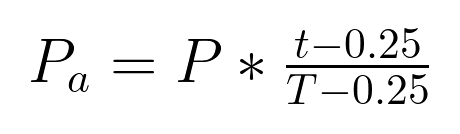
where:
- Pₐ is the value of the credit protection adjusted for maturity mismatch;
- P is the nominal amount of the credit protection, adjusted for currency mismatch if applicable;
- T is the lower of 5 and the residual maturity of the exposure expressed in years; and
- t is the lower of T and the residual maturity of the credit protection expressed in years.
The residual maturity of the underlying exposure is taken as the longest possible remaining time before the counterparty is scheduled to fulfil its obligation, taking into account any applicable grace period.
For the credit protection, embedded options that may reduce the term of the protection are taken into account so that the shortest possible effective maturity is used. In particular:
- Where a call is at the discretion of the protection seller, the residual maturity corresponds to the remaining time to the first call date.
- Where a call is at the discretion of the IAIG buying protection but the terms of the arrangement at origination contain a positive incentive for the IAIG to call the transaction before contractual maturity, the residual maturity corresponds to the remaining time to the first call date.
5.4.2.2.6 Sovereign counter-guarantees
Claims covered by a guarantee that is indirectly counter-guaranteed by a sovereign may be treated as covered by a sovereign guarantee provided that:
- The sovereign counter-guarantee covers all credit risk elements of the claim;
- Both the original guarantee and the counter-guarantee meet all the operational requirements for guarantees, except that the counter-guarantee need not be direct and explicit to the original claim; and
- The cover is robust, and there is no historical evidence suggesting that the coverage of the counter-guarantee is less than effectively equivalent to that of a direct sovereign guarantee.
5.4.2.2.7 Other items
Where an IAIG has multiple types of risk mitigation arrangements covering a single exposure, this exposure is subdivided into portions covered by each type of risk mitigation arrangement and the rating category for each portion is determined separately.
When a credit protection provided by a single protection provider has different maturities, it is subdivided into separate protections.
5.4.3 Use of external credit ratings
External credit ratings may be used for the calculation of the Credit risk charge, provided that the rating agency has published default and transition statistics extending back over a sufficiently long period of time, and satisfying six criteria related to: objectivity, independence, international access/transparency, disclosure, resources and credibility. Those criteria, as well as the required time period for which statistics need to have been published, are specified in the Level 2 text.
When external credit ratings are used in accordance with paragraph L1-133, they are mapped to ICS Rating Categories as described in section 1.4 and further specified in the Level 2 text.
The IAIG may use any ratings by a rating agency currently recognised by its home insurance regulator for local capital determination purposes, subject to clear instructions provided by the home insurance regulator on how to map those credit agency ratings to the ICS Rating Categories and explicit acceptance of the use of those ratings by the IAIS.
5.4.3.1 Eligible external credit ratings
The IAIG may use ratings produced by rating agencies other than those referred to in paragraph L1-135, provided that both of the following requirements are met:
- The rating agency is regulated or recognised by a suitable government authority in all of the jurisdictions in which the agency issues ratings that the IAIG chooses to use.
- The rating agency publishes at least annually publicly available default and transition statistics extending back at least seven years, and satisfies all of the following six criteria:
- Objectivity: the rating agency’s methodology for assigning credit assessments is rigorous, systematic, and subject to some form of validation based on historical experience. Moreover, assessments are subject to ongoing review and are responsive to changes in financial conditions. The agency has an assessment methodology for each market segment, including rigorous back testing that has been applied for at least one year and, preferably, three years.
- Independence: the rating agency is independent and is not subject to political or economic pressures that may influence the rating. The assessment process is free from any constraints that could arise in situations where the composition of the board of directors or the shareholder structure of the assessment institution may be seen as creating a conflict of interest.
- International access/Transparency: the individual assessments, the key elements underlining the assessments, and whether the issuer participated in the assessment process are made publicly available on a non-selective basis. In addition, the general procedures, methodologies and assumptions for arriving at assessments used by the rating agency are publicly available.
- Disclosure: A rating agency discloses the following information: its code of conduct; the general nature of its compensation arrangements with assessed entities; its assessment methodologies, including the definition of default, the time horizon, and the meaning of each rating; the actual default rates experienced in each assessment category; and the transitions of the assessments, eg the likelihood of AA ratings becoming A over time.
- Resources: A rating agency has sufficient resources to carry out high quality credit assessments. These resources allow for substantial ongoing contact with senior and operational levels within the entities assessed in order to add value to the credit assessments. Such assessments are based on methodologies that combine qualitative and quantitative approaches.
- Credibility: The rating agency’s external credit assessments are widely used by independent parties (investors, insurers, trading partners). In addition, the rating agency has internal procedures to prevent the misuse of confidential information.
5.4.3.2 Definition of rating categories
The mapping of the agency’s ratings to ICS RCs is based on the average of the three-year Cumulative Default Rates (CDRs) associated with the agency’s ratings, as follows:
| ICS RC | Average 3-year CDR based on over 20 years of published data | Average 3-year CDR based on between 7 and 20 years of published data |
| 1 | ||
| 2 | 0 ≤ CDR ≤ 0.15% | |
| 3 | 0.15% < CDR ≤ 0.35% | 0 ≤ CDR ≤ 0.15% |
| 4 | 0.35% < CDR ≤ 1.20% | 0.15% < CDR ≤ 0.35% |
| 5 | 1.20% < CDR ≤ 10.00% | 0.35% < CDR ≤ 1.20% |
| 6 | 10.00% < CDR ≤ 25.00% | 1.20% < CDR ≤ 10.00% |
| 7 | CDR > 25% | CDR > 10% |
5.4.3.3 Use of ratings
The IAIG chooses the rating agencies it intends to rely on and use their ratings consistently for each type of credit exposure.
Any rating used to determine an ICS RC is publicly available, ie the rating is published in an accessible form and included in the rating agency’s transition matrix.
If an IAIG is relying on multiple rating agencies and there is only one rating for a particular security, that assessment is used to determine the ICS RC. If there are two ratings from the rating agencies used by an IAIG, and those two ratings are mapped to different ICS RC, the IAIG uses the ICS RC corresponding to the lower of the two ratings. If there are three or more ratings for a security from an IAIG’s chosen rating agencies, one of the ratings that corresponds to the highest ICS RC is excluded, and the rating that corresponds to the highest rating category of those that remain is used to determine the ICS RC of the security.
Where a particular security has one or more issue-specific rating, the ICS RC for that security is based on these ratings. Otherwise, the following principles apply:
- Where the borrower has a specific rating for an issued debt security other than the one in which the IAIG has invested, an ICS RC of 4 or better on the rated security may be applied to the IAIG’s unrated investment if it ranks pari passu or senior to the rated security in all respects. If not, the credit rating cannot be used and the IAIG’s investment is treated as an unrated obligation.
- Where the borrower has an issuer rating, only senior securities issued by that issuer will benefit from an investment-grade (ICS RC 4 or better) issuer assessment; other unassessed securities issued by that issuer are treated as unrated. If either the issuer or one of its issues has an ICS RC of 5 or weaker, this rating is used to determine the ICS RC for an unrated claim on the issuer.
- Short-term assessments for a given security or facility can be used only for that security or facilities issued by that rated facility. They can neither be generalised to other short-term securities nor used to support a rating category assignment for an unrated long-term security.
- Where the rating category for an unrated exposure is based on the rating of an equivalent exposure to the borrower, a foreign currency rating may be used only for exposures denominated in that foreign currency. Domestic currency ratings, if separate, are used to determine the rating category for securities denominated in the domestic currency only.
The following additional conditions apply to the use of ratings:
- External assessments for one entity within a corporate group are not used to determine the rating category for other entities within the same group.
- No rating based on assets that the entity possesses is inferred for an unrated entity. The use of internal ratings is not allowed.
- The IAIG does not recognise collateral or guarantees in the Credit risk charge calculation if these credit enhancements have already been reflected in the issue-specific rating.
- The IAIG does not use a rating that is at least partly based on unfunded support (eg guarantees, credit enhancement or liquidity facilities) provided by the IAIG itself or one of its affiliates.
- Any assessment used takes into account the entire amount of Credit risk exposure the IAIG has with regard to all payments owed to it. In particular, if the IAIG is owed both principal and interest, the assessment fully takes into account the Credit risk associated with repayment of both principal and interest.
5.4.3.4 Exposures in default
For the purpose of the ICS, assets for which there is reasonable doubt about the timely collection of the full amount of principal or interest, including those assets that are contractually more than 90 days in arrears, are considered as defaulted exposures for the calculation of the Credit risk charge.
The exposure amount for a defaulted asset is taken net of all balance sheet write-downs and specific provisions that have been recorded for the asset.
5.5 Operational risk
The Operational risk charge is determined by applying prescribed stress factors to specified risk exposures.
The calculation of the Operational risk charge is based on data items split into geographical segments and the following line of business segments:
- Non-Life – insurance products that do not relate to life or similar to life health insurance, often referred to as property and casualty or general insurance;
- Life (risk) – insurance products that relate to life or similar to life health insurance where the insurer bears investment risk; and
- Life (non-risk) – products where the policyholder bears the investment risk.
The exposures and stress factors for Operational risk are specified in the Level 2 text.
The Operational risk charge is calculated as follows:
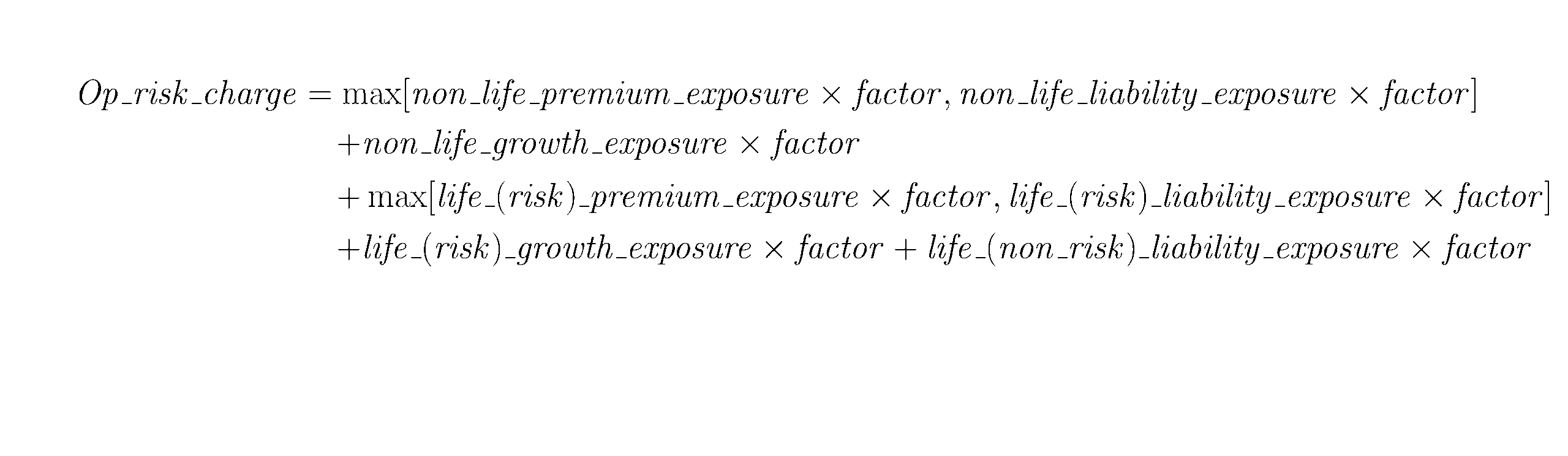
The Operational risk components are computed as factors multiplied by risk exposures. The same factors are applied across geographical segments as defined in section 5.1.2.
The exposures and stress factors for Operational risk are specified in the following table.
| Premium | Growth | Liabilities | |
| Risk from Non-Life Operations | Risk from Non-Life Operations | Risk from Non-Life Operations | Risk from Non-Life Operations |
| Exposure | Gross written premium (GWP) in most recent financial year |
GWP in most recent financial year in excess of the growth threshold (20%) compared to the previous year’s GWP |
Gross current estimate |
| Factor | 2.75% | 2.75% | 2.75% |
| Risk from Life Operations | Risk from Life Operations | Risk from Life Operations | Risk from Life Operations |
| Exposure | Life (risk): GWP in most recent financial year |
Life (risk): GWP in most recent financial year in excess of the growth threshold (20%) compared to the previous year’s GWP |
Life (risk): Gross current estimate Life (non-risk): Gross current estimate |
| Factor | Life (risk): 4% | Life (risk): 4% | Life (risk): 0.45% Life (non-risk): 0.40% |
GWP includes all business (new and renewal) written during the specified financial year before any allowance for reinsurance or other related recoverables. For single premium policies, premiums are included in full as written during the year. For other insurance policies, GWP includes premiums due to the IAIG during the specified time period (financial year) on all business in-force.
Gross current estimates are considered before any allowance for reinsurance or other related recoverables.
To calculate the growth risk component of Operational risk, the GWP for the two most recent financial years for non-life and life (risk) are used. The figures are considered before the effect of ceded reinsurance and on a consolidated basis.
Explanatory Texts
60. Non-Life insurance products include auto/motor, property, workers’ compensation/employer’s liability, other liability, and credit/ surety/pecuniary.
61. Life (risk) insurance products include individual life, group life, group pension and annuities (with a life aspect).
62. Life (non-risk) products may be labelled as savings without guarantees or living benefits.
5.6 Aggregation / diversification of ICS risk charges
ICS Risk charges are aggregated together using multiple levels:
- A top-level aggregation between major risk categories (Life risk, Non-life risk, Catastrophe risk, Market risk, Credit risk and Operational risk) using a correlation matrix;
- A medium-level aggregation between the sub-risks of Life risk, Catastrophe risk and Market risk, using correlation matrices; and
- An aggregation within individual risk charges (eg interest rate risk, non-life risk).
The aggregation of risk charges incorporates a degree of diversification between the individual risks, based on a specified dependency between the risks.
Correlation matrices are specified for the aggregation of the individual Life Risk charges and the aggregation of individual Market risks charges. A top-level correlation matrix is specified for the aggregation of Life, Non-Life, Catastrophe, Market and Credit risk charges. The Operational risk charge is then added to that aggregate to determine the overall ICS insurance risk charge.
The correlation matrices used to aggregate the ICS risk charges are specified in the Level 2 text. The aggregation approach used within individual risk charges is described in the specific risk section in the Level 1 and 2 texts.
The top-level aggregation matrix between major risk categories is:
| Life | Non-life | Catastrophe | Market | Credit | |
| Life | 100% | 0% | 25% | 25% | 25% |
| Non-life | 0% | 100% | 25% | 25% | 25% |
| Catastrophe | 25% | 25% | 100% | 25% | 25% |
| Market | 25% | 25% | 25% | 100% | 25% |
| Credit | 25% | 25% | 25% | 25% | 100% |
5.7 Non-insurance risk charges
The ICS capital requirement includes a risk charge for non-insurance entities, to be added to the capital requirement calculated as described in sections 5.1 to 5.6. The calculation of the non-insurance risk charges is specified in the Level 2 text.
For financial non-insurance entities with a sectoral capital requirement, the capital requirement is calculated as follows:
- For consolidated banking entities, the capital requirement is calculated in accordance with the Basel regime.
- For consolidated non-banking entities, it is equal to the following:
- The maximum of the sectoral capital requirement and 15% of three-year average gross income.29; or
- At the group wide supervisor’s request, the maximum of the sectoral capital requirement and the Operational Risk Capital Requirement as calculated under the Basel regime calculation for operational risk.30 If additional, material risks of the entity are not appropriately captured by either operational risk-type charge, the group wide supervisor may require an additional risk charge to cover these risks.
If neither i. nor ii. appropriately captures additional material risks to the overall group, the group wide supervisor imposes an additional capital charge to i. or ii. to cover these risks.
- For banking entities reported as an equity method investment, it is equal to the sectoral charge in proportion of voting rights or capital ownership.
- For non-banking entities reported as an equity method investment it is equal to the following, in proportion of voting rights or capital ownership:
- The maximum of the sectoral capital requirement and 15% of three-year average gross income; or
- At the group wide supervisor’s request, the maximum of the sectoral capital requirement and the Operational Risk Capital Requirement as calculated under the Basel regime calculation for operational risk.30
If neither i. nor ii. appropriately captures additional material risks to the overall group, the group wide supervisor imposes an additional capital charge to i. or ii. to cover these risks.
- For both banking and non-banking entities reported as a market value investment it is equal to the equity charge on the investment as described in section 5.3.4.
29 For asset managers, gross income relates only to third-party asset management, not the management of the IAIG’s own assets where the risk is captured elsewhere. Gross income is defined in paragraph 650 of Basel II Comprehensive version (https://www.bis.org/publ/bcbs128.pdf).
30 The Basel III calculation for operational risk capital requirement is specified in the following document:https://www.bis.org/basel_framework/chapter/OPE/25.htm?inforce=20230101&published=20221208&export=pdf
For financial non-insurance entities without a sectoral capital requirement, the capital requirement is as follows:
- For consolidated banking entities, it is equal to 4% of the exposure as determined by the leverage ratio as calculated under the Basel regime.
- For consolidated non-banking entities, it is equal to the following:
- 15% of three-year average gross income; or
- At the group wide supervisor’s request, the Operational Risk Capital Requirement as calculated under the Basel regime calculation for operational risk.³⁰
If neither i. nor ii. appropriately captures additional material risks to the overall group, the group wide supervisor imposes an additional capital charge to i. or ii. to cover these risks.
- For banking entities reported as an equity method investment it is equal to the sectoral leverage ratio in proportion of voting rights or capital ownership.
- For non-banking entities reported as an equity method investment it is equal to the following, in proportion of voting rights or capital ownership:
- 15% of three-year average gross income; or
- At the group wide supervisor’s request, the Operational Capital Requirement as calculated under the Basel regime calculation for operational risk.³⁰
If neither i. nor ii. appropriately captures additional material risks to the overall group, the group wide supervisor imposes an additional capital charge to i. or ii. to cover these risks.
- For both banking and non-banking entities reported as a market value investment it is equal to the equity charge on the investment as described in section 5.3.4.
For non-financial entities, the capital requirement is equal to the equity risk charge as described in paragraph L2-226, a) to d), applied to the net asset value if consolidated, equity method or market value investment. For net asset values or equity method investments with a negative value, the equity risk charge is calculated based on the absolute value of the investment and does not exceed the maximum potential loss. If an equity risk charge does not appropriately capture all material risks to the overall group, the group wide supervisor imposes an additional capital charge to cover these risks.
6 Tax
6.1 General principles
Deferred taxes, as recognised on the consolidated GAAP or SAP balance sheet (“consolidated GAAP”), are also recognised on the ICS balance sheet. DTA and DTL on the consolidated GAAP are reported the same way on the ICS balance sheet, whether that be two numbers or a single number.
There are two areas of the ICS that are tax affected:
- Differences in valuation between the consolidated GAAP and the ICS balance sheet (ICS Adjustment), made in accordance with section 3.1; and
- The ICS insurance capital requirement.
The ICS applies a group level calculation using a group effective tax rate (G-ETR) to calculate the change in deferred tax resulting from the ICS Adjustment and the tax effect on the ICS insurance capital requirement.
The method to calculate the G-ETR is specified in the Level 2 text.
The G-ETR is calculated as a weighted average effective tax rate, weighted using the previous three-year average of GAAP earnings before tax on a sub-group/entity level basis. The scope of the weighted average calculation is limited to insurance-related activities, and GAAP earnings before tax is floored at zero.
Statutory tax rates that have been enacted or substantially enacted as of the reporting date are used for the G-ETR calculation.31
31 For example, a tax authority announces tax rate changes that would have a material impact for future periods. In such a case,the newly announced statutory tax rate is used in the G-ETR calculation.
Example
G-ETR calculation
An insurance group consists of the following entities located in different jurisdictions:
- Entity A: Insurance entity in country X
- Entity B: Insurance entity in country Y
- Entity C: Reinsurance entity in country Z
- Entity D: Banking entity in country Z
| Group entities | Effective tax rate | GAAP Earnings before tax | ||
|---|---|---|---|---|
| FY2016 | FY2017 | FY2018 | ||
| Entity A | 30% | 500 | 700 | -200 |
| Entity B | 25% | 1,000 | -100 | 900 |
| Entity C | 20% | 2,000 | 500 | 1,500 |
| Entity D | 20% | 200 | 500 | 300 |
- GAAP losses for Entity A in FY2018 and Entity B in FY2017 should be floored at zero.
- Entity D conducts non-insurance related activities, and should be excluded from the G-ETR calculation.
The G-ETR for this insurance group:
(30% * (500 + 700 + 0) + 25% * (1,000 + 0 + 900) + 20% * (2,000 + 500 + 1,500)) / 7,100
= 23.03%
6.2 Deferred tax resulting from the ICS Adjustment
The valuation adjustments made to the consolidated GAAP in order to derive the ICS balance sheet give rise to corresponding adjustments to deferred tax assets and liabilities. Any additional DTAs, created as a consequence of the ICS Adjustment, are subject to an utilisation assessment. The conditions of calculation and recognition of those deferred tax adjustments, including the utilisation assessment, are specified in the Level 2 text.
The adjustment to deferred tax is determined for each balance sheet line item that has been adjusted in order to arrive at the ICS balance sheet. Line items may yield an adjustment to deferred tax asset, deferred tax liability or no adjustment to deferred tax depending on the tax treatment of the line item. No adjustment for tax is made where the change in a line item, or component of a line item, does not result in a temporary tax difference (eg equity line items, line items representing permanent tax differences such as items that may not be expensed or generate revenue that is exempt for tax purposes). These line items or components of line items are excluded from the deferred tax adjustment calculation.
The deferred tax adjustment is calculated on a line by line basis. For all lines or components of lines, other than MOCE, where the adjustment creates a tax impact, the deferred tax is then calculated by multiplying the tax effected difference between consolidated GAAP and ICS balances by the G-ETR (as specified in paragraphs L2-339 and L2-340). The sum of DTA and the sum of DTL resulting from this line by line calculation are reported separately. The consolidated GAAP deferred tax is adjusted by the net outcome of the deferred tax resulting from the ICS Adjustment.
The MOCE is included as an ICS Adjustment and creates a DTA on the ICS balance sheet.
6.2.1 Utilisation assessment of DTAs recognised from the ICS Adjustment
Before the utilisation assessment, the DTA recognised from the ICS Adjustment is the sum of DTAs resulting from the line by line calculation specified in paragraph L2-342 and the DTA on MOCE specified in paragraph L2-343.
The DTA recognised from the ICS Adjustment after the utilisation assessment is limited to a + max (0, b – c – d), where:
- The sum of DTLs resulting from the line by line calculation specified in paragraph L2-342;
- Consolidated GAAP DTL;
- GAAP DTL netted from assets deducted from Tier 1 capital resources, as specified in paragraph L1-63; and
- Consolidated GAAP DTA.
The consolidated GAAP DTL and DTA referred to in paragraph L2-345 are limited to DTL and DTA reported from insurance-related activities.
6.3 Tax effect on the ICS insurance capital requirement
The mitigating effect of tax is taken into account when determining the ICS capital requirement. That tax effect on the ICS capital requirement is based on the increase in net DTA that would result from an instantaneous operational loss equal to the ICS capital requirement before tax, post diversification and post management actions. Any increase in net DTA is subject to a utilisation assessment as specified below.
The ICS insurance capital requirement is reduced by the amount of utilisable tax effect.
By default, the utilisable tax effect on the ICS insurance capital requirement is calculated as: 80% * notional tax effect on insurance capital requirement
where:
- notional tax effect on insurance capital requirement = ICS insurance capital requirement × G-ETR;
When deemed appropriate by the group-wide supervisor, a limit to the utilisation of the tax effect on the ICS insurance capital requirement may be set. The utilisable tax effect on the ICS insurance capital requirement is then calculated using the following formula:

where:
- notional tax effect on insurance capital requirement = ICS insurance capital requirement × G-ETR;
- a = 85% * ΣTax sub-group/entities min (Tax loss carry back capacity, Allocated notional tax effect on insurance capital requirement32)
- b = post-stress future taxable income × G-ETR;
- c = max (0, DTL for insurance-related activities on ICS balance sheet post-deduction in paragraph L2-353 – DTA for insurance-related activities on ICS balance sheet); and
- d = max [0, min(15% × ICS insurance capital requirement, DTA for insurance-related activities on ICS balance sheet – DTL for insurance-related activities on ICS balance sheet post-deduction in paragraph L2-353)].
32 Allocated notional tax effect on insurance capital requirement – refer to paragraph L2-351.
6.3.1 Component a: tax loss carry backs
A tax loss carry back is defined as a mechanism allowing a sub-group/entity to offset current net operating losses against tax obligations from previous years (whether tax loss carry backs are allowed and the number of years allowed differs by tax jurisdiction).
In order to perform the calculation of component a in the utilisable tax effect:
- The tax loss carry back capacity for insurance-related activities is evaluated at the legal entity or sub-group level where taxes are assessed, including any fiscal unity for corporate tax as of the ICS reporting date.
- The notional tax effect on the ICS insurance capital requirement is allocated between tax sub-groups/entities using a weighted average based on consolidated GAAP insurance liabilities.
6.3.2 Component b: post-stress future taxable income projections
In order to perform the calculation of component b in the utilisable tax effect:
- When the IAIG projects consolidated GAAP net losses for the cumulative five-year period, component b is set to zero.
- Otherwise, component b is approximated by 50% of the total historical five years’ consolidated GAAP earnings before tax, adjusted for mergers, acquisitions and dispositions.
6.3.3 Components c and d: Deferred taxes
DTL used in components c and d represent the amount after the application of deferred tax from the ICS Adjustment, as described in section 6.2 and after deduction of the DTL for insurance-related activities associated with assets subject to deduction from Tier 1 capital resources (see section 4.4.1).
Example
Utilisable tax effect on the ICS insurance capital requirement calculation
An insurance group has insurance-related activities in the US, UK, Korea and Japan and does not apply a fiscal unity:
- Insurance capital requirement: 10,000
- G-ETR: 30%
- Notional tax effect on the insurance capital requirement: 3,000 (10,000 * 30%)
- DTA on ICS balance sheet: 300 (insurance activities 250, non-insurance activities 50)
- DTL on ICS balance sheet: 850 (insurance activities 700, non-insurance activities 150)
Component a: tax loss carry-backs
| US | UK | Korea | Japan | Total | |
|---|---|---|---|---|---|
| GAAP insurance liabilities | 8,000 | 2,000 | 6,000 | 4,000 | 20,000 |
| a. Allocated notional tax effect on insurance capital requirement | 1,200 | 300 | 900 | 600 | 3,000 |
| b. Maximum tax loss carry back | 100 | 1,000 | n/a | n/a | 1,100 |
| Limited maximum tax loss carry back before the 15% deduction (min (a,b)) | 100 | 300 | n/a | n/a | 400 |
Tax loss carry backs for the utilisation assessment: 340 = 400 * (1-15%)
Component b: post-stress future taxable income projections
- Total of the last five years of consolidated GAAP earnings before tax: 8,000
- IAIG acquired an entity during the five-year period. Earnings before tax of the entity at the beginning of the period before being acquired: 100
Post-stress future taxable income projection from insurance business for the utilisation assessment: 1,215 = (8,000+100) * 30% * 50%
Components c and d: deferred taxes
Net deferred tax liability for insurance activities: 450 = max (0, 700-250)
Net deferred tax asset for insurance activities: 0 = max [0, min (15% * 10,000, 250 – 700)]
Utilisable tax effect on the ICS insurance capital requirement calculation:
Tax loss carry backs (340) + post-stress future taxable income projections (1,215) + Net DTL for insurance activities (450) – Net DTA for insurance activities (0) = 2,005
Utilisable tax effect on the insurance capital requirement: 2,005 = min (80% * 3,000, 2,005)
7 Capital requirement – Other Methods
7.1 General principles
The scope of Other Methods is limited to the capital requirement. When Other Methods are used, the valuation and capital resources elements of the ICS remain subject to the provisions set in sections 5 and 6 respectively. Other Methods provide the same level of protection as the standard method, with target criteria of 99.5% VaR over a one-year time horizon.
Other Methods permitted are:
- Supervisor-owned and controlled credit assessment processes; and
- Internal models.
Explanatory Text
63. IAIGs that are able to use NAIC Designations should calculate and report the Credit risk charges using the following mapping table, for unrated exposures. The mapping table has been updated from the 2022 data collection exercise to reflect the broader range of NAIC designations that became effective as of year-end 2021, and now includes the designation modifiers (A-G) for exposures in category 1. Each designation has been mapped to the most relevant ICS rating category.
7.2 Supervisory Owned and Controlled Credit Assessments (SOCCA)
A SOCCA process is an independent and objective process for assessing Credit risk, owned and controlled by a financial supervisory a, and that relies upon credit assessment methodologies deemed suitable by the supervisory authority in determining the regulatory a requirement for Credit risk of supervised entities. An example of a SOCCA is NAIC Designations. The criteria for a SOCCA process to be recognised in the ICS are specified in the Level 2 text.
A SOCCA process may be used for the calculation of the Credit risk charge for unrated exposures if all the following criteria are met:
- Objectivity: The SOCCA’s methodology for assigning credit assessments is rigorous, systematic, and subject to some form of validation. Moreover, assessments are subject to ongoing review and responsive to changes in financial condition.
- Independence: The SOCCA process is aligned with the regulatory objectives of the supervisor, evidenced by the supervisor’s approval of the credit assessment process. Any outsourcing arrangement of the credit assessment is held to the same standards of competency and independence as the in-house credit assessment processes.
- International access/transparency: an IAIG with operations outside the jurisdiction of the SOCCA process can request designations/ratings be assigned to securities they own. Public access to the credit assessment is available through third-party platforms.
- Disclosure: Default statistics over time are developed for each designation/rating so that three-year cumulative default rates (CDRs) can be derived from published statistics.
- Resources: Staff has appropriate qualifications and experience to undertake the credit assessment process. The SOCCA process relies on adequate resources to carry out the credit assessments required by the supervisor.
- Credibility: The SOCCA process relies on internal procedures to prevent the misuse of confidential information. The SOCCA process has at least 10 years of demonstrable business history in assessing the Credit risk of a large number of securities such that statistical performance data can be derived. All designations/ratings are updated at least on a yearly basis; in addition, the designations/ratings are reviewed as soon as a significant event occurs that may affect them.
- Alignment of interests with the purposes of prudential supervision: The entity performing the credit assessment is fully owned and controlled by a supervisory authority. There are policies approved by the supervisory authority as to how the credit assessment process is applied.
7.3 Internal models
7.3.1 Overall requirements
Whenever internal models are allowed as an Other Method for calculating the ICS capital requirement, the group-wide supervisor (GWS) considers how the Balance Sheet, used within the internal model, complies with the requirements for the calculation of the balance sheet in the standard method, currently set out within section 3 on Market-Adjusted Valuation. In doing so, the GWS should ensure consistency between the approaches used for the determination of capital requirements and capital resources.
Whenever internal models are allowed as an Other Method for calculating the ICS capital requirement, their use is subject to the requirements specified in sections 7.3.2 to 7.3.5.
7.3.2 General provisions on the use of an internal model to determine regulatory capital requirements
7.3.2.1 Internal model approval process
7.3.2.1.1 Framework for application and review process
The GWS sets up an internal model application process (IMAP). The IMAP enables the GWS to decide whether the IAIG may use a specified internal model to calculate its group-wide PCR under the ICS.
The GWS ensures that the IMAP is open by allowing any IAIG under its supervision to apply for the use of an internal model to calculate its PCR and by stating, as the case may be, the basis for its decision to reject the application.
The GWS is responsible for the decision to approve or reject the IM application of an IAIG under its supervision.
The GWS may wish to consult with other members of the supervisory college on the review process, the outcome of the application process and the on-going supervision.
Finally, a model is not considered for approval unless the IAIG can demonstrate a comprehensive and effective approach to risk management which includes establishing and successfully achieving an internal capital target greater than the regulatory capital requirement as indicated by the internal model.
7.3.2.1.1.1 Pre-application process
The GWS may choose to develop a pre-application process to indicate the IAIG’s preparedness to undergo an internal model review and outline criteria that should be satisfied before an internal model application. The process may consist of the IAIG’s submission and the GWS’s review of the following four items:
- Self-Assessment – consists of a number of qualitative and quantitative affirmations, with a brief narrative explaining how the statistical quality test, calibration test, validation standards, use test, governance and documentation standards are met;
- Overview of internal model – provides the GWS with an introduction to the model and its role within the IAIG’s risk management framework;
- Model Demonstration – provides a high-level overview of the internal model’s functionality; and
- Documentation Gap Analysis – initial assessment of an IAIG’s ability to satisfy the GWS’s information request.
The pre-application process aims to indicate the IAIG’s preparedness to undergo an internal model review and is not necessarily an indication of internal model approval. The GWS may provide feedback regarding any significant internal model deficiencies as soon as possible during the pre-application and review processes so that the IAIG may have the opportunity to resolve these issues before the start of the application process.
7.3.2.1.1.2 Application process
The internal model application and review process can comprise several stages, including at least the following:
- Application for internal model approval – an application for the approval from the GWS to use a specified internal model for the determination of the group-wide PCR of the IAIG;
- Provision of information – quantitative and qualitative information as specified by the GWS;
- Internal model review process – thorough model review by the GWS on an on-site and/or off-site basis, with extensive dialogue and requests for supplemental information;
- Decision on the outcome of the process; and
- Communication of results – communication relating to the GWS assessment of IAIG’s internal model and response to the application to use the internal model for the calculation of the group-wide PCR.
7.3.2.1.1.2.1 Application for internal model approval
Upon completion of the pre-application process, if any, and confirmation of the GWS, the IAIG may proceed with a formal application for the approval of its internal model. Depending on the GWS’ request, the application may include:
- A cover letter requesting the approval to use internal model to calculate the group-wide PCR starting from a specified target date signed by the Board of Directors or its representative; with a statement confirming that the information is accurate and complete and that no relevant facts were omitted; a general explanation of the model, including its structure, scope, and how it should be integrated into the standard method to calculate the group-wide PCR in case of a partial internal model; and the contact details for relevant personnel to whom additional information requests can be submitted;
- An explanation of how the IAIG meets the criteria of the statistical quality test, calibration test, validation standards, use test, governance and documentation standards;
- An explanation of the model and how all material and quantifiable risks of the IAIG are covered;
- For partial internal model:
- an explanation of the model;
- demonstration that all material and quantifiable risks of the scope are covered;
- the reason for the limited scope; and
- plan for the expansion of the scope, if any
- A justification of risks not covered by the model but considered in the standard method taking into consideration materiality;
- The allocation of the risks in the internal model according to the risks categories of the ICS standard method;
- An assessment of the proposed approach’s material strengths, weaknesses, and limitations to determine the group-wide PCR. The identified weaknesses and limitations should be accompanied by a plan on how to mitigate them;
- An inventory of all the documents and sets of evidence included in the application organised in a clear manner to a knowledgeable third party;
- The technical documentation of the internal model;
- The results of the proposed approach to calculating the group-wide PCR and the results of the ICS standard method of the last three years;
- A plan for information disclosure to stakeholders;
- The results of the profit and loss attribution of the last three years;
- A log file with the model changes
- Planned future changes;
- A log file with the validation findings; and
- A proposal for model change policy.
The documents for the application should be complete and allow a knowledgeable third party to understand the multiple dimensions of the model and collect evidence for the assessment, seeking to minimise additional document requests by the GWS. They should include, but are not limited to:
- the technical specifications of the model, and justification of the modelling choices;
- all relevant policies and guidelines related to different aspects of the model, including governance, calibration and validation;
- evidence of compliance with the governance and guidelines, model use and validation; and
- Integration in the ICS standard method in the case of partial internal model.
7.3.2.1.1.2.2 Provision of information
For the GWS to properly consider an internal model application, the IAIG should provide complete and timely responses to all quantitative and qualitative information requests.
The information submission process can comprise several stages and include:
- a standardised information request to be completed at the time of application
- a more specific request of information, which will take into account the IAIG’s unique attributes, to be completed soon after the application is submitted; and
- supplemental requests are to be completed at various stages during the review process to further assist in evaluating the IAIG’s internal model.
7.3.2.1.1.2.3 Internal model review process
The review process involves off-site monitoring and may involve on-site inspections.
The internal model review process is expected to include the following elements:
- review of any documentation related to the internal model;
- review of responses to information requests;
- detailed model demonstrations by the IAIG; and
- discussions with the IAIG’s management and staff.
As part of the internal model review, the IAIG is required to provide a comparison of the group-wide PCR calculated using the internal model with the one resulting from the ICS standard method at the time of the internal model review.
Also, the GWS approves the allocation of the risks in the internal model according to the risks categories of the ICS standard method. The IAIG is able to identify the risks not covered by the model but considered in the standard method and provide justification for not including these risks in the internal model.
7.3.2.1.1.2.4 Interaction with supervisory college
During the internal model approval process, the GWS keeps the supervisory college informed of the status of the process and collect relevant views from other involved supervisors, e.g., local specificities such as tax rules and product features. Whilst the GWS may consider any information received from other involved supervisors, the GWS retains the responsibility to decide on the internal model application concerning the IAIG.
7.3.2.1.1.2.5 Decision on the outcome of the process
Below are listed the possible outcomes of the process:
- Approved;
- Not approved; and
- Approved conditionally
Should the application be approved, the GWS states the effective date and any applicable conditions. The GWS may approve conditionally and allow the IAIG to commence using its internal model to calculate the PCR if the areas that require further improvement or review do not prevent the approval of the IAIG’s internal model application. Conditions may include capital floors based on the ICS, more conservative model parameters or design features, capital add-ons or further reviews by the GWS, the IAIG or a third party.
If the application is unlikely to be approved, GWS communicates this to the IAIG so the latter can resolve the issues in a reasonable timeframe. If the identified issues cannot be resolved within a reasonable time, the GWS does not approve the internal model application.
7.3.2.1.1.2.6 Communication of the outcome of the decision
Before communicating the results to the IAIG, the GWS shares the results of its findings with the supervisory college to see if any issues need to be addressed. Moreover, the GWS discloses to the supervisory college the justification of risks not covered by the model but considered in the standard method.
After the review process is complete, the GWS sends a formal response to the IAIG regarding the application to use the proposed internal model to calculate its group-wide PCR.
If the internal model is approved, the GWS works with the IAIG to communicate the decision to the public. Particular attention should be given to the clarity of the approved internal model’s scope and the differences with the ICS standard method’s underlying assumptions when possible. If the IAIG uses an approved internal model, it does not revert to using the standard method to calculate the PCR unless authorised and/or directed by the GWS to do so.
7.3.2.2 Post-approval monitoring and control process
Following approval of an internal model for calculating the group-wide PCR, the GWS requires some additional reporting regarding the internal model. The GWS conducts periodic reviews to ensure that the internal model continues to meet the criteria of statistical quality test, calibration test, validation standards, use test, governance and documentation standards.
Post-approval reporting will enable the GWS to monitor internal model developments and conduct relevant analysis and benchmarking exercises. The GWS should include the elements necessary for benchmarking exercise in the information request.
Specific reporting requirements relating to the internal model will be established during the model review process. The GWS works with the IAIG in developing data submission templates for post-approval reporting purposes. While most reporting will be required annually, some circumstances may require more frequent filings. Reporting requirements may include:
- standard periodic internal model output;
- ICS standard method output;
- narrative discussing previous and future planned changes and developments to the internal model;
- updated model documentation; and
- new or updated validation reports.
The IAIG cooperates with the GWS to establish an appropriate policy relating to post-approval monitoring and reporting major and minor changes, including the materiality threshold in relation to major and minor model modifications as described in section 7.3.4.1 on the model change policy.
Moreover, the GWS ensures that the IAIG establishes an appropriate policy relating to communication and public disclosure on model results and changes post-approval.
As part of the supervisory process the GWS reviews the model post approval regularly to assess whether the internal model deviates from the assumptions, portfolio characteristics, structure or parameterisation used in previously approved versions, and ad-hoc reviews in case such deviations have been identified.
Where relevant, the post-approval internal model reviews by the GWS will focus on the portions of the internal model that have changed. However, the GWS reserves the right to conduct a comprehensive review on an already approved internal model at its discretion and may resort to a capital add-on in case the deviation is material.
Should any conditions of an internal model approval be breached, the GWS may allow the IAIG a reasonable time to correct such breach and work with the IAIG to resolve any issues. If these outstanding issues cannot be corrected within the allotted time, the GWS may revoke its approval of the internal model.
In the event that the GWS revokes approval of an internal model, the affected IAIG may reapply once all internal model deficiencies have been resolved.
The GWS should cooperate with other involved supervisors as part of its internal model supervisory review. The GWS should engage in collaborative model review efforts with other members of the supervisory college to maximise the effectiveness and consistency of outcomes of the ICS.
7.3.3 Criteria for internal model approval
The IAIG is responsible to ensure and provide evidence that the model complies with all the requirements in this section and the GWS should be satisfied that these requirements are met.
7.3.3.1 Statistical quality test
7.3.3.1.1 Scope, theory and structure of the internal model
The scope of the internal model is complete by including all material quantifiable risks in assets, liabilities, legal entities and lines of business within its intended scope. The methods used in the internal model are based upon current and credible information and realistic assumptions.
The data used is accurate, complete and appropriate. The parameterisation approach is well justified, consistently implemented, tested and documented. The documentation of the scope of the internal model covers how materiality has been assessed.
The base quantitative methodology of the internal model is in line with generally accepted market practice and robust actuarial and statistical theory. More specifically, the methodology and technology implementation used for this should be perceived as an industry standard or better.
The structure of the model is clear, logical and consistent with how business is managed.
The IAIG explains the appropriateness of the chosen methodology taking into consideration the nature, scale and complexity of the risks.
In addition, for everything within the scope of the internal model, the IAIG has demonstrated an approach to differentiate between the materiality of the risks being taken by the IAIG. The internal model allows for changes in the risk profile over time adapt to foreseeable risks, which can be achieved by parameterisation or model changes. If future management actions are considered, they follow the principles below:
- be objective, realistic and verifiable;
- They cannot be contrary to the IAIG’s obligations to policyholders or legal provisions applicable to the IAIG;
- Are consistent with the IAIG’s current business practice and business strategy unless the GWS is satisfied that there is sufficient evidence that the IAIG will change its practices or strategy;
- Can reasonably be expected to be carried out under the specific circumstances to which they apply; and
- The assumptions about future management actions take into account the time needed to implement them, as well as any resulting incremental expenses.
Risk mitigation techniques may be recognised in the ICS risk charges provided they meet the requirements specified in the Level 2 text.
In order to be recognised, a risk-mitigation technique should meet the following criteria:
- The risk mitigation technique is effective and legally enforceable in all relevant jurisdictions and results in an effective transfer of risk to a third party;
- The contractual arrangement has been reviewed to ensure that the risk transfer is clearly defined;
- The calculation of the ICS risk charges allows for the effects of risk mitigation techniques through a reduction of the risk charge commensurate with the extent of risk mitigation. That reduction makes a reasonable allowance for any basis risk effects due to changes in risk mitigation assumptions and relationships including during tail events, and there is an appropriate treatment for any corresponding risk embedded in the use of risk mitigation techniques (eg counterparty default). These two effects are treated separately;
- There is no double-counting of mitigation effects;
- The documentation for the arrangement sets out a direct claim on the IAIG’s counterparty in the event of its default, insolvency, bankruptcy or other credit events; and
- Consideration of the credit quality of the providers of the risk mitigation is made within the internal model.
The methodology to calculate the ICS capital requirement are consistent with the methods to calculate the ICS balance sheet. The initial balance sheet of the internal model reconciles with the ICS balance sheet.
The IAIG decides the best way to consolidate and account for the risks to the whole of its business.
The determination of overall regulatory capital requirements with the internal model considers dependencies within and across risk categories. Key variables leading to dependencies must be identified and modelled, tail dependencies and non-linear effects must be adequately captured. Where the internal model allows for diversification effects, the IAIG justifies its allowance for diversification effects and demonstrate that it has considered whether dependencies may increase under stressed circumstances.
7.3.3.1.2 Assumptions
The main assumptions of the model have a sound theoretical and empirical justification, including the circumstances under which the assumptions would be considered false and provide a rationale for not using alternatives.
Where simplifying assumptions are used, this is clearly defined and documented.
7.3.3.1.3 Data
The length of data has sufficient historical information to assess the characteristics of the underlying risks, and no relevant data is excluded from the use in the model without justification. Where historical data is deemed insufficient, this may be complemented with expert judgment.
The data is accurate and consistent, free of material errors and recorded consistently over time, and is part of the validation process.
The data is appropriate, fit for its purposes and reflect the relevant risks to which the IAIG is exposed.
Nonetheless, the model still allows for outcomes not directly observed in past data but to which the IAIG may be exposed in the future, eg new business classes or tail risks.
In addition, data extensions, capping or modification is documented and justified. The process for dealing with outliers and data-smoothing is performed in a way that does not materially underestimate the actual volatility of the risk.
The data used for estimations is up-to-date, recorded on time and updated at least annually, and the IAIG minimises the gap between the end-of sample data and the calibration date.
The IAIG has a data policy that is consistent with the provisions above and demonstrate that they comply with it.
7.3.3.1.4 Parametrisation
The parameterisation methods are in line with appropriate actuarial and statistical practices. The latter includes an explanation for the input and the reasoning for the selection among several candidates.
When parameterisation is made using expert judgment, this is in compliance with the IAIG’s policy on expert judgment.
Parameterisation results are reasonable, up-to-date and validated. The IAIG defines minimum fitting requirements, such as R², chi-square statistics, q-q plots, residual analysis, whenever possible. Whenever appropriate, the IAIG performs stress testing and sensitivity analysis when choosing model parameters. Parameter risks are taken into consideration whenever material.
The parameterisation is reviewed at least once a year. In the event of material differences in the parameters between exercises, this is explained and justified.
7.3.3.2 Calibration test
The IAIG may use a different confidence level, risk measure or time horizon than Value-at-Risk (VaR) at 99.5% confidence level over the one-year time horizon for internal modelling purposes as long as the outputs of the internal model can be used by the IAIG to calculate the ICS Requirement in a manner that provides policyholders and beneficiaries with an equivalent or higher level of protection.
Where the IAIG uses a different confidence level, risk measure or time horizon than the one set out for the ICS standard method, capital requirement calculations provide evidence on how the model outcomes compare to the ICS target criterion (ie VaR 99.5% over a one-year time horizon).
Where the IAIG cannot derive the ICS capital requirement directly from the probability distribution forecast generated by the internal model, the GWS may allow approximations to be used in the process to calculate the ICS capital requirement, as long the IAIG can demonstrate to the GWS that policyholders are provided with a level of protection at least equivalent to VaR at 99.5% confidence level over the one-year time horizon.
7.3.3.3 Use test and governance
The IAIG explains the different uses of their internal model and how they ensure consistency between the different outputs where the internal model is used for different purposes.
The internal model is adequately fit to the way business and risks are managed:
- The modelling approaches reflect the nature, scale and complexity of the risks inherent in the activities of the IAIG, which are within the scope of the internal model;
- The outputs of the internal model and the content of the internal and external reporting of the IAIG are consistent; and
- The internal model is capable of producing outputs that are sufficiently granular to play an important role in the relevant management decisions of the IAIG. Furthermore, IAIG are able to run the model in a promptly and timely manner, in case model outputs are need to decision-making outside form the usual reporting timeline.
The model is widely used and plays an important role in the system of governance of the IAIG and how business and risk are managed.
The model is used, but not limited to, for example in:
- Strategic and business planning and business management;
- Risk management, economic capital calculation, and own risk and solvency assessment;
- Risk appetite setting;
- Measurement of risk-adjusted performance and performance management;
- Reporting, decision making, communication and feedback loop development; and
- The internal model is sufficiently used in profit and loss (P&L) attribution.
Profit and loss (P&L) attribution compares the internal model’s predicted profit and loss with the actual profit and loss incurred.
The IAIG should demonstrate that the model is fully embedded in its operational and organisational structure and confirm that it remains valid and is applied consistently over time.
The Board and Executive Management of the IAIG are able to demonstrate an overall understanding of the internal model including their major assumptions, strengths and limitations.
The persons who effectively run (Executive and Senior Management) the IAIG and staff who run the internal model are able to demonstrate a sufficiently detailed understanding of the parts of the internal model used in the area for which they are responsible.
The Board, executive and senior management receives appropriate training on the internal model.
7.3.3.3.1 Model governance
Model governance structure, roles, and responsibilities are clearly defined by the IAIG and considered appropriate by the GWS.
The IAIG Board is responsible for ensuring the ongoing appropriateness of the design and operations of the internal model and that the internal model continues to appropriately reflect the risk profile of the IAIG.
The Board may delegate its responsibility for the ongoing maintenance, use, application and validation of the internal model to the risk management function, or senior management and staff, possessing relevant expertise and no conflicts of interest. The model’s governance structure is clearly defined and documented, and this includes reporting lines, allocation of responsibilities and escalation paths.
The IAIG has documented procedures for appropriate segregation of duties between those responsible for building, operating and maintaining the model and those responsible for making decisions based on the model’s output.
Mechanisms to prevent conflicts of interest are in place and addressed in the model’s governance framework.
The resources that operate the model are adequate with respect to the nature, scale and complexity of the risks modelled.
There are adequate and effective controls in place in relation to the operation and maintenance of the internal model.
7.3.3.4 Validation standards
The regular validation process aims to ensure the ongoing appropriateness of the design and operations of the internal model and that the internal model continues to appropriately reflect the risk profile of the IAIG.
The internal model validation process specifies the following:
- Scope of validation;
- Processes, methods, and tools to be used;
- Frequency of validation; and
- Persons involved, roles, reporting lines and escalation paths.
The model validation process applies to all internal model parts and cover all requirements.
The IAIG demonstrates that the model has been validated independently (externally or internally) from those who develop, change, update, run, and use the model.
Internal model validation requires the IAIG to have model validation reports covering model components and the entire model. The reports document the validation process and conclude on the adequacy of the model component or model being validated and the appropriateness of the resulting capital charge for the regulatory capital.
There is a clearly defined remediation and follow-up process for model validation findings, an action plan, and implementation monitoring.
As part of the validation process, the IAIG performs at a minimum and obtain reasonable results and insights from inter alia:
- Sensitivity testing, stress testing and scenario analysis, including reverse stress testing;
- Back-testing;
- Stability testing;
- Profit and loss attribution; and
- Other validation tools, such as benchmarking or alternative methods/models.
7.3.3.5 Documentation standard
Model documentation allows a knowledgeable third party to understand the design and details of the internal model and form a sound judgment as to its compliance with regulatory requirements.
The documentation provides a detailed description of the structure, scope, theory, data, assumptions, expert judgment, parameterisation, results, validation, model changes, model governance and model policies. Furthermore, the documentation details all key software, external models (including their customisation) and data and the reasons for their use.
The model documentation, processes including roles and responsibilities are covered by the model governance. The documentation is appropriately structured and may include an inventory of all the documents forming the internal model documentation.
Finally, the documentation identifies the main limitations and weaknesses of the internal model and conditions under which the model may not adequately determine the IAIG’s capital requirement.
7.3.4 Additional considerations
7.3.4.1 Model change policy
The internal model may need to change over time, particularly when it no longer captures the underlying risk in its entirety.
There is a model change policy that sets out the governance requirements in relation to changes to the internal model, including internal approval, internal communication, documentation and validation of changes and implementation.
The policy addresses the following:
- the definition of major and minor changes;
- how these are assessed; and
- the governance and decision-making process for such changes.
The model change policy defines how minor model changes may be aggregated over time and when a combination of minor changes is considered a major change.
Major changes to the internal model, as well as changes to that policy, are always subject to prior supervisory approval.
Minor changes to the internal model are not subject to prior supervisory approval insofar as they are developed in accordance with that policy.
There are formal criteria and processes to assess model changes and ensure these are appropriate, these include:
- impact on the ICS capital requirement and on the relevant risk charges and diversification benefits, changes in model scope;
- structure and theory/methodology;
- data sources and external model changes and changes in the system of governance;
- validation framework;
- model policies; and
- model use.
Model changes are appropriately documented, implemented and communicated to the GWS.
7.3.4.2 Expert judgement
The IAIG has a thorough governance process concerning all inputs that are subjected to expert judgment.
The IAIG grades all inputs that are subjected to expert judgement by the level of uncertainty and impact in the model, and demonstrate that they comply with it.
Where expert judgment is employed, this is documented. The supporting documentation describes the assumptions used, their materiality, the rationale for the opinion, the experts involved, the qualification of the experts, the appropriateness of the judgment being made, the intended use and the period of validity.
Expert judgment is approved at levels of sufficient seniority according to their materiality. To assess the materiality of expert judgment, quantitative and qualitative indicators may be considered.
The process and the tools for validating the assumptions and using expert judgment are documented and in compliance with the expert judgment governance.
7.3.4.3 External models and data
External models used in parts of the internal model adhere to the same standards as the internally developed parts of the internal model.
The GWS ensures there is an appropriate understanding of the validation process for and results of external models within the IAIG.
Where external data is used, the IAIG demonstrates an appropriate understanding of its limitation and adherence to the risk profile, and it is in compliance with the data and expert judgment governance.
External data and expert judgement are in the scope of model validation.
7.3.4.4 Ongoing appropriateness of the model
The IAIG ensures the ongoing appropriateness of the design and operations of the internal model and that the internal model continues to appropriately reflect the risk profile of the IAIG.
The IAIG develops benchmarking studies that allow them to monitor the evolution of the model overtime, defining indicators that allow understanding of how the model evolved in comparison to its risks and the cumulative effect of model changes. Approximations for the cumulative effect can lead to appropriate results such that it may not be necessary for the IAIG to calculate the capital charges using different development stages of the internal model. The indicators are not limited to ICS standard method.
The persons who effectively run (Executive and Senior Management) the IAIG and staff who run the internal model receive appropriate training on the IM periodically. They are able to demonstrate a sufficiently detailed understanding of the parts of the internal model used in the area for which they are responsible.
The IAIG ensures that the teams involved with the IM are adequately staffed and that the model knowledge is maintained over time.
The rigour of the validation process is maintained over time and ensures that the standards under which the IM was approved are maintained. The validation process includes regular internal model reviews post-approval to assess whether the internal model deviates from the assumptions, portfolio characteristics, structure or parameterisation used in previously approved versions, and ad-hoc reviews in case such deviations have been identified. In addition, the validation process ensures that the IM continues to be perceived as an industry standard or perceived best practice. The IAIG informs the GWS in due time if it becomes aware that the internal model may not be longer compliant with the requirements imposed by the GWS.
7.3.4.5 Non-insurance entities
For financial non-insurance entities with a sectoral capital requirement, the capital requirement should be consistent with the equivalent requirements under the ICS standard method (L2-336). For other non-insurance non-financial entities, the IAIG can use an internal model if it can demonstrate that the risks being run are covered and validated within it or, failing that, the IAIG can use a partial internal model with the approach specified under the standard method for non-financial entities.
7.3.5 General provisions on the use of partial internal models (PIM)
7.3.5.1 Framework for partial internal models
An IAIG may use an internal model if the requirements specified in earlier sections are met. The internal model is considered as partial if at least one of the conditions below are met:
- The scope of the model does not cover all quantifiable risks identified; and
- The scope of the model does not cover the entire insurance business within the group. For instance, a specific portfolio, or an entity is not covered.
7.3.5.2 Justification of the scope of partial internal models
An application for approval of a PIM includes the evidence of such compliance, as well as a proper justification for the limited scope of the model.
The IAIG explains how the capital requirement resulting from the PIM reflects more appropriately the risk profile of the IAIG.
In case the model is partial in terms of business coverage, the explanation provided specifies the reasons for excluding certain business from the internal model and demonstrate that the overall risks to which the group is exposed are not underestimated by using a partial internal model (eg cherry-picking).
When assessing an application for the use of a PIM, the GWS considers at least the following:
- the materiality and risk profile of the business excluded with respect to the risk profile of the IAIG; and
- the appropriateness of the standard approach for the calculation of the capital requirement of both the business included in the scope of the internal model and for the business excluded from the scope of the internal model. In particular, the GWS should assess whether the exclusion of a business could lead to:
- an inadequate capital requirement in relation to the risk profile of the group;
- an improper allocation of own funds based on the capital requirements of the excluded business rather than on its contribution to the risk profile of the IAIG; and
- weaknesses in risk management of the IAIG and its business resulting from the limited scope of the internal model.
When assessing an application for the use of a PIM that only covers certain risks, or part of the business of an IAIG, the GWS may require the IAIG to develop a realistic transitional plan to extend the scope of the model. The transitional plan should set out the manner in which the IAIG plans to extend the scope of the model to other risks, portfolios or entities, in order to ensure that the model covers a predominant part of their insurance operations with respect to that specific risk module. In such case, the GWS should consider whether mitigation measures are necessary until the transitional plan is completed, such as terms and conditions or a capital add-on.
7.3.5.3 Integration of partial internal models
The capital requirement resulting from a PIM is fully integrated into the capital requirement obtained from the standard approach and vice versa.
In the case of a PIM, it might be more appropriate to calculate the capital requirement for different risk components separately and integrate them directly into the standard approach without further aggregation in the internal model use. For instance, the PIM could cover the market risk module and the non-life underwriting risk module, which are not integrated under the same probability distribution but directly integrated to the standard approach.
The integration technique used is considered part of the PIM and should be approved by the GWS.
As a default integration technique, IAIGs should consider the correlation matrices and formulas of the standard approach set out in the ICS Technical Specifications
If the IAIG demonstrates to the GWS that it would not be appropriate to use the standard approach correlations, an alternative technique can be submitted for approval to the GWS. The IAIG should demonstrate the appropriateness of the integration technique proposed. The integration technique used should ensure a level of protection for policyholders in line with the ICS risk measure and time horizon. It should also reflect the IAIG’s risk profile.
The assessment of the integration of PIM results should be regularly validated by the IAIG, in particular when there is a material change to the PIM or to the IAIG’s risk profile.
The annual reporting to the GWS should allow identifying the capital requirements stemming both from the PIM and from the standard approach in a way that allows the estimation of the diversification benefit obtained from the integration of both parts.
Annex 1 Treatment of non-voting interest entities (asset and insurance securitisations)
Asset securitisations
Insurers must meet all of the following conditions in order to not consolidate a securitisation originated by the group:
- Significant credit risk associated with the underlying exposures has been transferred to third parties.
- The transferor does not maintain effective or indirect control over the transferred exposures. The exposures are legally isolated from the transferor in such a way (eg through the sale of assets or through sub-participation) that the exposures are put beyond the reach of the transferor and its creditors, even in bankruptcy or receivership. Banks should obtain legal opinion that confirms true sale.
- The transferor is deemed to have maintained effective control over the transferred credit risk exposures if it: (i) is able to repurchase from the transferee the previously transferred exposures in order to realise their benefits; or (ii) is obligated to retain the risk of the transferred exposures. The transferor’s retention of servicing rights to the exposures will not necessarily constitute indirect control of the exposures.
- The securities issued are not obligations of the transferor. Thus, investors who purchase the securities only have claim to the underlying exposures.
- The transferee is an SPE and the holders of the beneficial interests in that entity have the right to pledge or exchange them without restriction.
- Clean-up calls must satisfy the following conditions: (i) the exercise of the clean-up call must not be mandatory, in form or in substance, but rather must be at the discretion of the originating company; (ii) the clean-up call must not be structured to avoid allocating losses to credit enhancements or positions held by investors or otherwise structured to provide credit enhancement; and (iii) the clean-up call must only be exercisable when 10% or less of the original underlying portfolio or securities issued remains, or, for synthetic securitisations, when 10% or less of the original reference portfolio value remains.
- The securitisation does not contain clauses that (i) require the originating company to alter the underlying exposures such that the pool’s credit quality is improved unless this is achieved by selling exposures to independent and unaffiliated third parties at market prices; (ii) allow for increases in a retained first-loss position or credit enhancement provided by the originating company after the transaction’s inception; or (iii) increase the yield payable to parties other than the originating company, such as investors and third-party providers of credit enhancements, in response to a deterioration in the credit quality of the underlying pool.
- There must be no termination options/triggers except eligible clean-up calls, termination for specific changes in tax and regulation or early amortisation provisions.
Insurance securitisations
Insurers must meet all of the following conditions in order to not consolidate a securitisation originated by the group:
- The SPE is any entity other than an insurer or reinsurer, which assumes risks from (re)insurers through reinsurance contracts or similar arrangements, and which funds in full its risk exposures by issuing debt or any other financing arrangement the repayment rights of which are subordinated to the reinsurance obligations of the (re)insurer.
- Where the SPE assumes risks from more than one (re)insurer, the solvency of that SPE is not adversely affected by winding-up proceedings of any one of those (re)insurers.
- The SPE meets at all time the following conditions:
- the SPE has at all times assets the market value of which is equal to or exceeds the maximum payments – including expenses – of the SPE, and the SPE is able to pay the amounts it is liable for as they fall due;
- the proceeds of the debt issuance or other financing mechanism are fully paid-in.
- The contractual arrangements relating to the transfer of risk from a (re)insurer to a SPE and from the SPE to the providers of debt or financing meet the following conditions:
- The transfer of risk is effective in all circumstances;
- The extent of risk transfer is clearly defined and incontrovertible;
- the claims of the providers of debt or financing mechanisms are at all times subordinated to the reinsurance obligations of the SPE to the (re)insurers of the IAIG;
- no payments are made to the providers of debt or financing, if following those payments the SPE would no longer be fully funded;
- the providers of debt or finance to the SPEs have no rights of recourse to the assets of the (re)insurers;
- the providers of debt or finance to the SPEs have no rights to apply for the winding-up of the SPE.
Annex 2 Definition of ICS Non-life segments
| ICS segment | Definition |
| EEA and Switzerland / Medical expense insurance | Insurance obligation that covers the provision or financial compensation for medical treatment or care including preventive or curative medical treatment or care due to illness, accident, disability or infirmity. |
| EEA and Switzerland / Income Protection | Insurance obligation that covers the financial compensation arising from illness, accident, disability or infirmity (excluding medical expense insurance). |
| EEA and Switzerland / Workers’ Compensation | Health insurance obligations which relate to accidents at work, industrial injury and occupational diseases and where the underlying business is not pursued on a similar technical basis to that of life insurance. |
| EEA and Switzerland / Motor vehicle liability – Motor third party liability | Insurance obligations which cover all liabilities arising out of the use of motor vehicles operating on land (including carrier’s liability). |
| EEA and Switzerland / Motor, other classes | Insurance obligations which cover all damage to or loss of land vehicles (including railway rolling stock). |
| EEA and Switzerland / Marine, aviation and transport | Insurance obligations which cover all damage or loss to sea, lake, river and canal vessels, aircraft, and damage to or loss of goods in transit or baggage irrespective of the form of transport. Insurance obligations which cover liabilities arising out of the use of aircraft, ships, vessels or boats on the sea, lakes, rivers or canals (including carrier’s liability). |
| EEA and Switzerland / Fire and other damage | Insurance obligations which cover all damage to or loss of property (other than those included in motor (other) and marine/aviation/transport) due to fire, explosion, natural forces including storm, hail or frost, nuclear energy, land subsidence and any event such as theft. |
| EEA and Switzerland / General liability – third party liability | Insurance obligations which cover all liabilities other than those in motor vehicle liability and marine, aviation and transport. |
| EEA and Switzerland / Credit and suretyship | Insurance obligations which cover insolvency, export credit, instalment credit, mortgages, agricultural credit and direct and indirect suretyship. |
| EEA and Switzerland / Legal expenses | Insurance obligations which cover legal expenses and cost of litigation. |
| EEA and Switzerland / Assistance | Insurance obligations which cover assistance for persons who get into difficulties while travelling, while away from home or while away from their habitual residence. |
| EEA and Switzerland / Miscellaneous financial loss | Insurance obligations which cover employment risk, insufficiency of income, bad weather, loss of benefit, continuing general expenses, unforeseen trading expenses, loss of market value, loss of rent or revenue, indirect trading losses other than those mentioned above, other financial loss (non-trading) as well as any other risk of non-life insurance not covered by the lines of business above. |
| EEA and Switzerland / Non-proportional health reinsurance | Reinsurance on a non-proportional basis of health insurance classes. |
| EEA and Switzerland / Non-Proportional Casualty reinsurance | Reinsurance on a non-proportional basis of casualty classes (motor vehicle liability and general liability). |
| EEA and Switzerland / Non-proportional marine, aviation and transport reinsurance | Reinsurance on a non-proportional basis of marine, aviation and transport. |
| EEA and Switzerland / Non-Proportional property reinsurance | Reinsurance on a non-proportional basis of property classes (other motor, fire, credit/suretyship, legal expenses and assistance) |
| Canada / Property – personal | Insurance against the loss of, or damage to, property, and includes insurance against loss caused by forgery. It includes such classifications as habitational property and multi-peril policies, including residential contents of buildings such as apartments, rooming houses, motels, manufacturing and mercantile buildings and the liability exposure of personal package policies issued with indivisible premiums. This line would include fire policies, householder contents and homeowner personal risks, residential burglary and theft and special residential glass coverage. Casualty coverage such as personal liability for bodily injury would not be included in this category. |
| Canada / Home Warranty | Refers to a contract of insurance issued by a warranty provider covering defects in the construction of a new home and consequential losses or costs incurred by the owner. |
| Canada / Product Warranty | Insurance not incidental to any other class of insurance against loss of, or damage to, personal property, other than a motor vehicle, under which an insurer undertakes to pay the costs of repairing or replacing the personal property. |
| Canada / Property – commercial | Insurance against the loss of, or damage to, property, and includes insurance against loss caused by forgery and all commercial property and multi-peril policies, but excludes all separate classes of insurance as defined by regulators |
| Canada / Aircraft | Insurance against: 1. liability arising from bodily injury to, or the death of, a person, or the loss of, or damage to, property, in each case caused by an aircraft or the use of an aircraft; or 2. the loss of, the loss of use of, or damage to, an aircraft. |
| Canada / Automobile – liability/personal accident | Insurance: 1. against liability arising from bodily injury to, or the death of, a person, or the loss of, or damage to, property, in each case caused by an automobile or the use or operation of an automobile; or 2. that falls within clause (i) or (ii) of the definition of accident and sickness insurance, if the accident is caused by an automobile or the use or operation of an automobile, whether or not liability exists in respect of the accident, and the policy includes insurance against liability arising from bodily injury to, or the death of, a person caused by an automobile or the use or operation of an automobile. |
| Canada / Automobile – other | Insurance against the loss of, the loss of use of, or damage to, an automobile. |
| Canada / Boiler and Machinery | Insurance against: 1. liability arising from bodily injury to, or the death of, a person, or the loss of, or damage to, property, or against the loss of, or damage to, property, in each case caused by the explosion or rupture of, or accident to, pressure vessels of any kind or pipes, engines and machinery connected to or operated by those pressure vessels; or 2. liability arising from bodily injury to, or the death of, a person, or the loss of, or damage to, property, or against the loss of, or damage to, property, in each case caused by a breakdown of machinery. |
| Canada / Equipment Warranty | The sub-class of boiler and machinery insurance that covers loss of or damage to a motor vehicle or to equipment arising from its mechanical failure, but does not include automobile insurance or insurance incidental to automobile insurance. |
| Canada / Credit Insurance | Insurance against loss to a person who has granted credit if the loss is the result of the insolvency or default of the person to whom the credit was granted. |
| Canada / Credit Protection | Insurance under which an insurer undertakes to pay off credit balances or debts of an individual, in whole or in part, in the event of an impairment or potential impairment in the individual’s income or ability to earn an income. |
| Canada / Fidelity | Insurance against loss caused by the theft, the abuse of trust or the unfaithful performance of duties by a person in a position of trust; and insurance under which an insurer undertakes to guarantee the proper fulfilment of the duties of an office. |
| Canada / Hail | Insurance against the loss of, or damage to, crops in the field caused by hail. |
| Canada / Legal Expenses | Insurance against the costs incurred by a person or persons for legal services specified in the policy, including any retainer and fees incurred for the services, and other costs incurred in respect of the provision of the services. |
| Canada / Liability | Insurance, other than insurance that falls within another class of insurance: 1. against liability arising from bodily injury to a person or the disability or death of a person, including an employee; 2. against liability arising from the loss of, or damage to, property; or 3. if the policy includes the insurance described in sub-clause (i), against expenses arising from bodily injury to a person other than the insured or a member of the insured’s family, whether or not liability exists. Includes general liability, cyber liability, directors & liability, excess liability, professional liability, umbrella liability and pollution liability. |
| Canada / Mortgage | Insurance against loss caused by default on the part of a borrower under a loan secured by a mortgage or charge on, or other security interest in, real property. |
| Canada / Surety | Insurance under which an insurer undertakes to guarantee the due performance of a contract or undertaking or the payment of a penalty or indemnity for any default. |
| Canada / Title | Insurance against loss or damage caused by: 1. the existence of a mortgage, charge, lien, encumbrance, servitude or any other restriction on real property; 2. the existence of a mortgage, charge, lien, pledge, encumbrance or any other restriction on personal property; 3. a defect in any document that evidences the creation of any restriction referred to in sub-clause (i) or (ii); 4. a defect in the title to property; or 5. any other matter affecting the title to property or the right to the use and enjoyment of property. |
| Canada / Marine | Insurance against liability arising from: 1. bodily injury to, or the death of, a person; or 2. the loss of, or damage to, property; or 3. the loss of, or damage to, property, occurred during a voyage or marine adventure at sea or on an inland waterway, or during a delay or a transit other than by water that is incidental to a voyage or marine adventure at sea or on an inland waterway. |
| Canada / Accident and Sickness | |
| Canada / Other Approved Products | Insurance against risks that do not fall within another class of insurance. |
| US / Auto physical damage | Any motor vehicle insurance coverage (including collision, vandalism, fire and theft) that insures against material damage to an insured’s vehicle. |
| US / Homeowners/ Farm owners | Homeowners: coverage for personal property and/or structure with broad personal liability coverage, for dwelling, appurtenant structures, unscheduled personal property and additional living expenses. Farm owners: similar, for farming and ranching risks; property + liability coverages for personal and business losses, on farm dwellings and contents (eg mobile equipment and livestock), barns, stables, other farm structures and farm inland marine. |
| US / Special property | Various, including: fire; allied lines; inland marine; earthquake; burglary and theft. Fire insurance includes the loss to real or personal property from damage caused by the peril of fire or lightning, including business interruption, loss of rents, etc. Allied lines are coverages generally written with property insurance, eg, glass; tornado; windstorm and hail; sprinkler and water damage; explosion, riot, and civil commotion; growing crops; flood; rain; and damage from aircraft and vehicle, etc. Inland marine is coverage for property that may be in transit, held by a bailee, at a fixed location, a movable good that is often at different locations (eg, off road construction equipment), or scheduled property (eg, Homeowners Personal Floater) including items such as live animals and property with antique or collector’s value. This line also includes instrumentalities of transportation and communication, such as bridges, tunnels piers, wharves, docks, pipelines, power and phone lines, and radio and television towers. |
| US / Private passenger auto liability/ medical | Coverage for financial loss resulting from legal liability for motor vehicle related injuries (bodily injury and medical payments) or damage to the property of others caused by accidents arising out of the ownership, maintenance or use of a motor vehicle. Does not include coverage for vehicles used in a commercial business. |
| US / Commercial auto/ truck liability/ medical | Similar to private passenger auto liability/medical, except for commercial vehicles. |
| US / Workers’ compensation | Insurance that covers an employer’s liability for injuries, disability or death to persons in their employment, without regard to fault, as prescribed by state or Federal workers’ compensation laws and other statutes. Includes employer’s liability coverage against the common law liability for injuries to employees (as distinguished from the liability imposed by Workers’ Compensation Laws). Excludes excess workers’ compensation. |
| US / Commercial multi-peril | Two or more insurance coverages for a commercial enterprise, including various property and liability risks, that are included in the same policy. Includes multi-peril policies other than farmowners, homeowners and automobile policies. |
| US / Medical professional liability – Occurrence | For a licensed health care provider or health care facility against legal liability resulting from the death or injury of any person due to the insured’s misconduct, negligence, or incompetence in rendering professional services. The insurance covers events occurring during the policy coverage period. |
| US / Medical professional liability – Claims-Made | For a licensed health care provider or health care facility against legal liability resulting from the death or injury of any person due to the insured’s misconduct, negligence, or incompetence in rendering professional services. The insurance covers claims presented during the period of coverage. |
| US / Other Liability–Occurrence | Insurance against legal liability resulting from negligence, carelessness, or a failure to act causing property damage or personal injury to others. Typically, coverage includes liability for the following: construction and alteration; contingent; contractual; elevators and escalators; errors and omissions; environmental pollution; excess stop loss, excess over insured or self-insured amounts and umbrella; liquor; personal injury; premises and operations; completed operations; nonmedical professional, etc. Also includes indemnification coverage provided to self-insured employers on an excess of loss basis (excess workers’ compensation). The insurance covers events occurring during the policy coverage period. |
| US / Other Liability – Claims-Made | Same types of coverages as other liability – occurrence above except that the insurance covers claims presented during the period of coverage. The insurable event does not need to occur during the policy period. |
| US / Products liability | Products liability – occurrence: covers events occurring during coverage period. Products liability – claims made. – covers claims made during the coverage period. Coverage for the manufacturer, distributor, seller, or lessor of a product against legal liability resulting from a defective condition causing personal injury, or damage, to any individual or entity, associated with the use of the product. Products liability – occurrence: covers events occurring during coverage period. Products liability – claims made. – covers claims made during the coverage period. Coverage for the manufacturer, distributor, seller, or lessor of a product against legal liability resulting from a defective condition causing personal injury, or damage, to any individual or entity, associated with the use of the product. Products liability – occurrence: covers events occurring during coverage period. Products liability – claims made. – covers claims made during the coverage period. Coverage for the manufacturer, distributor, seller, or lessor of a product against legal liability resulting from a defective condition causing personal injury, or damage, to any individual or entity, associated with the use of the product. |
| US / Reinsurance – non-proportional assumed property | Non-proportional assumed liability reinsurance in fire allied lines, ocean marine, inland marine, earthquake, group accident and health, credit accident and health, other accident and health, auto physical damage, boiler and machinery, glass, burglary and theft and international (of the foregoing). |
| US / Reinsurance – non-proportional assumed liability | Non-proportional assumed liability reinsurance in farm owners multiple-peril, homeowners’ multiple-peril, commercial multiple-peril, medical professional liability, workers’ compensation, other liability, products liability, auto liability, aircraft (all perils) and international (of the foregoing). |
| US / Special liability | Various insurance coverages including ocean marine, aircraft (all perils), and boiler and machinery. Ocean marine is coverage for ocean and inland water transportation exposures; such as goods or cargoes; ships or hulls; earnings; and liability. Aircraft is coverage for aircraft (hull) and their contents; aircraft owner’s and aircraft manufacturer’s liability to passengers, airports and other third parties. Boiler and machinery is coverage for the failure of boilers, machinery and electrical equipment. Coverage includes the property of the insured, which has been directly damaged by an accident, costs of temporary repairs and expediting expenses and liability for damage to the property of others. |
| US / Mortgage insurance | Mortgage guaranty is indemnification of a lender from loss if a borrower fails to meet required mortgage payments. |
| US / Fidelity/surety | Fidelity is a bond covering an employer’s loss resulting from an employee’s dishonest act (eg, loss of cash, securities, or valuables). Surety is a three-party agreement where the insurer agrees to pay a second party or make complete an obligation in response to the default, acts, or omissions of a third party. |
| US / Financial Guaranty | Financial guaranty is a surety bond, insurance policy, or when issued by an insurer, an indemnity contract and any guaranty similar to the foregoing types, under which loss is payable upon proof of occurrence of financial loss to an insured claimant, oblige or indemnitee as a result of failure to perform a financial obligation. |
| US / Other | Coverages not included elsewhere which includes credit coverages, warranty, and, where considered part of property/casualty, accident/health coverages. The Schedule P “International” LOB should be allocated to the region(s) where risk is located, but if this is not possible could be included in this segment. |
| US / Reinsurance – non-proportional assumed financial lines | Non-proportional assumed reinsurance in the following lines: mortgage guaranty, financial guaranty, fidelity, surety, credit, and international (in the foregoing). |
| Japan / Fire | This insurance covers property damage for either commercial or household caused by fire, windstorm, hail, water damage and earthquake |
| Japan / Hull | This insurance covers damage of vessel. |
| Japan / Cargo | This insurance covers damage on good and property in transit by vessel. |
| Japan / Transit | This insurance is called as Inland marine, which covers property being transported by other than vessel or aircraft. |
| Japan / Personal Accident | This insurance covers loss by accidental bodily injury. Under this insurance, policyholder is reimbursed based on actual losses occurred or receives a fixed benefit due to a certain accident event. |
| Japan / Automobile | This insurance covers personal injury or automobile damage sustained by the insured and liability to third parties for losses caused by the insured. Please note fleet automobile insurance should be included here. |
| Japan / Aviation | This insurance covers aircraft, goods or property in transit by aircraft and launch to the space, and liability arising from the loss of or damage to the goods or property in transit or bodily injury or property loss or damage to third parties |
| Japan / Guarantee Ins. | This insurance covers financial loss caused by the insolvency or payment default of customers to whom credit has been granted |
| Japan / Machinery | This insurance protects the insured against loss incurred as a result of machinery breakdown. |
| Japan / General Liability | This insurance covers any legal obligations to pay compensation and costs for bodily injury, property loss or damage to third parties. |
| Japan / Contractor’s All Risks | This insurance is purchased by contractors to cover damage to property under construction. |
| Japan / Movables All Risks | This insurance covers loss or damage to property other than motor, aircraft and vessel. |
| Japan / Workers’ Compensation | This insurance covers no-fault basis compensation payments to employees who sustained bodily injury or occupational disease during or which arises out of the course of their employment, and provides employers with protections against claims which their employees make for bodily injury or occupational disease caused by tort. |
| Japan / Misc. Pecuniary Loss | This insurance provides the insured with tailor-made covers for consequential losses that are not covered by any other classes of business. |
| Japan / Nursing Care Ins. | This Insurance provides benefit to meet specified conditions requiring the insured to be nursed. Under this insurance, policyholder is reimbursed based on actual cost incurred or receives a fixed benefit for nursing care. |
| Japan / Others | Includes any other non-life insurance not listed above. |
| China / Motor | A vehicle insurance that the object of insurance is vehicle itself and related liability to pay compensation. |
| China / Property, including commercial, personal and engineering | Insurance that the object of insurance is property and related interests. |
| China / Marine and Special | Insurance that the object of insurance is watercraft and related liability to pay compensation. |
| China / Liability | Insurance that the object of insurance is assumed liability of the insurant to pay compensation to the third party. |
| China / Agriculture | Insurance that the object of insurance is the property loss of agriculture caused by disasters. |
| China / Credit | Insurance that the object of insurance is the economical loss of loaner because of the debtor’s incapacity or refusing to pay for the debt. |
| China / Short-term Accident | A short-term accident insurance, the object of insurance is the death or disability of insurant because of accident. The period of insurance is usually no more than one year. |
| China / Short-term Health | Health insurance that the period of insurance is no more than one year and without guaranteed renewable terms. |
| China / Short-term Life | A short-term life insurance, the object of insurance is the lift of insured. The period of insurance is usually no more than one year. |
| China / Others | Other insurances. |
| Australia&NZ / Householders | This class covers the common Householders policies, including the following classes/risks: contents, personal property, arson and burglary. Public liability normally attaching to these products is to be separated. This class also covers proportional reinsurance of householders business. |
| Australia&NZ / Commercial Motor | Motor vehicle insurance (including third party property damage) other than insurance covering vehicles defined below under Domestic Motor. It includes long and medium haul trucks, cranes and special vehicles, and policies covering fleets. This class also covers proportional reinsurance of commercial motor. |
| Australia&NZ / Domestic Motor | Motor vehicle insurance (including third party property damage) covering private use motor vehicles including utilities and lorries, motor cycles, private caravans, box and boat trailers, and other vehicles not normally covered by business or commercial policies. This class also covers proportional reinsurance of domestic motor. |
| Australia&NZ / Other type A | Other classes of business with similar characteristics to householders and motor This class also covers proportional reinsurance of other type A. |
| Australia&NZ / Travel | Insurance against losses associated with travel including loss of baggage and personal effects, losses on flight cancellations and overseas medical costs. This class also covers proportional reinsurance of travel insurance. |
| Australia&NZ / Fire and ISR | Includes all policies normally classified as fire (includes sprinkler leakage, subsidence, windstorm, hailstone, crop, arson and loss of profits) and Industrial Special Risk This class also covers proportional reinsurance of fire and industrial special risk. |
| Australia&NZ / Marine and Aviation | Includes Marine Hull and Marine Liability (including pleasure craft), and Marine Cargo (including sea and inland transit insurance). Also includes Aviation (including aircraft hull and aircraft liability). This class also covers proportional reinsurance of marine and aviation. |
| Australia&NZ / Consumer Credit | Insurance to protect a consumer’s ability to meet the loan repayments on personal loans and credit card finance in the event of death or loss of income due to injury, illness or unemployment. This class also covers proportional reinsurance of consumer credit. |
| Australia&NZ / Other Accident | Includes miscellaneous accident, all risks (baggage, sporting equipment, guns), engineering when not part of Fire & ISR, plate glass when not package, livestock, pluvius and sickness and accident. This class also covers proportional reinsurance of other accident. |
| Australia&NZ / Other type B | Other classes of business with similar characteristics to Fire & ISR, marine, aviation, consumer credit and other accident. This class also covers proportional reinsurance of other type B. |
| Australia&NZ / Mortgage | Insurance against losses to a lender in the event of borrower default on a loan secured by a mortgage over residential or other property. This class also covers proportional reinsurance of mortgage. |
| Australia&NZ / CTP | Compulsory Third Party business. This class also covers proportional reinsurance of CTP. |
| Australia&NZ / Public and Product Liability | Public Liability covers legal liability to the public in respect of bodily injury or property damage arising out of the operation of the insured’s business. Product Liability includes policies that provide for compensation for loss and/or injury caused by, or as a result of, the use of goods and environmental clean-up caused by pollution spills where not covered by Fire and ISR policies. Includes builders warranty and public liability attaching to householders policies. This class also covers proportional reinsurance of public and product liability. |
| Australia&NZ / Professional Indemnity | PI covers professionals against liability incurred as a result of errors and omissions made in performing professional services that has resulted in economic losses suffered by third parties. Includes Directors’ and Officers’ Liability insurance plus legal expense insurance. Cover for legal expenses is generally included in this type of policy. This class also covers proportional reinsurance of professional indemnity. |
| Australia&NZ / Employers’ Liability | Includes workers’ compensation, seaman’s compensation and domestic workers’ compensation. This class also covers proportional reinsurance of employer’s liability. |
| Australia&NZ / Short tail medical expenses | Insurance obligation that covers the provision or financial compensation for medical treatment or care including preventive or curative medical treatment or care due to illness, accident, disability or infirmity usually made during the term of the policy or shortly (typically, up to 1 year) after the coverage period of the insurance has expired. |
| Australia&NZ / Other type C | Other classes of business with similar characteristics to mortgage, CTP, and other liability. This class also covers proportional reinsurance of other type C. |
| Australia&NZ / Householders – non-prop reins | Non-Proportional reinsurance of householders business (refer definition). |
| Australia&NZ / Commercial Motor – non-prop reins | Non-Proportional reinsurance of commercial motor (refer definition). |
| Australia&NZ / Domestic Motor – non-prop reins | Non-Proportional reinsurance of domestic motor business (refer definition). |
| Australia&NZ / Other non-prop reins type A | Non-Proportional reinsurance of other type A business (refer definition). |
| Australia&NZ / Travel – non-prop reins | Non-Proportional reinsurance of travel business (refer definition). |
| Australia&NZ / Fire and ISR – non-prop reins | Non-Proportional reinsurance of Fire & ISR business (refer definition). |
| Australia&NZ / Marine and Aviation – non-prop reins | Non-Proportional reinsurance of marine and aviation business (refer definition). |
| Australia&NZ / Consumer Credit – non-prop reins | Non-Proportional reinsurance of consumer credit business (refer definition). |
| Australia&NZ / Other Accident – non-prop reins | Non-Proportional reinsurance of other accident business (refer definition). |
| Australia&NZ / Other non-prop reins type B | Non-Proportional reinsurance of other type B business (refer definition). |
| Australia&NZ / Mortgage – non-prop reins | Non-Proportional reinsurance of mortgage business (refer definition). |
| Australia&NZ / CTP – non-prop reins | Non-Proportional reinsurance of CTP business (refer definition). |
| Australia&NZ / Public and Product Liability – non-prop reins | Non-Proportional reinsurance of public and product liability business (refer definition). |
| Australia&NZ / Professional Indemnity – non-prop reins | Non-Proportional reinsurance of professional indemnity business (refer definition). |
| Australia&NZ / Employer’s Liability – non-prop reins | Non-Proportional reinsurance of employer’s liability business (refer definition). |
| Australia&NZ / Other non-prop reins type C | Non-Proportional reinsurance of other type C business (refer definition). |
| Hong Kong / Accident and health | Providing fixed pecuniary benefits or benefits in the nature of indemnity (or a combination of both) against risks of the persons insured 1. Sustaining injury or dying as a result of accident; or 2.Becoming incapacitated in consequence of disease; or 3. Sickness. |
| Hong Kong / Motor vehicle, damage and liability | This includes 1. Insurance against the risk of the person sustaining injury or dying as a result of travelling as passenger on motor vehicle; 2. Insurance upon loss of or damage to vehicles used on land, including motor vehicles but excluding railway rolling stock; or 3. Insurance against damage arising out of or in connection with the use of motor vehicles on land, including third-party risks and carrier’s liability. |
| Hong Kong / Aircraft, damage and liability | This includes 1. Insurance against the risk of the person sustaining injury or dying as a result of travelling as passenger on aircraft; 2. Insurance upon aircraft or upon the machinery, tackle, furniture or equipment of aircraft; or 3. Insurance against damage arising out of or in connection with the use of aircraft, including third-party risks and carrier’s liability. |
| Hong Kong / Ships, damage and liability | This includes 1. Insurance against the risk of the person sustaining injury or dying as a result of travelling as passenger on marine transport; 2. Insurance upon vessels used on the sea or on inland water, or upon the machinery, tackle, furniture or equipment of such vessels; or 3. Insurance against damage arising out of or in connection with the use of vessels on the sea or on inland water, including third-party risks and carrier’s liability. |
| Hong Kong / Goods in transit | Insurance upon loss of or damage to merchandise, baggage and all other goods in transit, irrespective of the form of transport (ie include goods in transit via motor, aircraft, ships and other transport). |
| Hong Kong / Fire and Property damage | This includes insurance against loss of or damage to property (other than property to which motor, aircraft, ships or goods in transit relates) due to 1. Fire, explosion, storm, natural forces other than storm, nuclear energy or land subsidence; or 2. hail or frost or to any event (such as theft) other than those mentioned in 1. |
| Hong Kong / General liability | Insurance against risks of the persons insured incurring liabilities to third parties, the risks in question not being risks to which motor, aircraft or ships relates. |
| Hong Kong / Pecuniary loss | This includes: 1. Insurance against risks of loss to the persons insured arising from the insolvency or failure of debtors of theirs; 2. Suretyship; 3. Insurance against risks attributable to interruptions of the carrying on of business carried on by them or to reduction of the scope of business so carried on; or 4. Insurance against risks of loss to the persons insured attributable to their incurring legal expenses (including costs of litigation). |
| Hong Kong / Non-proportional treaty reinsurance | In the event that it is impracticable to allocate the treaty reinsurance business to the respective eight accounting classes of general business above, such business may be shown under 2 broad classes, namely, Non-proportional Treaty Reinsurance and Proportional Treaty Reinsurance |
| Hong Kong / Proportional treaty reinsurance | In the event that it is impracticable to allocate the treaty reinsurance business to the respective eight accounting classes of general business above, such business may be shown under 2 broad classes, namely, Non-proportional Treaty Reinsurance and Proportional Treaty Reinsurance |
| Korea / Fire, technology, overseas | This includes fire insurance, technology insurance, original overseas insurance, reinsurance assumed from overseas. – fire insurance: insurance for residential fire, factory fire, general fire (insurance for fire in any ordinary building and movable property therein, excluding residential houses and factories) and other fire. – technology insurance: insurance for construction, assembling, machinery, electronic devices and others. The definitions for each are set out below. 1) construction: protection against damage and liability for damage to a building under construction. 2) assembly: protection against damage and liability for damage to a structure in assembling progress. 3) machinery: insurance for damage to machinery. 4) electronic devices: insurance for damage to electronic devices and costs and expenses for restoration of data. – original overseas insurance: insurance for property damage, bodily injury, or liability for damages in connection with any goods located in a foreign country. – reinsurance assumed from overseas: assuming other insurer’s risk as a reinsurer from overseas. |
| Korea / Package | This includes package insurance for household and for business. – for household: insurance for two or more types of damage among insurance for an individual person’s property damage, bodily injury, and liability for damages. – for business: insurance for two or more types of damage among an enterprise’s property damage, liability for damages, and insurance for bodily injury of its members. |
| Korea / Maritime | This includes Marine, Transportation and aviation. More specifically this includes cargo, ship, general maritime, marine liability, transportation, aviation, space, and other maritime. 1) cargo: insurance for risks in marine transportation of cargoes. 2) ship: insurance for damage to a ship. 3) general maritime: insurance for risks in marine activities, such as risks in marine construction. 4) marine liability: protection against liability for damage on the seas, such as insurance of liability for marine contamination (excluding ship and general marine). 5) transportation: insurance for risks in cargoes in inland transportation. 6) aviation: insurance for damage to aircraft, such as operation and navigation of aircraft (property) and protection against liability for damages related to accidents of aircraft (liability for damages). 7) space: insurance for risks in successful launching and performance of missions of artificial satellites (property) and protection against liability for damages related to accidents of artificial satellites (liability for damages). 8) other maritime: marine insurance products other than those classified above. |
| Korea / Personal injury | This includes injury, travel and others (excluding those for foreigners). 1) injury: insurance for an insured person’s bodily injury caused by a sudden and unexpected accident. 2) travel: insurance for injuries inflicted while travelling within the Republic of Korea (domestic travel), insurance for injuries inflicted while travelling abroad (overseas travel) and insurance for injuries inflicted on persons staying abroad for a long time, such as students studying abroad and personnel stationed abroad (long stay abroad). 3) others: injury insurance products not listed above. |
| Korea / Workers accident, liability | This includes insurance for workers’ compensation for accidents and insurance for liability. – Workers’ compensation for accidents includes: 1) domestic: indemnity for accidents and employer’s liability. 2) overseas: indemnity for accidents and employer’s liability. 3) seafarers: indemnity for accidents and employer’s liability. 4) occupational trainee: indemnity for accidents and employer’s liability. – Insurance for liability includes: 1) general liability: personal liability, business liability, ship owner’s liability, excursion and ferry ship business, road transportation business, gas accident, sports facilities, local government and others. 2) product liability: product liability, product recall and product guarantee. 3) professional liability: malpractice and errors and omissions (E&O). |
| Korea / Foreigners | This includes insurance for injury, travel and others provided for foreigners. |
| Korea / Advance payment refund guarantee | Insurance purchased by a builder for damage that a buyer may sustain due to non-performance of repayment of advance payment in connection of building of a ship or construction of marine facilities. |
| Korea / Other Non-life | General insurance products other than those specified above. |
| Korea / Private vehicle (personal injury) | Insurance that indemnifies the policyholder from the liability for damages incurred to a victim by killing or injuring another person as a consequence of an accident incurred while the insured owns or manages a vehicle, among covers provided under an automobile insurance policy for a private motor vehicle, which shall include the liability insurance under Article 5 (1) of the Guarantee of Automobile Accident Compensation Act. |
| Korea / Private vehicle (property, vehicles damage) | Insurance that indemnifies the policyholder from the liability for damages incurred to another vehicle or the policyholder’s own vehicle as a consequence of an accident incurred while the policyholder owns or manages a vehicle, among covers provided under an automobile insurance policy for a private motor vehicle. |
| Korea / Vehicle for commercial or business purpose (personal injury) | Insurance that indemnifies the policyholder from the liability for damages incurred to a victim by killing or injuring another person as a consequence of an accident incurred while the policyholder owns or manages a motor vehicle, among covers provided under an automobile insurance policy for a motor vehicle for commercial or business purpose, which shall include the liability insurance under Article 5 (1) of the Guarantee of Automobile Accident Compensation Act. |
| Korea / Vehicle for commercial or business purpose (property, vehicles) | Insurance that indemnifies the policyholder from the liability for damages incurred to another vehicle or the policyholder’s own vehicle as a consequence of an accident incurred while the policyholder owns or manages a vehicle, among covers provided under an automobile insurance policy for a motor vehicle for commercial or business purpose. |
| Korea / Other motor | Automobile insurance other than insurance products specified above. |
| Singapore / Personal Accident | Refers to the insurance business of writing personal accident policy. |
| Singapore / Health | Refers to the insurance business of writing health policy. |
| Singapore / Fire | This insurance covers property damage for either commercial or household caused by fire, windstorm, hail, water damage and earthquake |
| Singapore / Marine and Aviation – Cargo | Includes insurance against risk of loss or damage of any cargo in transit, and any liability arising from such cargo in transit arising from the use of a vessel or ship or aircraft. |
| Singapore / Motor | Includes insurance against risk of loss, damage or liability arising out of or in connection with the use of motor vehicles. |
| Singapore / Work Injury Compensation | This insurance covers compensation payments to employees who sustained bodily injury or occupational disease during or which arises out of the course of their employment. |
| Singapore / Bonds | Includes maid insurance and insurance under which an insurer undertakes to guarantee (other than guarantees to which “Credit/ Credit related” relates to) the due performance of a contract or undertaking, or the payment of a penalty or indemnity for any default. |
| Singapore / Engineering Construction | Includes insurance against construction, erection, or engineering risks such as the loss or damage involved in a construction project, and installation and erection of ready built-engineering projects. It also includes boiler and pressure vessel insurance, construction all risk insurance, engineering all risk insurance, erection all risk insurance, machinery all risk insurance and insurance on any other specialised equipment or machinery that are excluded from the standard property insurance. |
| Singapore / Credit | Insurance protecting against the risk of non-payment of goods and services by buyers and importers. |
| Singapore / Mortgage | Insurance protecting against losses on mortgage loans arising from default by borrowers. |
| Singapore / Others- non liability class | Other non-liability classes not covered elsewhere. |
| Singapore / Marine and Aviation – Hull | Includes insurance against risk of physical loss or damage of vessel or ship used on sea or inland water or aircraft, any liability arising from such vessel or ship or aircraft, and damage of vessel or ship or aircraft while under construction. It also includes marine terminal operator insurance and airport operator insurance and insurance against aerospace risks. |
| Singapore / Professional indemnity | Includes insurance for professionals against risk of their liability to their principals, clients, principal’s clients, or any third parties arising out of neglect, omission or error in the discharge of their professional duties. It also includes directors and officers liability insurance, and errors and omission insurance. |
| Singapore / Public liability | Includes insurance against risk of the insured’s liability to third party in respect of bodily injury, property damage or any monetary losses arising out of negligence (other than liability to which business classes “Cargo”, “Marine Hull”, “Aviation Hull” and “Motor” relate to). |
| Singapore / Others- liability class | Other liability classes not covered elsewhere. |
| Chinese Taipei / Fire – residence | Fire insurance for personal residence. |
| Chinese Taipei / Fire – commercial | Fire insurance for commercial building. |
| Chinese Taipei / Marine – inland cargo | Marine insurance for inland cargo. |
| Chinese Taipei / Marine – overseas cargo | Marine insurance for overseas cargo. |
| Chinese Taipei / Marine – hull | Marine insurance for hull. |
| Chinese Taipei / Marine – fish boat | Marine insurance for fish boat/vessel. |
| Chinese Taipei / Marine – aircraft | Aviation insurance for aircraft. |
| Chinese Taipei / Motor – personal vehicle | Motor insurance for personal vehicle. |
| Chinese Taipei / Motor – commercial vehicle | Motor insurance for commercial vehicle. |
| Chinese Taipei / Motor – personal liability | Motor insurance for personal liabilities. |
| Chinese Taipei / Motor – commercial liability | Motor insurance for commercial liabilities. |
| Chinese Taipei / Liability – public, employer, product, etc. | Public liability insurance, employer liability insurance, product liability insurance, etc. |
| Chinese Taipei / Liability – professional | Professional liability insurance. |
| Chinese Taipei/ Engineering | Engineering insurance. |
| Chinese Taipei / Nuclear power station | Insurance for nuclear power station. |
| Chinese Taipei / Guarantee – surety, fidelity | Surety insurance, fidelity insurance, mortgage insurance, etc. |
| Chinese Taipei / Credit | Trade credit insurance, credit card insurance, small-amount loan credit insurance, etc. |
| Chinese Taipei / Other property damage | Property damage insurances not included in other LOBs, eg cash insurance, theft insurance, glass insurance, etc. |
| Chinese Taipei / Accident | Accident insurance for personal injuries or death. |
| Chinese Taipei / Property Damage – commercial earthquake | Earthquake insurance (other than compulsory earthquake insurance). |
| Chinese Taipei / Comprehensive – personal property and liability | Comprehensive insurance for personal property and liabilities. |
| Chinese Taipei / Comprehensive – commercial property and liability | Comprehensive insurance for commercial property and liabilities. |
| Chinese Taipei / Property damage – typhoon and flood | Typhoon and flood insurance. |
| Chinese Taipei / Property damage – compulsory earthquake | Compulsory earthquake insurance (compulsory for personal residence). |
| Chinese Taipei / Health | Health insurance. |
| OTHER / Motor | This includes: Motor property damage: Damage to own and third-party motor vehicles (and related property damage) through accident, theft, fire and weather events, excluding liability for personal injury; and Motor bodily insurances: Insurances relating to the injury or death of third parties due to or related to motor vehicles and accidents involving them. This may also extend to include the driver involved. |
| OTHER / Property damage | This includes, but is not limited to: 1. Property: Insurance of house or other property (including house contents) against loss through fire, windstorm etc., insurance of contents against losses due to theft, fire, windstorm, earthquake, impact, damages, water damage, and other natural and man-made perils. Contents insurances may extend to loss or damage to property outside the home or its usual location. 2. Fire and industrial: Loss or damage and loss of earnings due to damage to commercial buildings and other physical infrastructure due to fire, windstorm and other perils. 3. Consequential losses: Products covering consequential losses (such as ‘loss of profits’ or ‘business interruption’) is also included in this segment; 4 Construction: This includes ‘construction all risks and erection all risks’ (CAR/EAR) or similar written in connection with construction projects. This includes the construction and erection of infrastructure projects and buildings. |
| OTHER / Accident, protection and health (APH) | This includes, but is not limited to: 1 Accident and sickness: Accident cover provides benefits if an accident result in bodily injury or death. Benefits are lump sum or periodic (typically for at most 2 years). Sickness cover is often an extension of accident insurance; 2 Other consumer accident: Property damage other than householders or motor vehicle. For example, travel insurance. 3. Other commercial accident: Commercial property insurance other than Fire and Industrial risk and MAT, and other than commercial long-term liability; 4 Consumer credit: Guarantee of repayments on consumer credit contracts due to involuntary loss of employment; 5. Consumer liability: Private individual’s liability for personal injury through personal actions or property |
| OTHER / Short tail medical expenses | Insurance obligation that covers the provision or financial compensation for medical treatment or care including preventive or curative medical treatment or care due to illness, accident, disability or infirmity usually made during the term of the policy or shortly (typically, up to 1 year) after the coverage period of the insurance has expired. |
| OTHER / Other short tail | Any non-Life products which do not fit into the segments above, do not fit the definition of non-life medium-term business and where claims are usually made during the term of the policy or shortly (typically, up to 1 year) up to after the coverage period of the insurance has expired. |
| OTHER / Marine, Air, Transport (MAT) | This includes: 1. All damage or loss of river, canal, lake and sea vessels, aircraft, goods in transit, liabilities from use of aircraft, ships and boats.; 2 Loss or damage to property, consequential third party liability for damages to the property of others, and consequential third party liability for personal injury to operators, passengers and other. |
| OTHER / Workers’ compensation | This insurance covers compensation payments to employees who sustained bodily injury or occupational disease during or which arises out of the course of their employment. |
| OTHER / Public liability | Public liability insurance for bodily injury or damage to property. |
| OTHER / Product liability | Product liability insurance for bodily injury or damage to property for claims attributed to the use of products. |
| OTHER / Professional indemnity | Professional indemnity for a professional person or organisation for claims for losses legal and other) attributed to professional negligence (and related) in the services provided. For example, medical malpractice and directors and officers insurance products. |
| OTHER / Other liability and other long tail | Any non-life products which do not fit into the defined segments above, do not fit the definition of non-life medium-term business and where claims may be made many years (typically 1 or more years) after the coverage period of the insurance has expired. All other liability classes not covered elsewhere. |
| OTHER / Non-proportional motor, property damage, APH and MAT | Non-Proportional reinsurance of motor, property damage and accident/protection/health business, marine, aviation and transport (refer definition). |
| OTHER / Catastrophe reinsurance | Catastrophe Reinsurance is an inwards reinsurance line of business providing excess of loss protection or proportional protection in respect of aggregate losses arising from a single event or a combination of events. Typically, such business is covering damages to property and is sold with an ‘hours’ clause and provides protection against natural catastrophe perils such as windstorms, earthquakes and man-made catastrophe such as acts of terrorism. |
| OTHER / Non proportional liability | Non-Proportional reinsurance of public liability, product liability and other liability (refer definition). |
| OTHER / Non-proportional professional indemnity | Non-Proportional reinsurance of professional indemnity (refer definition). |
| OTHER / Mortgage insurance | Indemnity to credit providers for losses due to the failure of a borrower to repay a loan secured by a mortgage over property. |
| OTHER / Commercial credit insurance | Indemnity for financial losses due to the failure of a commercial entity to repay outstanding credit contracts or failure to perform contracted services or deliver contracted products other than short-term trade credit and suretyship insurance. |
| OTHER / Other medium-term | Any other non-life medium-term insurance products other than the above and not included in non-life insurance segments above. This includes, but is not limited to: Financing or monetising Insurance-linked securities (ILS, for example catastrophe bonds). For example, embedded Value/Present Value of Future Profit securitisations, ILS with financial risk as material trigger condition. |
Annex 3 Definitions and criteria applicable to infrastructure debt and equity
1 Infrastructure investments
Infrastructure (and by extension, infrastructure assets) means the physical structures, facilities, systems and networks that provide or support essential public services, for example:
- Water and waste, including water supply and distribution systems, and wastewater collection and treatment systems;
- Energy, including electricity generation, transmission, distribution and storage, oil and gas pipelines, production, distribution and storage of gas (incl. hydrogen);
- Transportation assets, including roads, bridges, tunnels, railroads, rapid transit links, seaports, airports, rolling stock (train or bus fleets or other means of transportation if they are used to service public transportation), ground transportation equipment, and facilities for alternative transportation (eg charging and refuelling stations);
- Digital assets, including telecommunication towers, cable systems, satellite networks, and data centres; and
- Social infrastructure assets, including schools, hospitals, courthouses, other government buildings, social housing, and privately run social infrastructure assets serving a public purpose.
Table 35 below provides an illustrative view of the different classes of infrastructure assets
| General title | What is infrastructure | What is not infrastructure | What typically makes the infrastructure investment safer |
| Water utilities | Water supply/distribution, Waste water collection / treatment |
Fixing water pipe leakages (unless as part of maintenance and repair of water supply/distribution systems) | Regulation relating to long-term concessions or pricing or return-on-assets or profit margin. |
| Waste management utilities | Facilities dedicated to waste management, treatment and recycling. | Using spare parts from scrapped vehicles for other vehicles. | Long-term concessions usually with the involvement of a local government or council. |
| Energy (including electricity and gas utilities) | Generation / transmission / distribution / storage / district heating | Batteries used in electric cars Insulation of houses. |
Regulation relating to long-term concessions, or pricing, or return-on-assets or profit margin. |
| Transportation | Airports/ports/roadways/railway network, rolling stock used to service public transportation, ground transportation equipment, facilities for alternative transportation (charging and refuelling stations) | Car, aircraft, boat manufacture
Spare parts for aircrafts, repairs, etc. |
Long-term concessions or agreements usually with the involvement of a local government or council.
Demand for such services. |
| Digital assets (including Telecom) | Core digital and telecom infrastructure such as broadband equipment, optical fibres, telecommunication towers, data centres. | Production and selling of telephones Internet Service Provider |
Long-term contracts, mostly business-to-business. |
| Social infrastructure | Infrastructure that provides a service for the public that is regulated or governed by a government or a similar authority (eg courts, prisons, juvenile facilities, schools, universities, libraries, refugee camps, subsidised/social housing, hospitals, etc.); or privately run social welfare institutions serving a public purpose. | The infrastructure facility is consistent with the social policies of the relevant government or public needs of the society. |
Infrastructure investments are debt or equity investments in entities that own, finance,develop or operate infrastructure assets.
Infrastructure investments can be segmented according to different criteria:The type of investment33:
- Equity
- Debt, provided that it is classified into the corporates category specified in L2-247 prior to the application of the definition and criteria
- Bonds (rated or unrated)
- Loans
- The type of issuer
- Corporate: an infrastructure corporate is an entity or a group that derives the substantial majority of its revenue from owning, financing, developing or operating infrastructure assets.
- Project: an infrastructure project entity is an entity which was created specifically to support, own, finance, develop or operate one or several infrastructure assets.
N.B.: with regard to debt financing, loans to infrastructure corporates are usually unsecured, while loans to infrastructure projects are generally collateralised.
- The involvement of the public sector (for instance through a PPP) or absence thereof
- The location of the infrastructure:
- Developed markets
- Emerging markets and developing economies (EMDEs)34
33 Look-through should be applied to investment funds to identify underlying infrastructure investments that are eligible, unless it can be shown that the fund as a whole meets all the definitions and criteria.
34Identified based on the World Bank classification of countries: all countries not classified as high income should be considered as EMDE.
2 Criteria applicable to infrastructure equity
The purpose of the criteria below is to identify subsets of infrastructure equity investments that can be recognised as infrastructure equity under paragraphs L1-120 and L2-226.
2.1 Subset of infrastructure corporate investments
Equity investments in infrastructure corporate are eligible to the specific risk charge for infrastructure equity when the investor can demonstrate all of the following:
- Revenues generated by the infrastructure assets are predictable, evidenced by:
- Availability-based revenues;
- Arrangements that are subject to rate-of-return regulations;
- Arrangements that provide a high degree of contractual or regulatory certainty of payments from future revenues by mitigating demand and/or price risk through concessions;
- Offtake contracts, such as take-or-pay contracts, or similar; or
- Resilient demand.
- Revenues generated by the infrastructure assets are diversified in terms of activities, location, or payers unless the revenues are subject to rate-of-return regulations or a take-or-pay contract or the revenues are availability-based;
- The equity issuer is either ICS RC 1-4, or:
- The infrastructure corporate is of strong credit quality;
- The capital structure of the infrastructure corporate allows debt service under conservative assumptions based on an analysis of the relevant financial ratios; and
- The infrastructure corporate has been active in its lines of business for at least five years, or in the case of an acquired business it has been in operations for at least five years.
- The IAIG is committed to holding the investment for a long period; and
- Where the revenues of the infrastructure corporate are not funded by payments from a large number of users, the contractual or regulatory framework includes provisions that effectively protect investors against losses resulting from the termination of the project by the contracted purchaser of the goods or services, and require the contracted purchaser to be of good credit standing35 or replaceable without a significant loss to equity investors.
35 The contracted purchaser is assumed to be of good credit standing if it belongs to the following list: national governments, multilateral development banks, supranational organisations, or other entities with an ICS RC 1-4.
2.2 Subset of infrastructure project investments
Equity investments in infrastructure projects are eligible to the specific risk charges for infrastructure equity when the investor can demonstrate all of the following:
- Revenues generated by the infrastructure assets are predictable, resulting from:
- Availability-based revenues or arrangements that are subject to rate-of-return regulations;
- Arrangements that provide a high degree of contractual or regulatory certainty of payments from future revenues by mitigating demand and/or price risk through concessions;
- Offtake contracts, such as take-or-pay contracts, or similar; or
- Resilient demand.
- The infrastructure project can meet its financial obligations under sustained stressed conditions that are relevant for the risk of the project;
- The infrastructure project is governed by a regulatory or contractual framework that provides equity investors with a high degree of protection, including the following:
- Where the revenues of the infrastructure project are not funded by payments from a large number of users, the contractual framework includes provisions that effectively protect investors against losses resulting from the termination of the project by the contracted purchaser of the goods or services and require the contracted purchaser to be of good credit standing36 or replaceable without a significant loss to equity investors; and
- The infrastructure project has sufficient reserve funds or other financial arrangements to cover its contingency funding and working capital requirements; and
- The IAIG is committed to holding the investment for a long period.
- Risks linked to the management of the project are significantly mitigated, resulting from:
- A good expertise and a track record of the sponsor of successfully overseeing infrastructure projects;
- Established incentives for the sponsor to protect the interests of other investors;
- A limited exposure of investors to the default of the sponsor;
- Established safeguards to ensure completion of the project according to the agreed specifications, budget and completion date (including for example completion guarantees or the involvement of an experienced constructor and adequate contract provisions for liquidated damages); and
- The use of tested technology and design.
- The project has been in operational phase for at least 5 years;
- The financial risks faced by the infrastructure project are significantly mitigated, resulting from:
- The capital structure of the infrastructure project allows it to service its debt under conservative assumptions based on an analysis of the relevant financial ratios;
- The refinancing risk for the infrastructure project is low; and
- The infrastructure project uses derivatives only for risk mitigation purposes; and
- Where operating risks are material, they are properly managed.
36 The contracted purchaser is assumed to be of good credit standing if it belongs to the following list: national governments, multilateral development banks, supranational organisations, or other entities with an ICS RC 1-4.
3 Criteria applicable to infrastructure debt
The purpose of the criteria below is to identify subsets of infrastructure debt investments that can be recognised as infrastructure debt under paragraph L2-248.
3.1 Subset of infrastructure debt corporate investments
Debt investments in infrastructure corporate are eligible to the specific risk charge for infrastructure debt when the investor can demonstrate all of the following:
- Revenues generated by the infrastructure assets are predictable, evidenced by:
- Availability-based revenues;
- Arrangements that are subject to rate-of-return regulations;
- Arrangements that provide a high degree of contractual or regulatory certainty of payments from future revenues by mitigating demand and/or price risk through concessions;
- Offtake contracts, such as take-or-pay contracts, or similar; or
- Resilient demand.
- Revenues generated by the infrastructure assets are diversified in terms of activities, location, or payers unless the revenues are subject to rate-of-return regulations or a take-or-pay contract or the revenues are availability-based;
- The infrastructure corporate is of strong credit quality, evidenced by:
- The capital structure of the infrastructure corporate allows debt service under conservative assumptions based on an analysis of the relevant financial ratios; and
- The infrastructure corporate has been active in its lines of business for at least three years, or in the case of an acquired business it has been in operations for at least three years.
- The IAIG is committed to holding the investment to maturity; and
- Where the revenues of the infrastructure corporate are not funded by payments from a large number of users, the contractual or regulatory framework includes provisions that effectively protect investors against losses resulting from the termination of the project by the contracted purchaser of the goods or services, and require the contracted purchaser to be of good credit standing37 or replaceable without a significant loss to debt and equity investors.
37 The contracted purchaser is assumed to be of good credit standing if it belongs to the following list: national governments, multilateral development banks, supranational organisations, or other entities with an ICS RC 1-4.
3.2 Subset of infrastructure project investments
Debt investments in infrastructure projects are eligible to the specific risk charge for infrastructure debt when the investor can demonstrate all of the following:
- Revenues generated by the infrastructure assets are predictable, resulting from:
- Availability-based revenues or arrangements that are subject to rate-of-return regulations;
- Arrangements that provide a high degree of contractual or regulatory certainty of payments from future revenues by mitigating demand and/or price risk through concessions;
- Offtake contracts, such as take-or-pay contracts, or similar; or
- Resilient demand.
- The infrastructure project can meet its financial obligations under sustained stressed conditions that are relevant for the risk of the project;
- The infrastructure project is governed by a regulatory or contractual framework that provides debt investors with a high degree of protection, including the following:
- Where the revenues of the infrastructure project are not funded by payments from a large number of users, the contractual framework includes provisions that effectively protect investors against losses resulting from the termination of the project by the contracted purchaser of the goods or services, and require the contracted purchaser to be of good credit standing38 or replaceable without a significant loss to debt investors;
- The infrastructure project has sufficient reserve funds or other financial arrangements to cover its contingency funding and working capital requirements; and
- The contractual framework provides a strong security package, which includes security in project assets and contracts, restrictions on the use of net operating cash flows, restrictions on permitted investments and activities, and on the issuance of new debt. Where the IAIG can demonstrate that the security in project assets and contracts is not essential for effective protection or recovery of the vast majority of its investment, a different security package may be relied upon. In that case, the security package includes at least one of the following: equity pledges, step in rights, lien over bank accounts, control over cash flows, provisions for assignment of contracts.
- The IAIG is committed to holding the investment to maturity.
- The risks during the construction phase of the project are significantly mitigated, resulting from:
- A good expertise and a track record of the sponsor of successfully overseeing infrastructure projects;
- Established incentives for the sponsor to protect the interests of other investors;
- A limited exposure of investors to the default of the sponsor;
- Established safeguards to ensure completion of the project according to the agreed specifications, budget and completion date (including for example completion guarantees or the involvement of an experienced constructor and adequate contract provisions for liquidated damages); and
- The use of tested technology and design.
- The financial risks faced by the infrastructure project are significantly mitigated, resulting from:
- The capital structure of the infrastructure project allows it to service its debt under conservative assumptions based on an analysis of the relevant financial ratios;
- The refinancing risk for the infrastructure project is low;
- The infrastructure project uses derivatives only for risk mitigation purposes; and
- Debt ranks pari passu or senior to all claims other than statutory claims; and
- Where operating risks are material, they are properly managed.
38 The contracted purchaser is assumed to be of good credit standing if it belongs to the following list: national governments, multilateral development banks, supranational organisations, or other entities with an ICS RC 1-4.